Night Safari Singapore guide: the honest verdict for 2026
Singapore: Night Safari and tram ride ticket
Is Singapore Night Safari worth it?
Yes — Night Safari is a genuinely unique experience and Singapore's only nocturnal zoo. The 45-minute tram ride through dimly lit habitat zones is atmospheric. Tickets cost around SGD 55 per adult with tram. The experience is better at 7–9 pm when animals are most active. Book in advance; it sells out on weekends. Not worth it if you dislike the dark or have young children easily frightened.
Quick answer: Night Safari is a genuinely unique experience and Singapore’s most distinctive wildlife attraction. Tickets with tram cost around SGD 55 per adult. Arrive by 7 pm for the most active animals. Book in advance for weekends — it sells out.
| Where | Mandai Wildlife Reserve |
| Cost | Around SGD 55 adult / SGD 40 child, incl. tram |
| Time needed | 2.5–3 hours |
| Opening | 6:30pm, last tram around 11pm |
| Getting there | MRT Khatib + Mandai shuttle, or Grab (~SGD 25–35) |
What makes Night Safari different
Night Safari opened in 1994 as the world’s first nocturnal wildlife park — an attraction specifically designed around the behaviour of animals that are active at night. Rather than illuminating the enclosures brightly (which would distress nocturnal animals and make the experience feel artificial), Night Safari uses a warm-spectrum low lighting system that is bright enough for human visitors to see clearly but dim enough to avoid disrupting natural animal behaviour.
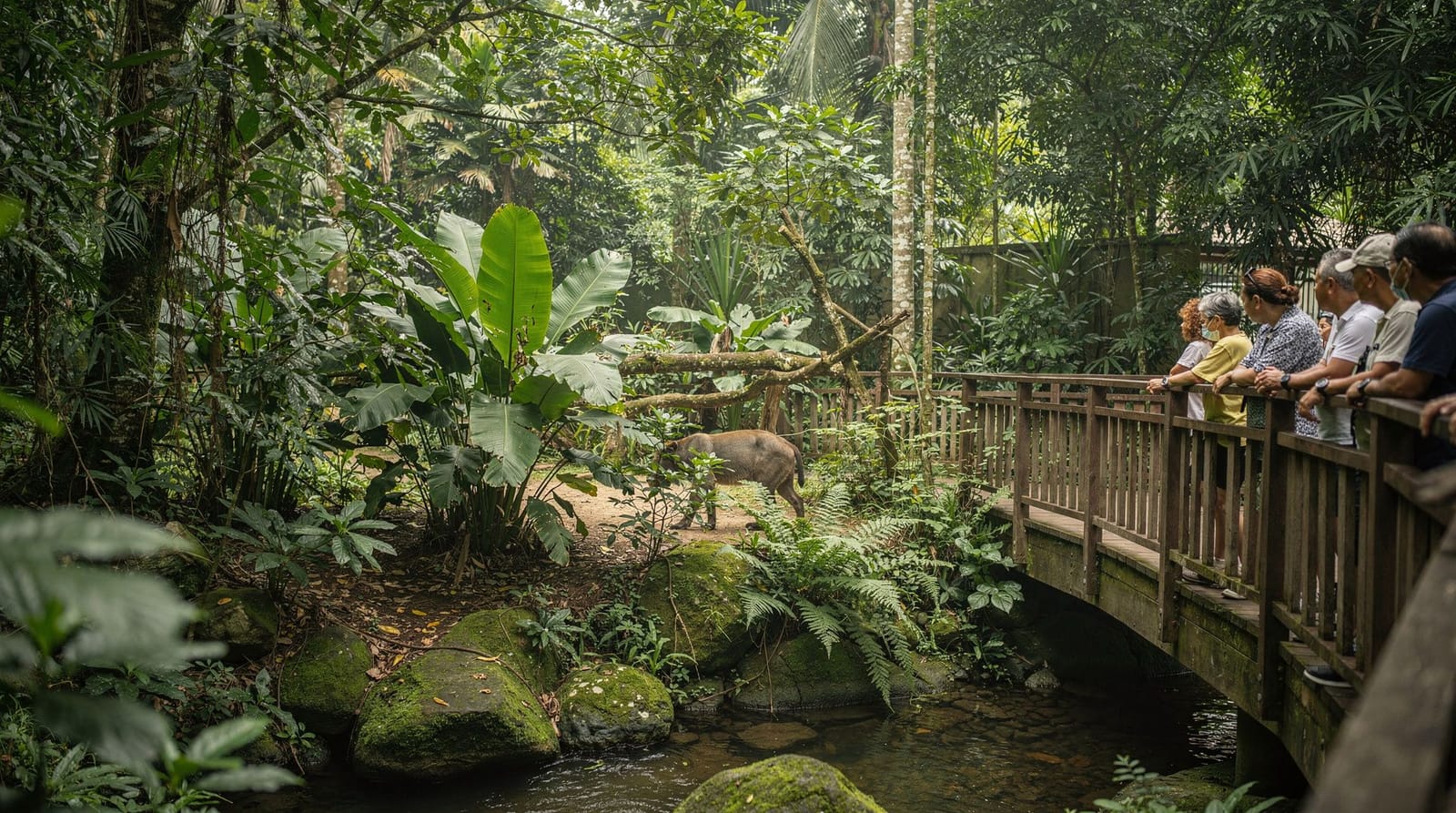
The result is an experience unlike any daytime zoo. You ride through or walk alongside large habitat zones in near-darkness, spotting animals that are genuinely active — hunting, foraging, moving — because this is their natural active period. In a conventional daytime zoo, many nocturnal species sleep through the day; at Night Safari, you see them as they actually behave.
Night Safari covers 35 hectares and is part of the Mandai Wildlife Reserve, adjacent to Singapore Zoo, River Wonders, and Bird Paradise.
Getting there
Night Safari uses the same Mandai Wildlife Reserve access as Singapore Zoo. From the city centre:
MRT + Mandai Khatib Shuttle: North-South Line to Khatib station, then the Mandai Khatib Shuttle bus to the Mandai hub. Total: approximately 50–60 minutes from Orchard Road. The shuttle is timed to match zoo visitor hours including evening operations.
MRT + Bus 138: North-South Line to Ang Mo Kio, then bus 138 to Mandai. About 60–70 minutes total.
Grab/taxi: SGD 25–35 from Orchard Road, depending on time and traffic. On Friday and Saturday evenings (when Night Safari is busiest), factor in 20–30% higher Grab prices during surge periods.
Direct shuttle from city: Some hotels and tour operators run evening shuttle services specifically for Night Safari. These are worth investigating if you are staying in a central hotel.
The opening time of 6:30 pm means you need to leave the city centre by around 5:30–6 pm to arrive at opening. This is manageable from most Singapore locations.
Singapore: Night Safari and tram ride ticketThe tram ride: what to expect
The tram ride is the core Night Safari experience. Open-sided trams carry groups of visitors through a series of habitat zones, each representing a different geographical region and its nocturnal wildlife community. The ride takes approximately 45 minutes and covers about 3.2 km.
Zone by zone:
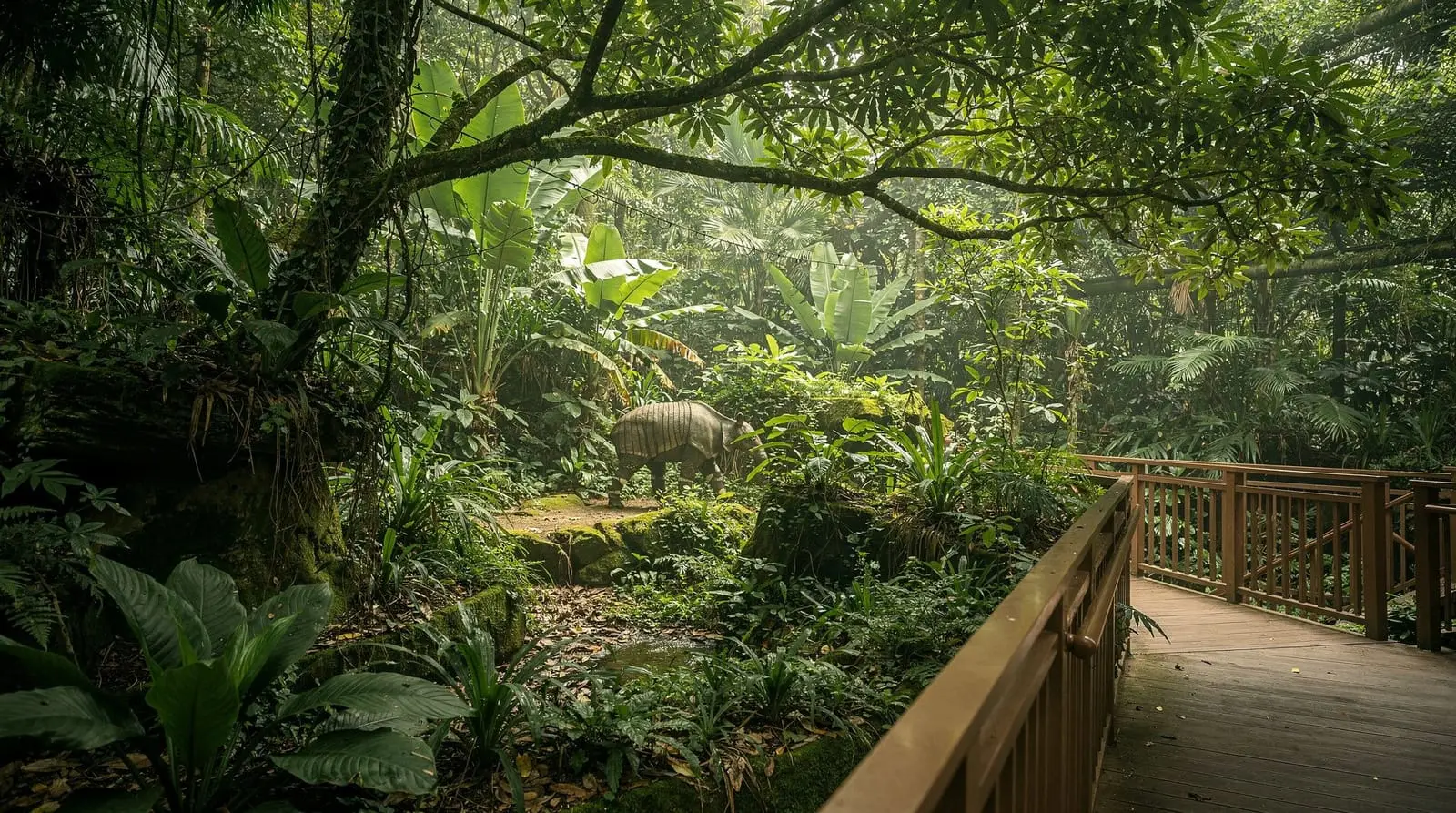
Himalayan Foothills: Bharal (Himalayan blue sheep), Himalayan tahrs, takins (large Tibetan ungulates), Indian rhinoceros. The Indian one-horned rhino is often visible close to the tram route in this zone.
Indian Subcontinent: Striped hyenas, sloth bears, and Indian ghavials (thin-snouted gharials). The sloth bear enclosure often puts the animals very close to the tram at the fence line.
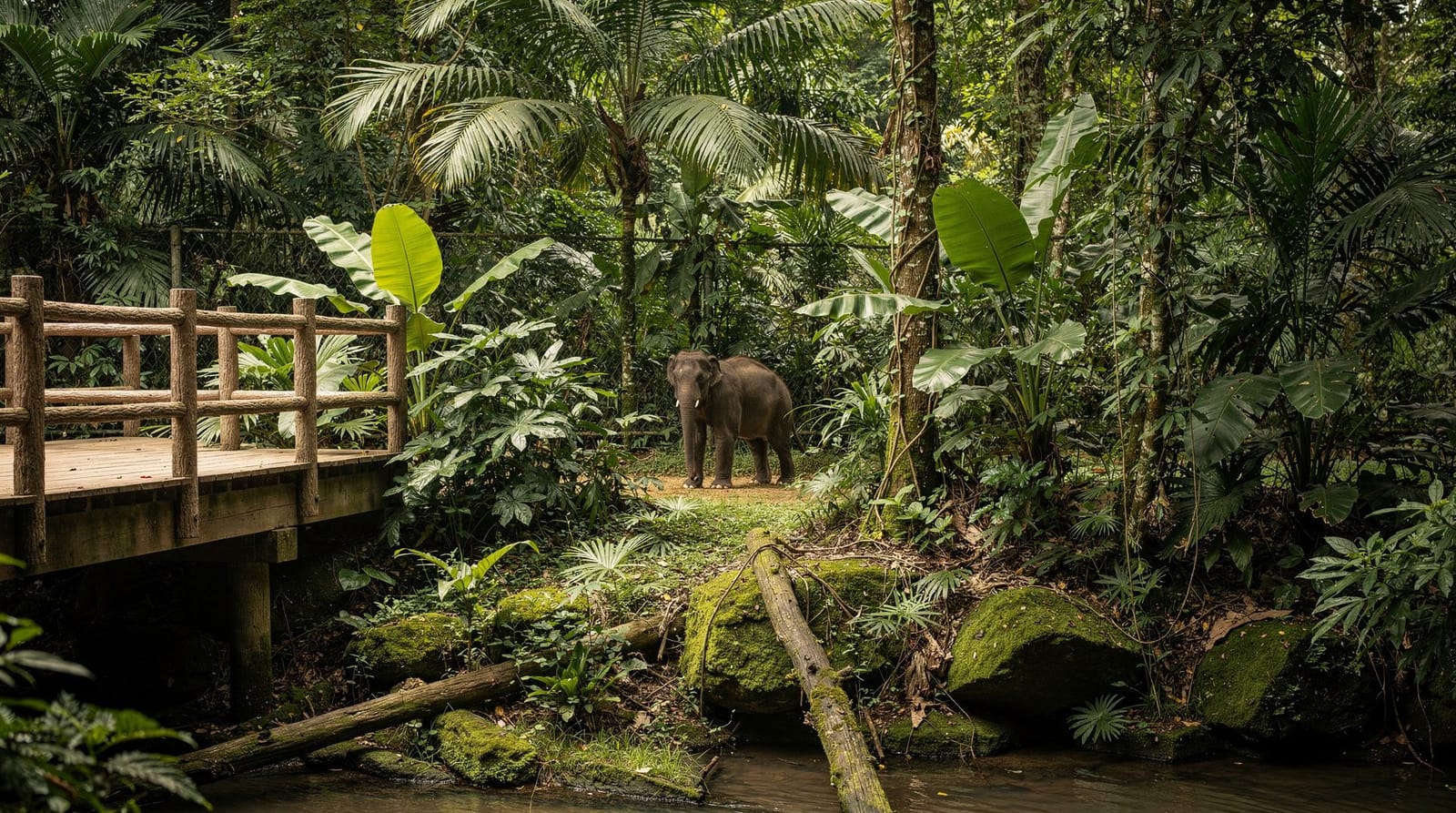
African Savannah: Lions, spotted hyenas, African elephants, giraffes, zebras, and white rhinos. One of the most dramatic zones — seeing these animals in the low light with the savannah environment is compelling.
South American Pampas: Giant anteaters, pampas deer, capybaras, and rheas. Capybaras are frequently close to the tram path.
Equatorial Africa: Okapis, bongo antelopes, forest buffaloes. The okapi — a forest relative of the giraffe — is a genuinely unusual animal to see.
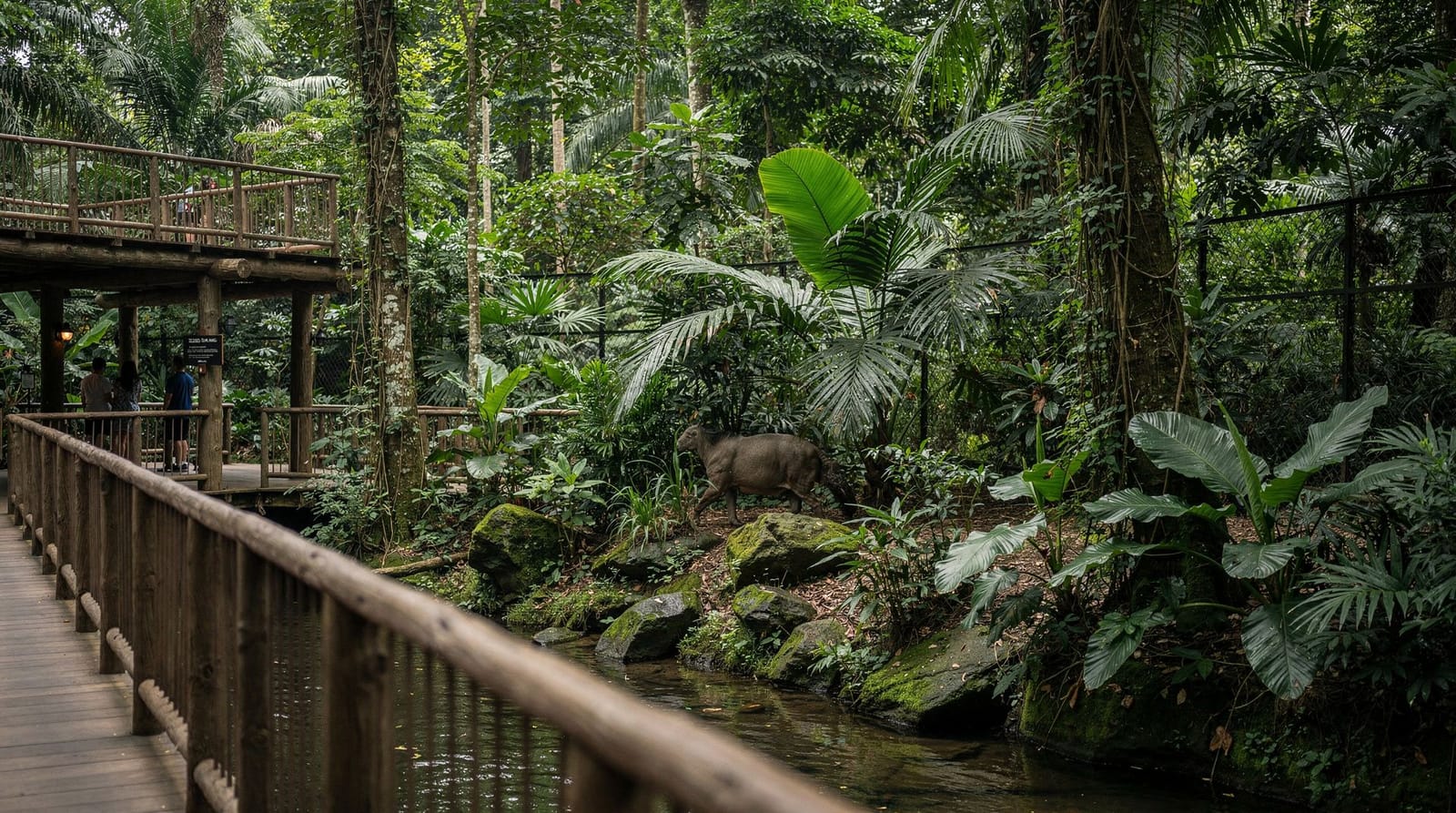
Asian Riverine Forest: Tapirs, gaurs, banteng (Bornean wild cattle), sambar deer. The Malayan tapirs in this zone are often very active in the evening.
What the tram guide does: A live commentary is provided on each tram. The quality varies by guide — some are excellent and genuinely informative, others are formulaic. The bilingual commentary (English and Mandarin) may limit the pace for English-only visitors.
Walking trails
Four signed walking trails branch off from the tram route and let you explore specific areas on foot. These are included in the standard ticket and do not require additional payment.
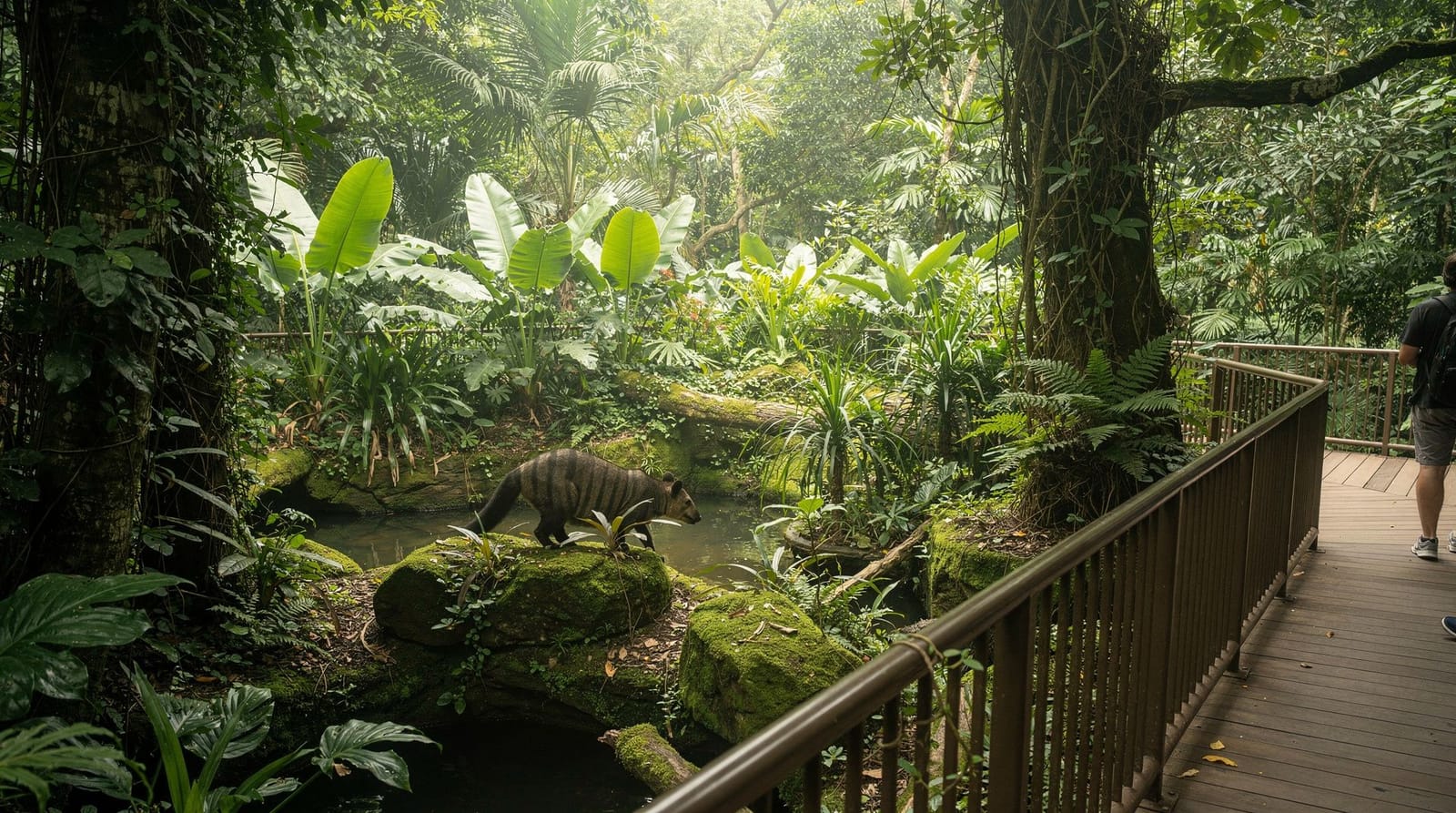
Leopard Trail (main trail): The longest trail, winding through habitat areas including the leopard enclosure (both clouded and regular leopards), fishing cats, and binturongs. The fishing cat — an unusual semi-aquatic wild cat — is often visible here. Approximately 1.1 km; allow 20–30 minutes.
East Lodge Trail: Connects to the Wallaby Trail, with common wallaroos in a free-range area. Short (0.6 km).
Fishing Cat Trail: Shorter loop with water-adjacent habitats — crocodiles, water birds, and the fishing cat enclosure.
Wallaby Trail: Free-range wallabies that wander near the path and may approach visitors. Family favourite. Short (0.6 km).
Recommendation: Do the main tram ride first, then walk the Leopard Trail. The combination (about 1.5 hours total) is the core Night Safari experience.
The Thumbuakar fire show
At the main entrance plaza, the Thumbuakar fire show takes place approximately every 30 minutes from 7:15 pm, performed by traditional fire-eating and drumming performers. The show runs for about 10–15 minutes.
Honest verdict: Energetic and entertaining, particularly for families with children. The drums and fire effects are spectacular in the evening setting. It is not deeply culturally specific — it is a tourist entertainment performance rather than an authentic cultural ceremony — but it adds to the atmosphere and is worth watching while you wait for the tram queue.
Dining: Bongo Burgers and hawker options
The Bongo Burgers restaurant at Night Safari’s entrance is the main food venue — burgers, noodles, and standard theme-park food at above-average prices (SGD 18–30 for a main). Quality is fair for the context.
The Mandai Food Hub complex outside the park gates (near the shuttle bus drop-off) has a wider selection at hawker-style prices. Eating here before entering the park is a better value option.
If you have the Mandai multi-park package and are spending multiple days at Mandai, it is worth planning meals outside the gates.
Singapore: Mandai Wildlife Reserve multi-park ticket (5-in-1)Is Night Safari worth the price?
At approximately SGD 55 per adult, Night Safari is one of Singapore’s more expensive single-attraction experiences. The honest answer is that it is worth it if:
- Wildlife is a genuine priority for your trip, not just a tick-box exercise
- You appreciate the atmospheric and unusual experience of seeing nocturnal animals in their active period
- You are visiting with family members (particularly children aged 5+) for whom the tram ride and unusual animals will be memorable
- You have already visited Singapore Zoo and want the contrasting night experience
It is less worth it if:
- You find the SGD 55 ticket price hard to justify for a 2–3 hour experience
- You are generally less interested in wildlife than in food, culture, or urban experiences
- You have young children (under 4) who may find the darkness genuinely upsetting
- You are comparing it against Singapore’s free-entry options and need to prioritise
See Mandai parks honest verdict for a frank comparison of all four Mandai parks and which combination represents the best value for your travel style.
Practical tips
Book in advance: Night Safari sells out, especially on Friday and Saturday evenings. Book at least 3–4 days ahead for weekends, and as far ahead as possible for school holiday periods. Walk-up tickets may not be available.
Dress code: Comfortable walking shoes (the trails are uneven in places), insect repellent (the Mandai forest has mosquitoes — DEET-based repellent is recommended), light long trousers for the trails. The park is humid but the movement and breeze on the tram make it comfortable.
Photography: Night Safari is genuinely dark — phone cameras without a strong night mode will struggle. The low-light red spectrum is sufficient to see animals clearly with the naked eye but very challenging for photography. A mirrorless camera with a fast prime lens (f/1.8 or faster) and ISO capabilities of 3200+ is needed for reasonable animal shots. The tram movement makes long exposures impossible.
Crowds and timing: Aim to arrive at 6:30 pm (opening). The first tram departs quickly, queues are shortest, and animal activity is highest in the early evening. By 9–10 pm, the park is both busier and animals may be less active.
What to eat and drink beforehand
Because the entrance food options (Bongo Burgers) run above-average theme-park prices, many visitors eat before arriving rather than after. If you’re coming from the city, a hawker meal near your last stop before heading to Mandai is both cheaper and better; if you’re arriving via the Khatib shuttle, the Mandai Food Hub outside the gates is the practical last-chance option and is noticeably better value than eating inside the park. Bring a reusable water bottle — the humidity means you’ll want more water than the walk length suggests, even after dark.
Comparing the tram vs the walking trails
If you can only choose one, the tram is the better introduction — it covers ground the trails can’t and the guide’s commentary adds context you’d otherwise miss. But the walking trails give something the tram can’t: standing still at a fence line for a few minutes rather than passing at tram speed. The Leopard Trail rewards that patience the most, since clouded leopards and binturongs are often stationary and easy to miss from a moving vehicle. If your legs and schedule allow both, do the tram first for orientation, then return on foot to the zones that interested you most — the trails and tram route overlap enough that this isn’t a duplicated experience.
How Night Safari fits a longer Mandai day
Because Night Safari only opens in the evening, most visitors pair it with a daytime activity elsewhere rather than spending the whole day at Mandai. A common pattern: spend the morning and early afternoon on a Marina Bay or Gardens by the Bay circuit, rest through the worst of the midday heat, then head to Mandai for the 6:30 pm opening.
If wildlife is the whole-day priority, Singapore Zoo or River Wonders in the same complex let you build a full Mandai day without the exhausting double-park marathon described above — see Mandai multi-park pass for how the combined tickets work across two visits. For families deciding which nocturnal or daytime park suits younger children better, Best family attractions in Singapore has the fuller comparison.
Planning the rest of your Singapore days around it
Night Safari works best as the evening anchor of a day that starts elsewhere. If you are still choosing between wildlife parks, Zoo vs Night Safari sets the two side by side, and Night Safari tips goes deeper on the small habits that make the visit smoother. For the wider Mandai area, the Mandai destination page shows how the reserve fits together, and Bird Paradise is the natural daytime partner if you want more wildlife without another night out.
Getting to and from Mandai in the evening is the part visitors underestimate. Getting around Singapore explains the public transport options, and Grab and taxis in Singapore is worth reading before you commit to a ride home, since late-evening demand can change how easy it is to find a car.
If Night Safari is one stop among many, the Singapore at night guide helps you decide what else belongs on your evening list, and the 3-day Singapore itinerary shows one way to slot a Mandai evening between the city highlights without rushing. Travelling with children? The Singapore with kids itinerary pairs well with the advice above about spreading wildlife parks across separate days. Readers who want a first-hand account can also read the Night Safari review on the blog.
Frequently asked questions about Night Safari Singapore
What if it rains during Night Safari?
Night Safari operates in rain — tropical showers are common in Singapore. The tram is open-sided, so light rain means you will get wet. Ponchos are sold at the entrance (SGD 2–3) and are worth buying if rain looks likely. Heavy tropical downpours are uncomfortable on the tram; in this case, wait in the entrance area or do the covered indoor walkway sections until the rain eases.
Are there any height or health restrictions?
No height restrictions. The tram ride is smooth and low-speed. Those with significant motion sickness issues should take medication before boarding. The walking trails involve uneven terrain and some slopes but are manageable for most visitors.
Can I visit both Night Safari and Singapore Zoo on the same day?
Technically yes — Singapore Zoo opens at 8:30 am and closes at 6 pm, while Night Safari opens at 6:30 pm. An extremely long day is required (8:30 am to 11 pm). This is feasible for very committed wildlife enthusiasts but exhausting for most visitors, especially with children. The multi-park pass covers both and allows the combination. Most visitors spread these over two days.
Is Night Safari one of the world’s best nocturnal parks?
It was the world’s first purpose-built nocturnal zoo and remains one of the most visited. For nocturnal wildlife diversity and the habitat zone approach, it is a standout facility. Other notable nocturnal zoos include Taipei Zoo’s night section and the National Zoo Malaysia’s night experience, but Singapore’s Night Safari remains the benchmark.
Does Night Safari have photography restrictions?
No flash photography. This is strictly enforced — flash upsets the animals and ruins the experience for other visitors. The low-light conditions mean flash would make little difference anyway. Beyond the no-flash rule, photography is unrestricted.
Top experiences
Bookable activities with verified prices and instant confirmation on GetYourGuide.