Batam
Batam is Indonesia's nearest island to Singapore — 35 minutes by ferry, with affordable seafood, massage, and a genuine Indonesian urban day trip.
Batam day tour with Singapore ferry ticket, massage & lunch
Quick facts
- Country
- Indonesia — passport required; Indonesian VOA or visa needed depending on nationality
- Ferry from Singapore
- HarbourFront Ferry Terminal → Batam Centre or Sekupang; 35–45 min
- Ferry cost
- SGD 25–45 return depending on operator and terminal
- Currency
- Indonesian Rupiah (IDR); approx 1 SGD = 11,500–12,000 IDR as of 2026
- Best for
- Affordable massage, fresh seafood, Batam's old town, an accessible Indonesian city experience
Batam is the Indonesian island that sits in Singapore’s literal backyard — the southern shore of the island is visible from Singapore’s coast on clear days, and the ferry crossing takes 35–40 minutes from HarbourFront. It is the most visited day-trip destination from Singapore: Singaporeans go for the seafood, the massage, and the lower prices; expats go for a change of pace; and international visitors sometimes go without quite knowing what they will find.
What they find is an Indonesian city. Not a resort island, not a nature escape — an actual Indonesian urban environment with local markets, food courts, traffic, seafood restaurants, massage parlours, and a Malay-Chinese-Indonesian cultural character that is entirely distinct from anything Singapore contains. The gap between Singaporean costs and Batam costs is significant: a 60-minute traditional Javanese massage costs IDR 150,000–200,000 (roughly SGD 13–17), and a plate of chilli crab or butter prawns at a proper seafood restaurant costs a fraction of Singapore prices for equivalent quality.
A repeat caveat, stated clearly: Batam is Indonesia. You need a passport and you need to satisfy Indonesian entry requirements. Most Western and many Asian nationalities qualify for Indonesia’s Visa on Arrival (VOA), currently USD 35 payable at the immigration counter. Verify your eligibility at immigration.go.id before travelling.
| Where | HarbourFront Ferry Terminal → Batam Centre or Sekupang, 35–40 min |
| Cost | Ferry SGD 25–45 return; Indonesian VOA around USD 35 if required |
| Time needed | Full day trip; comfortable as a single-day round trip |
| Getting there | HarbourFront MRT (Circle/North-East Line), ferry check-in 45 min before departure |
| Best time | Year-round; avoid Indonesian national holidays for ferry crowds |
Getting to Batam — ferries from HarbourFront
HarbourFront Ferry Terminal (HFFT): The primary Singapore departure point for Batam. Connected directly to HarbourFront MRT (Circle Line / North-East Line). The terminal is on level 2 of the HarbourFront complex; check-in begins approximately 45 minutes before departure.
Tanah Merah Ferry Terminal: Also serves some Batam routes, primarily to the Nongsapura terminal.
Batam terminals: Batam has multiple entry points:
- Batam Centre (Batu Ampar): The most central for Nagoya and Harbour Bay areas.
- Sekupang: Western side; some accommodation clusters here.
- Nongsapura: Further east; used by some operators.
- Harbour Bay: Near the main commercial area.
Most day-trippers target Batam Centre, which puts you closest to Nagoya — the main shopping and commercial district — and the seafood restaurants of Harbour Bay and Batam Centre waterfront.
Ferry operators: Majestic Fast Ferry, Batam Fast, Indo Falcon, and several others. Return tickets cost approximately SGD 25–45 depending on operator and booking platform. Book online in advance and collect at the terminal; walk-in tickets are available but Indonesian holiday periods can see ferries sell out. First departures are typically around 07h30–08h00; last returns around 20h–21h.
What to do in Batam
Seafood
Batam’s Harbour Bay and the waterfront strip near Batam Centre have clusters of seafood restaurants that are among the best reasons to make the trip. The freshness of the fish and shellfish (predominantly sourced from surrounding Indonesian waters), combined with Indonesian spicing and substantially lower prices, creates a genuinely worthwhile dining experience.
Dishes worth ordering: black pepper crab, butter prawn (udang mentega), assorted shellfish in chilli sauce, grilled fish (ikan bakar). A meal for two people with beer or drinks typically costs IDR 300,000–600,000 (SGD 25–50) at a decent waterfront restaurant — half or less of what the equivalent would cost in Singapore.
Massage
The massage industry in Batam is substantial and affordable. Parlours range from bare-bones local operations to air-conditioned, professional establishments. A 60-minute traditional full-body massage (urut Melayu or Javanese style) costs IDR 120,000–200,000 (SGD 10–17). A 90-minute session including foot reflexology and traditional massage runs IDR 200,000–350,000. The quality at mid-tier establishments is consistently good; always confirm pricing before starting.
Nagoya — shopping and commercial centre
Nagoya is Batam’s main commercial district — a grid of shopping malls, street markets, and small shops. The flagship Nagoya Hill Mall carries a mix of Indonesian brands, electronics, and accessories at below-Singapore prices. The surrounding streets have traditional market stalls (pasar) selling batik fabric, local snacks, and household goods.
The honest assessment: Nagoya’s commercial appeal has diminished somewhat as Singapore’s own retail has expanded and the SGD-IDR exchange rate shift has reduced the price differential. Electronics are not necessarily cheaper (counterfeit risk exists in street stalls); branded goods are Singapore-sourced anyway. The main shopping value is in Indonesian-specific products: batik, local food items, Indonesian cosmetics and skincare brands, and custom tailoring.
Batam day tour with ferry, massage, and lunch included — the all-in day trip packageHeritage areas — Sekupang and the old town
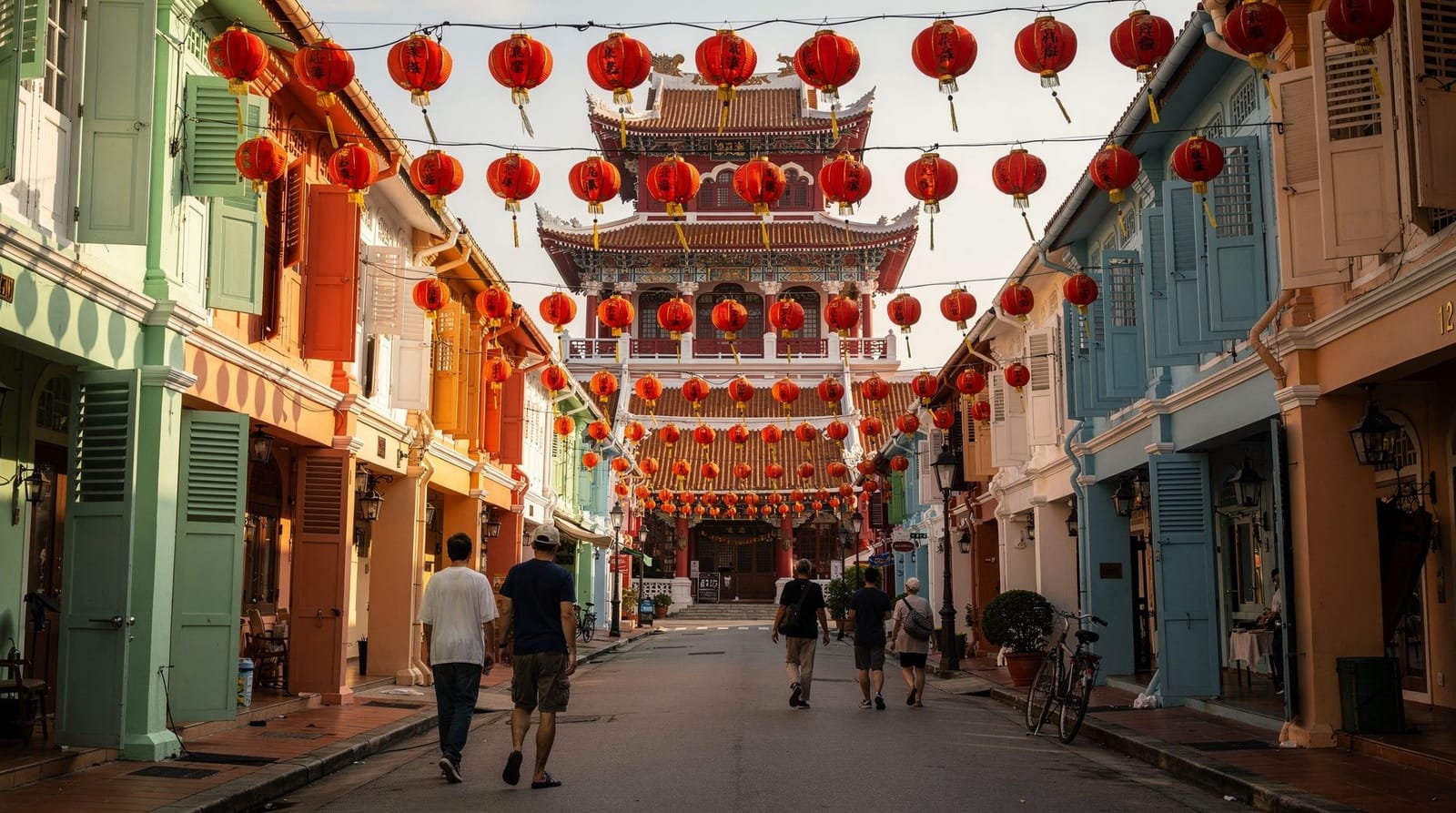
The parts of Batam that most day-trippers skip but which offer more cultural interest than Nagoya: the older kampung and Chinese quarter areas near Sekupang and around the heritage streets of the town centre. Batam’s Chinese community (Hokkien and Hakka descent) left architectural traces in the older shophouses around the commercial port area. The Maha Vihara Duta Maitreya Buddhist Temple is one of the largest Chinese Buddhist temples in Indonesia — a lavish complex of multiple halls, ornate gateway, and extensive gardens.
Batam heritage day tour with lunch and massage — temples, markets, and Batam’s cultural layersHighlight half-day option
For visitors arriving on a later ferry or who want a flexible self-guided experience, the key half-day circuit covers the waterfront, Nagoya Hill, and a seafood lunch before the return ferry. A private guide or organised half-day tour can structure this efficiently without losing time to navigation and local logistics.
Batam private highlight half-day tour — efficient coverage of the main areas without the hassleEating beyond seafood
Beyond the seafood restaurants, Batam’s food scene offers:
Nasi Padang (Padang-style rice with an array of cooked dishes): ubiquitous throughout Indonesia, and Batam has many good options. A full plate costs IDR 25,000–50,000 (SGD 2–4.50).
Soto ayam (chicken soup with vermicelli, egg, and spices): the Indonesian breakfast standard, available from street carts from early morning at IDR 15,000–25,000.
Indonesian coffee: Batam coffee shops (kopitiam style but Indonesian rather than Singaporean) serve kopi tubruk (ground coffee poured in the cup, boiling water added) and various filtered styles. At IDR 8,000–15,000 a cup, substantially cheaper than equivalent Singapore kopi.
Practical considerations
Cash: The Indonesian Rupiah economy outside the resort-zone hotels is primarily cash. Bring sufficient SGD to exchange at the terminal (Batam has money changers at Batam Centre offering reasonable rates) or at Nagoya Hill. Indonesian ATMs accept most international cards but fees apply.
Mobile data: Singapore roaming rates in Indonesia can be expensive. An Indonesian SIM card (Telkomsel or Indosat) at the terminal or in Nagoya costs IDR 50,000–100,000 and provides several days of data. Alternatively, check if your Singapore plan includes ASEAN data at no extra charge.
Immigration timing: Allow 45–60 minutes on arrival for Indonesian immigration processing, particularly on busy days. Return immigration at Batam is usually faster. Singapore immigration on return is typically efficient.
Return timing: Do not cut it too close to the last ferry. If you are aiming for the 20h ferry back, be at the terminal by 19h00–19h15. The journey from Nagoya or Harbour Bay to the terminal takes 15–25 minutes depending on traffic.
Staying overnight — is it worth it?
Most visitors treat Batam as a single-day trip, and for a first visit that is the right call — the island’s main draws (seafood, massage, Nagoya, the temple) fit comfortably into a day without rushing. An overnight stay makes more sense if you want to combine Batam with a genuine budget break: hotel rates in Nagoya and the resort strips near Batam Centre run IDR 300,000–700,000 (roughly SGD 25–60) for a clean mid-range room, well below equivalent Singapore rates, and an evening plus a second morning lets you see the older Sekupang quarter without cramming it into a single ferry window.
For travellers who prefer a beach-and-nature overnight instead of an urban one, Bintan is the better choice — see the comparison above. Either way, book the return ferry (or, for an overnight stay, the outbound one only) in advance, since Indonesian holiday periods sell out fast.
Compared with staying in Singapore for that day and spending on Singapore’s pricier hawker and shopping circuit, a Batam day trip is one of the more effective ways to stretch a travel budget without sacrificing a real cultural experience — closer in spirit to the value proposition of Johor Bahru than to a beach escape like Pulau Ubin, which stays within Singapore.
Fitting Batam into a longer Singapore stay
Batam works best as a contrast day. If you have spent a few days on the busier circuit — Marina Bay, Sentosa and Orchard Road — an unhurried day on an Indonesian island resets the pace, and it pairs well with a lighter schedule the day after. Our plan a trip to Singapore guide and how many days in Singapore help you decide where a ferry day fits.
If you like the idea of crossing a border for the day but want to compare options, the Bintan day trip guide covers the resort side, while the Batam day trip guide goes deeper on the practical running order. The Johor Bahru day trip is the land-border alternative if you would rather avoid a ferry altogether.
Food is a big part of the appeal, so it helps to know what you are comparing against. The Singapore hawker centres guide and the chilli crab guide show what the same dishes look like at home, which makes the Batam seafood lunch easier to judge. Travellers watching their spending can also read the Singapore on a budget itinerary to see where a ferry day sits against the rest of the week.
Finally, keep your return plans in mind. If you fly out of Changi soon after, do not schedule the Batam trip on your departure day; leave a full buffer for ferry delays and immigration queues on both sides.
Frequently asked questions about Batam
Is Batam safe?
Batam has a reputation for petty crime in certain areas, though it is not considered high-risk by Southeast Asian standards. Standard travel precautions apply: keep phones and valuables out of obvious view in markets and busy public areas, use reputable transport rather than unmarked vehicles, and stay in the main commercial and tourist areas during the day. Evening activities in the central areas are generally fine; late-night wandering in unfamiliar districts is not recommended.
How does Batam compare to Bintan for a day trip?
Batam is closer (35–40 min vs 45–55 min), cheaper overall, and better for urban experiences — food, massage, shopping. Bintan is better for beaches, nature, and resort experiences. If you have to choose one: Batam for budget travellers and those who want Indonesian city life; Bintan for beach and nature. See the Bintan guide for that option.
What is the Indonesian Visa on Arrival and how do I get it?
The VOA is available for citizens of eligible countries (most Western nations plus many Asian countries) and is purchased at the designated VOA counter at Batam immigration on arrival. As of 2026 the fee is USD 35, payable by card or cash. The process takes 10–20 minutes. Alternatively, the e-VOA can be applied for online in advance, which saves time at the counter. Check immigration.go.id for current eligibility and fees.
Can I do Batam without joining an organised tour?
Yes. Many Singaporeans and expats make the trip independently — book the ferry online, navigate to Batam Centre, take a Grab or GoCar (Indonesia’s Grab equivalent) to wherever you want to go, and make your own arrangements for food and massage. An organised tour adds structure and local knowledge, which is helpful if you are time-constrained or want to reach specific sites efficiently. The day trips from Singapore guide compares the independent and organised approaches.
Is the seafood in Batam really better than Singapore?
The freshness is comparable; the prices are dramatically lower; and the style (Indonesian spicing, grilled preparations, chilli and butter sauce traditions) is different from Singapore seafood restaurants. Whether it is “better” depends on your flavour preferences. For budget-conscious travellers, the price difference makes it objectively better value. Even mid-range Singapore seafood restaurants charge 3–5 times the Batam equivalent for similar quality raw product.
Is Batam a good option for a Singapore visa run or a quick escape from a long layover?
It can be, though it is not its primary purpose. Because Batam only requires a passport and (for most nationalities) a VOA rather than a Singapore visa, some travellers use the ferry crossing as a straightforward day out during a longer Singapore stay. It is not suited to a tight airport layover — the ferry, immigration and return journey need the better part of a day — but for travellers with 4–5 spare days in Singapore, it is a low-effort way to add genuine variety without a flight.
Top experiences
Bookable activities with verified prices and instant confirmation on GetYourGuide.