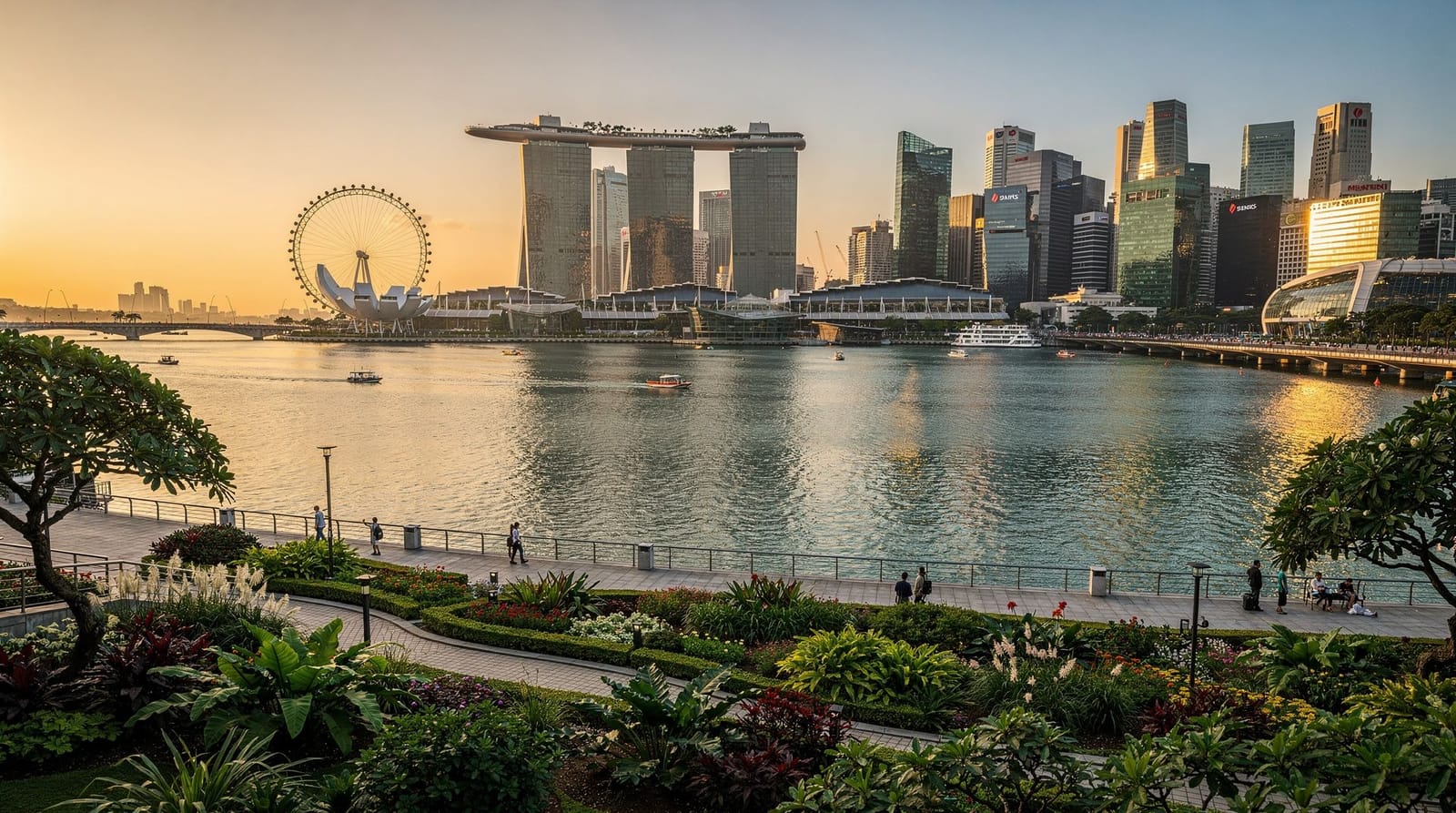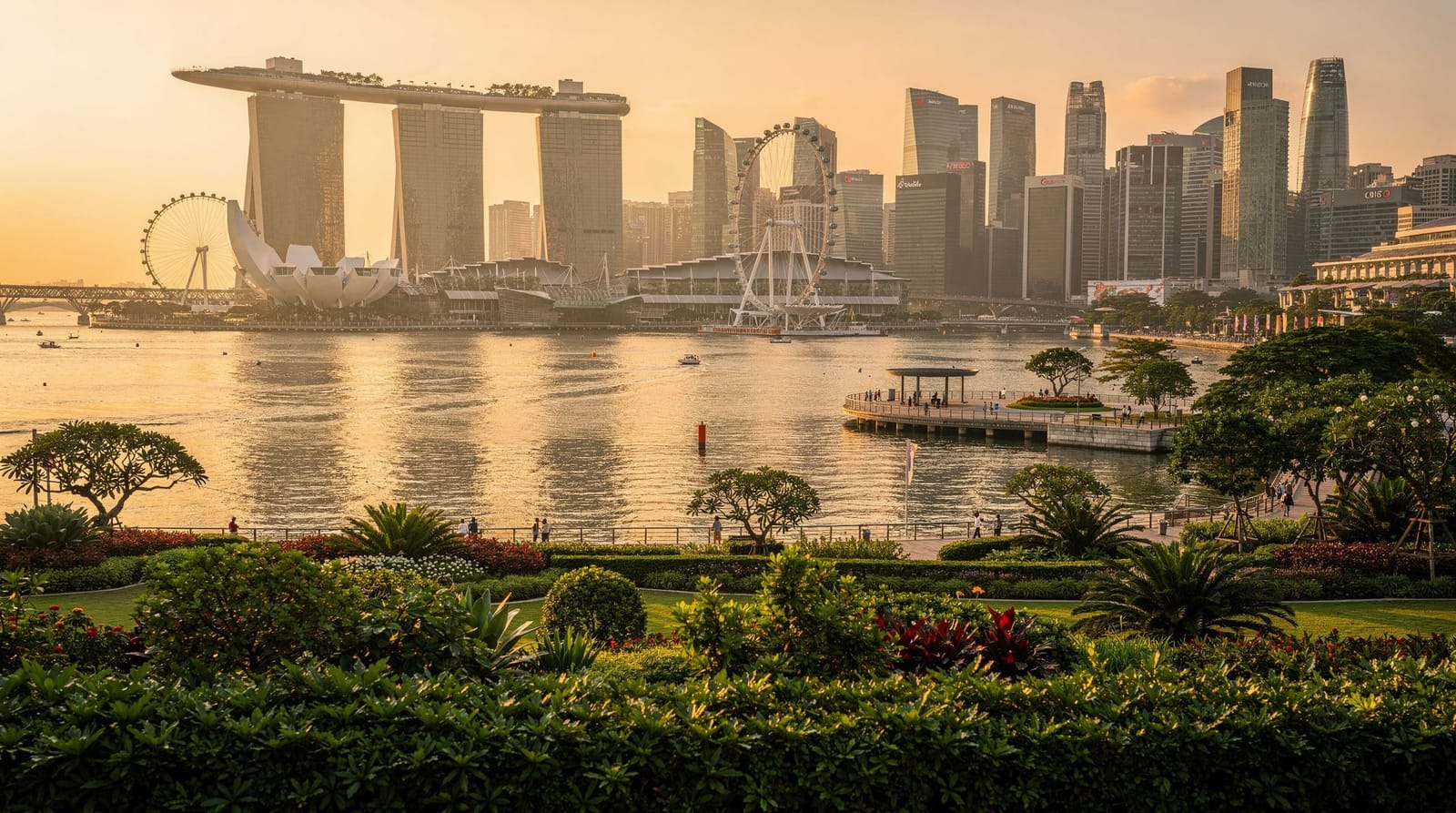
Singapore first impressions: what hits you in the first 48 hours and what to make of it
Singapore lands differently depending on what you expected. If you expected a generic Asian megacity — the visual grammar of elevated highways, crowded markets, smog — you’ll be surprised by the greenery, the cleanliness, and the sense of a city that has been thinking about itself for decades. If you expected a sterile, controlled, boring city-state — the “fine city” reputation based on its strict laws — you’ll be surprised by how much the place has its own food culture, its own humour, its own street-level personality that doesn’t fit the corporate branding Singapore sometimes projects.
| First stop | Changi Airport / Jewel — budget 1–2 hours if it’s your first visit |
| To the city | MRT, around SGD 1.40–2, about 30 minutes |
| First meal | Hawker centre — Maxwell Food Centre or Lau Pa Sat, SGD 8–12 |
| Adjustment | Heat and humidity — plan outdoors before 11am or after 4pm |
| Language | English works everywhere — no local phrasebook needed |
Both expectations are wrong in productive ways. Here’s what the first 48 hours actually produce. For the fuller planning framework beyond first impressions, the Singapore for first-timers guide and the must-see first time guide cover what to prioritise once the initial adjustment is done.
The airport is the first signal
Changi Airport routinely wins “world’s best airport” polls and the award is deserved in a specific way: it’s not just that the airport is clean and efficient (though it is both), it’s that the airport has been designed with the understanding that waiting in an airport is an experience, and the experience can be better than it needs to be. The transit gardens, the butterfly garden in Terminal 3, the multi-storey movie theatre, the swimming pool on the roof of Terminal 1 (accessible to passengers in transit) — these are all real, and they signal something about how Singapore thinks about infrastructure.
Jewel, the glass-and-steel dome connecting Terminals 1, 2, and 3, opened in 2019 and contains a 40-metre indoor waterfall (Rain Vortex) and five stories of retail, restaurants, and a rooftop garden. It is legitimately extraordinary. First-time visitors often spend longer in the airport than they planned.
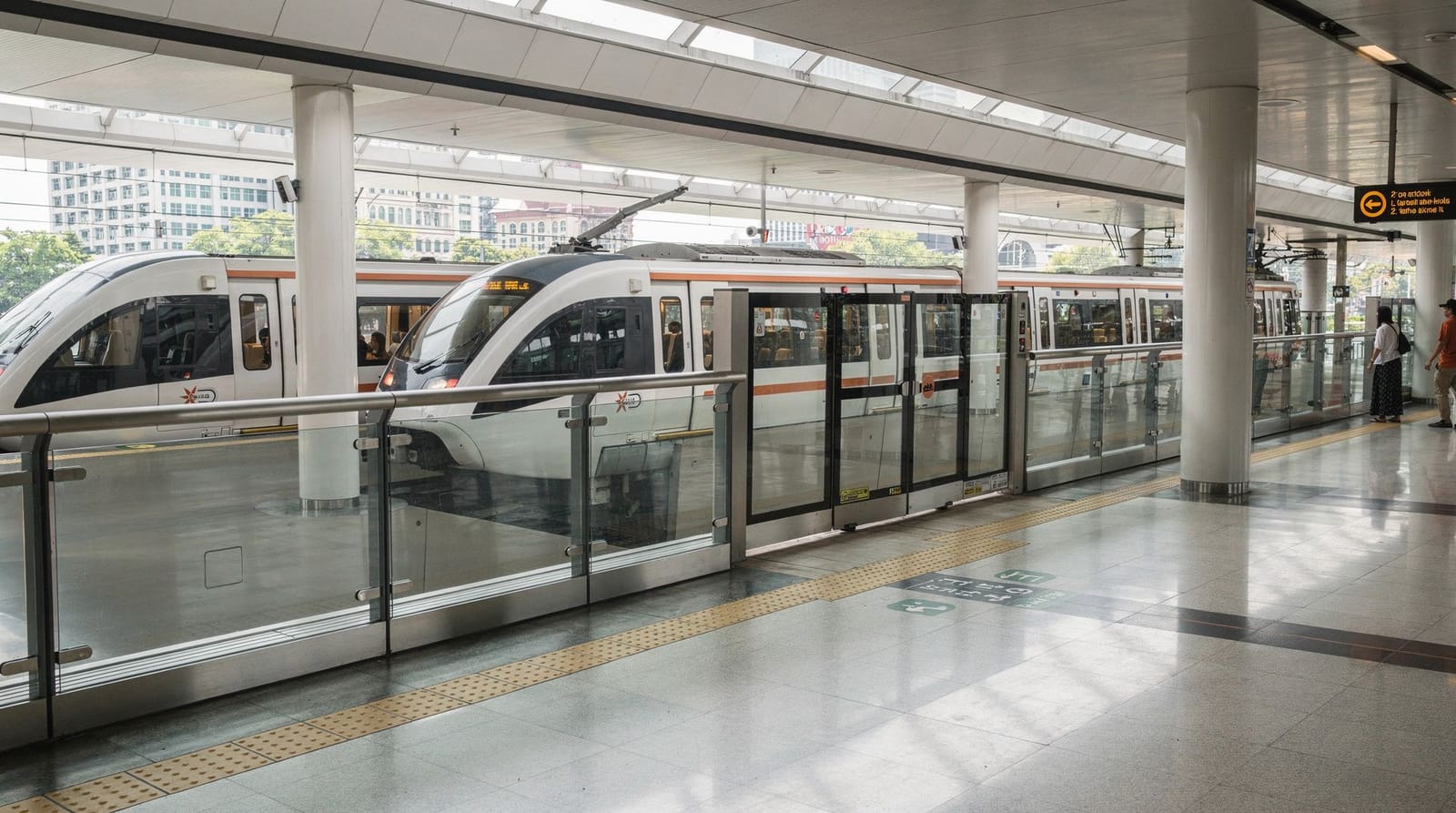
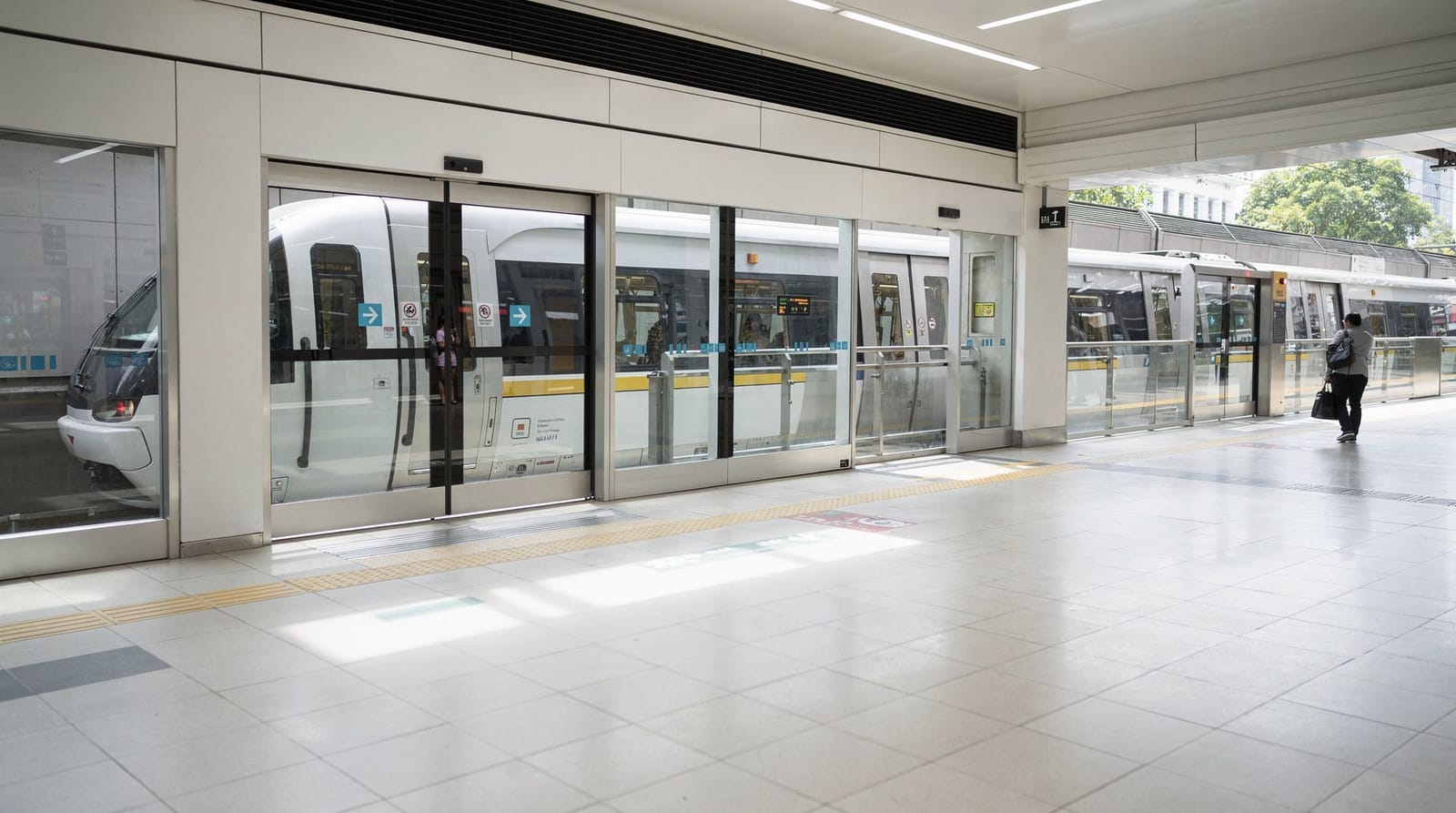
The MRT to the city centre costs SGD 1.40–2 from Changi Airport and takes 30 minutes. An EZ-Link card (Singapore’s transit card, SGD 10 including SGD 5 stored credit) can be bought from the MRT station inside Changi Airport Terminal 2/3. Use it for every MRT and bus journey — it’s the correct format. The Changi Airport to city guide has the full breakdown of every transfer option if the MRT doesn’t suit your arrival time or luggage load.
The heat
The heat is the first thing. Singapore sits 137 kilometres north of the Equator, and the temperature in February is 30–32°C. The humidity is somewhere between 75 and 90%. Moving in Singapore requires recalibration — not because it’s impossible to be comfortable, but because the city has built its outdoor infrastructure around the assumption that most people want to be under cover or in air conditioning for most of the day.
The sheltered walkways are real and comprehensive. The underground MRT connections between malls are real and comprehensive. The ceiling fans in hawker centres are real. The air conditioning in every MRT train, bus, shop, and museum is real and cold.
What this means practically: walking outdoors between 11am and 3pm in Singapore requires acceptance of sweating. By 4pm, if you’ve had a cold drink, been out of the sun for a while, and not made the mistake of wearing synthetic fabric, you’re fine. The mornings (before 10am) and evenings (after 6pm) are comfortable in a way that the midday is not.
First-time advice: wear linen or cotton, carry a small bottle of water, and plan outdoor activities for the morning.
Hawker food as a first day experience
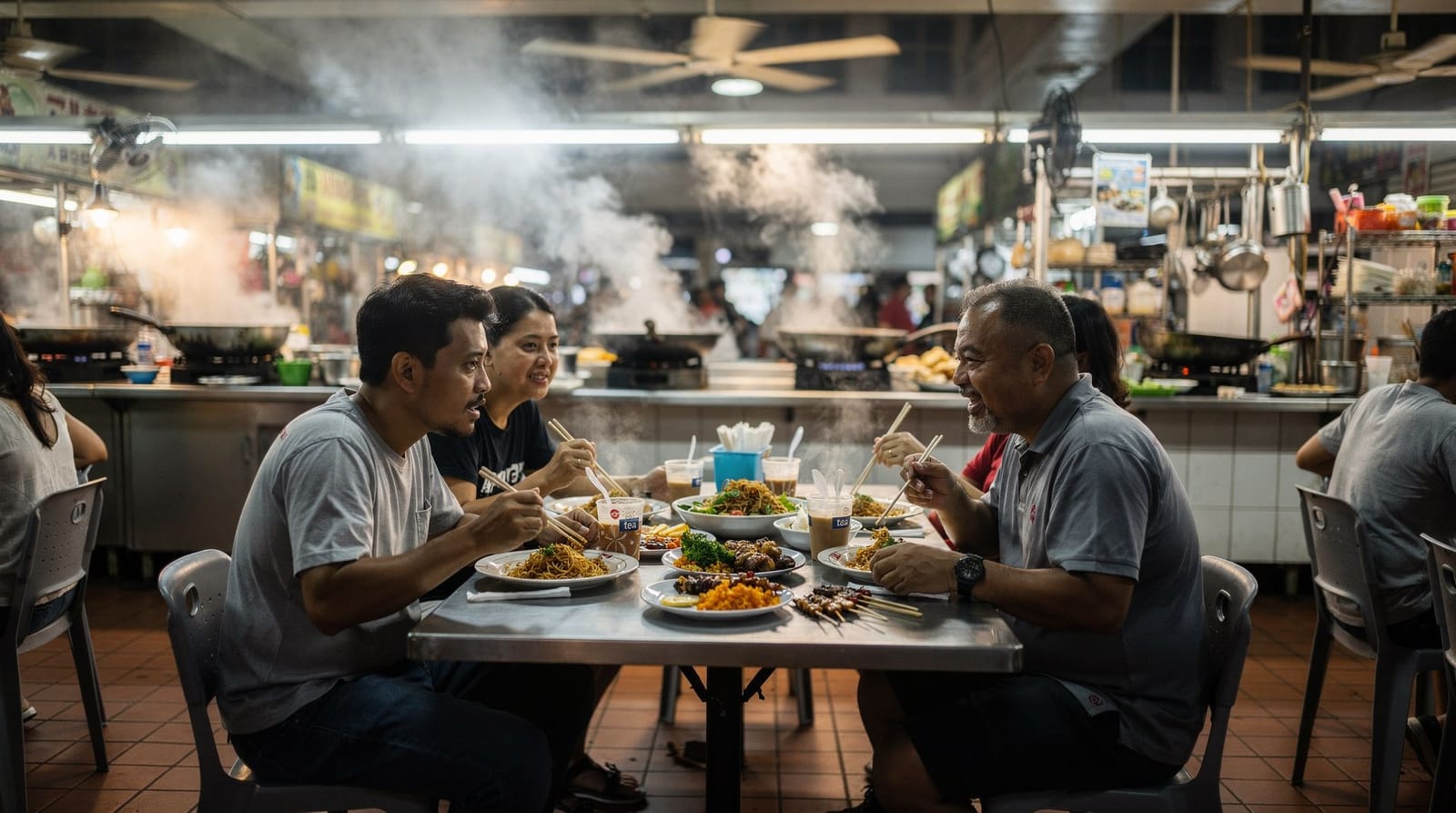
The correct first meal in Singapore is at a hawker centre, and if you land in the afternoon or evening, Maxwell Food Centre near Tanjong Pagar MRT or Lau Pa Sat in the CBD are the most accessible central options.
What a hawker centre is: a large, semi-open-air dining hall (usually covered by a metal roof, with open sides or ceiling fans rather than air conditioning) with anywhere from 30 to 200 individual food stalls, each specialising in a small number of dishes. You queue at the stall you want, order and pay (SGD 4–10 per dish), take a number if they give you one, and find a shared table. Drinks are ordered separately from a drinks stall.
First-meal recommendation: Hainanese chicken rice (poached chicken over fragrant rice with three dipping sauces), laksa (coconut milk noodle soup), or char kway teow (wok-fried flat noodles with egg, Chinese sausage, and beansprouts). All three are distinctively Singaporean in a way that other dishes are not. A full meal with a cold drink costs SGD 8–12.
The experience of eating at a hawker centre — the noise, the controlled chaos of a hundred simultaneous meals in production, the inherited system of ordering and finding tables — is one of the city’s most specific and genuinely irreplaceable experiences. No restaurant in Singapore, regardless of quality or price, produces the same feeling. Once the hawker format feels familiar, the what to eat in Singapore guide and the kaya toast breakfast guide are the natural next steps for building out a food itinerary.
What the first walk through a neighbourhood tells you
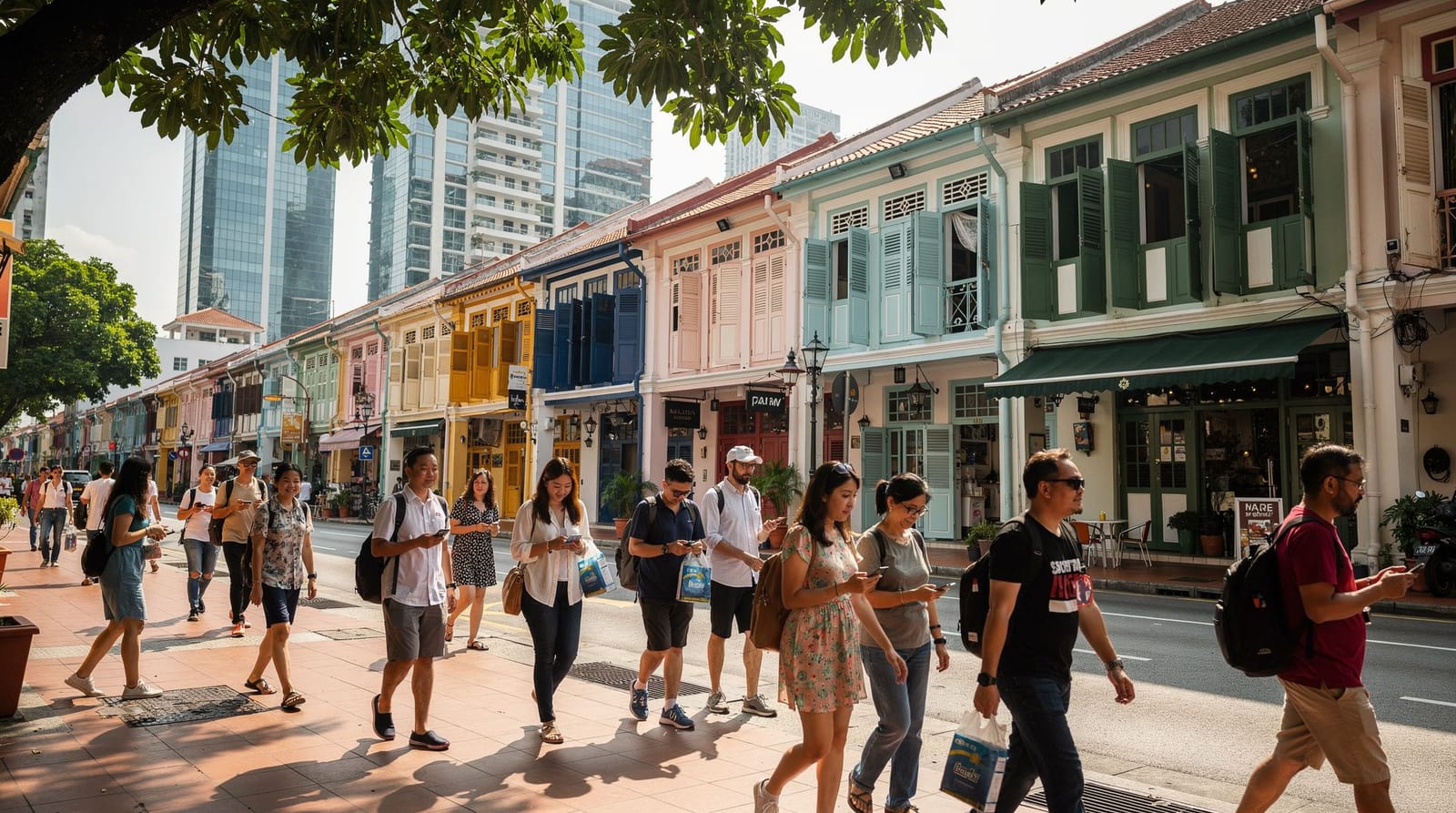
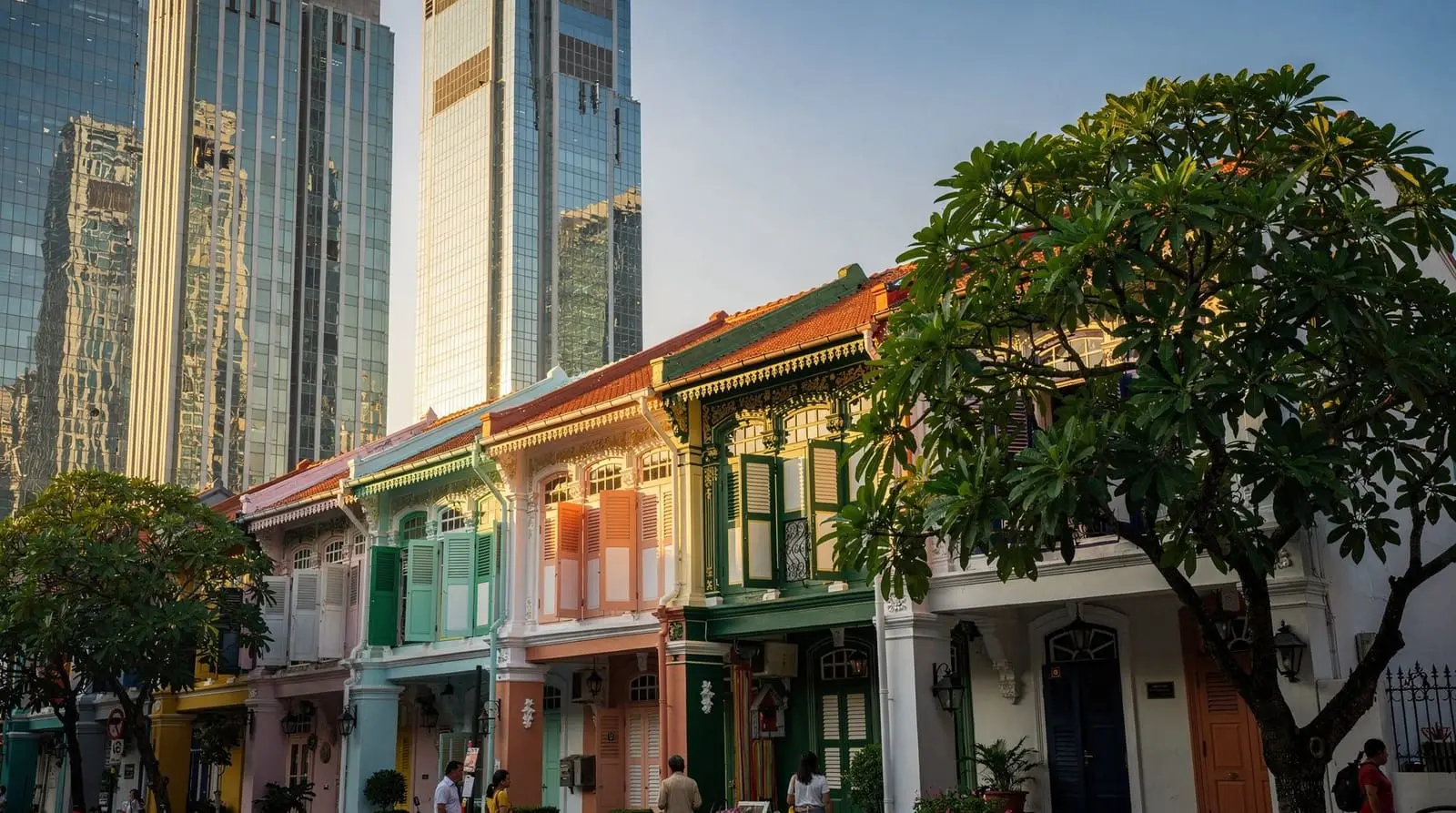
Beyond the airport and the first meal, the first proper neighbourhood walk is usually what recalibrates expectations most. Chinatown at street level — shophouses, temple incense, laundry drying above a hawker stall — reads nothing like the glass-and-steel skyline photographed from Marina Bay. Spend an hour there on day one if your schedule allows it; it does more to correct the “sterile city-state” assumption than anything else on a first visit. Little India and Kampong Glam do the same work from different cultural angles, and either is a reasonable second stop once Chinatown has reset the baseline.
Singapore: Marina Bay Sands observation deck e-ticketIf you want a guide for each of these walks, the Chinatown guide, the Little India guide and the Kampong Glam and Haji Lane guide lay out what to look at and in what order. The ethnic quarters guide puts the three side by side, which helps if you only have time for one or two. And if the heat or a sudden shower interrupts a walk, the Singapore in the rain guide covers how to keep the day going.
Singapore: Singapore River cruiseThe cultural mix and what it means practically
Singapore’s population is approximately 74% Chinese, 13% Malay, 9% Indian, and 3% other. The city-state has four official languages: English, Mandarin, Malay (the national language), and Tamil. English is the working language of virtually every public and commercial interaction. You will not need any Singaporean language skills for any practical purpose.
What you will encounter: a city in which Chinese, Malay, and Indian cultural traditions are visible in the same neighbourhoods, sometimes in the same block. The temple next to the mosque next to the hawker centre selling both pork dishes and halal stalls. The Deepavali lights in Little India in October, the Chinese New Year lanterns in Chinatown in January, the Ramadan bazaar in Geylang in March — all annual realities in a 720-square-kilometre island that has had to develop practical coexistence because it has no other option.
This coexistence is genuine without being frictionless. Singapore has tensions in its cultural politics, inequalities in its social structure, and a political system that permits less open criticism than most Western visitors’ home countries. These realities are worth knowing and don’t diminish the experience of the city at street level, where the practical multiculturalism of the food, the architecture, and the neighbourhoods produces something that is genuinely unlike anywhere else in Asia.
What surprises people most
Based on patterns I’ve observed across first-time Singapore visitors, the things that most reliably surprise:
-
How green it is. Singapore is a city-state with approximately 30% of its land area in parks, nature reserves, and green corridors. The Botanic Gardens (UNESCO World Heritage) sit next to Orchard Road. MacRitchie Reservoir is 20 minutes from the city centre by MRT. Trees line almost every major road under a greening programme that has been running since Lee Kuan Yew personally ordered the planting of roadside trees in 1963.
-
How fast and cheap the MRT is. The system is fully air-conditioned, remarkably quiet, and runs every 2–3 minutes at peak hours. No journey costs more than SGD 3. Changi Airport to the city centre: SGD 2, 30 minutes.
-
How much the food matters. Singapore’s hawker culture — UNESCO-listed in 2020 as an Intangible Cultural Heritage — is not background to the city; it is one of the city’s genuine organising principles. People plan their days around specific stalls, travel 45 minutes across the island for a particular chicken rice, have opinions about the correct broth consistency for bak kut teh. Food is how the city talks about itself and its history.
-
How safe it is, even at 2am on an unlit street. Singapore has a crime rate that is low by any global standard, a police presence that is visible without being oppressive, and a culture of public safety that means solo walking at night in almost any neighbourhood is genuinely fine.
The first 48 hours in Singapore tend to produce either a sense that you’ve arrived somewhere operating at a higher specification than you expected, or a feeling that something is slightly off — the control is too visible, the order is too enforced. Both responses are honest. The city is genuinely unusual, and the first impression is usually just the beginning of a more complicated conversation with what Singapore is and what it costs to be what it is.
Turning first impressions into a plan
Once the initial 48 hours have reset expectations, the practical question becomes what to do with the rest of the trip. If your first two days are still unplanned, the 48 hours in Singapore diary and the 24 hours in Singapore itinerary show how other first-timers sequenced them, and the Singapore first-timer itinerary turns the same ideas into a day-by-day route. For deciding how long to stay, the how many days in Singapore guide is the honest place to start. The plan a trip to Singapore guide is the logical next read, and the Singapore travel costs guide helps translate the “everything feels efficient” first impression into an actual daily budget.
Top experiences
Bookable activities with verified prices and instant confirmation on GetYourGuide.

Singapore: Universal Studios Singapore entry ticket

Singapore: Gardens by the Bay bundle entry ticket

Singapore: Night Safari and tram ride ticket

Singapore: S.E.A. Aquarium entrance ticket

Singapore: Singapore River cruise

Singapore: Marina Bay Sands observation deck e-ticket

Singapore: Sentosa cable car Sky Pass roundtrip ticket