Singapore for first-timers: what you actually need to know
Flagship Singapore cultural city tour
What do first-time visitors need to know about Singapore?
Singapore is one of the easiest first Asia trips — English everywhere, excellent MRT, very safe, and visa-free for most nationalities. Submit the free SG Arrival Card before departure. The food (hawker centres, SGD 5–10 per meal) is the main reason to be here. Three to five days covers the highlights. The two surprises for most visitors — it is more beautiful than expected, and the hawker food quality is extraordinary.
Quick answer: Singapore is the easiest first Asia destination — English everywhere, safe, excellent MRT, no visa for most nationalities. Submit the free SG Arrival Card online before departure. Eat at hawker centres (SGD 5–10 per meal). Three days covers the highlights; five days is ideal. The main surprises are how good the food is and how green the city is.
| Where to start | Marina Bay, Chinatown, and one hawker centre on day one |
| Cost per day | Around SGD 60–120 excl. hotel, mostly hawker food + MRT |
| Time needed | 3 days minimum, 5 days ideal for a relaxed first trip |
| Getting around | MRT (SGD 1.50–2.50 per ride), tap a contactless card |
| Visa | Visa-free for most nationalities; SG Arrival Card mandatory |
What Singapore actually is (and is not)
Singapore is a city-state — an island city that is also its own country, 50 km across, with 6 million people and zero countryside beyond the city boundary. It achieved independence in 1965 and went from a colonial trading port to one of the world’s wealthiest nations in two generations — a story the city wears visibly in its architecture, its cleanliness, and the quiet self-confidence of its residents.
What Singapore is: One of the world’s great food cities. A genuinely multicultural society (Chinese 74%, Malay 13%, Indian 9%) with distinct cultural quarters that are not theme-park recreations — Chinatown, Little India, and Kampong Glam are active living communities. A city with more greenery per capita than almost any metropolis on Earth. One of Asia’s best-run cities, with the infrastructure (MRT, airport, healthcare, public safety) to prove it.
What Singapore is not: A budget destination by Southeast Asian standards. A “traditional Asia” experience — it is a contemporary Asian global city, not a rural or historical one. A diving-into-the-unknown destination — Singapore is highly predictable, in the best sense. If you specifically want chaos, mystery, and uncertainty, Bangkok or Hanoi offer that. Singapore is the opposite.
Before you arrive: the essential checklist
1. Submit the SG Arrival Card
This is the single most important pre-departure administrative task. The SG Arrival Card (SGAC) is a free mandatory online declaration for all visitors, even those from visa-exempt countries. Submit it within 3 days before arrival at www.ica.gov.sg or via the MyICA app. It takes 5 minutes. See Singapore SG Arrival Card and visa: complete guide for visitors for the full guide.
Do not arrive without it. You may be able to complete it at a kiosk in Changi, but it adds delay and some immigration officers ask about it.
2. Check your passport validity
Your passport must be valid for at least 6 months beyond your Singapore arrival date. Airlines enforcing this rule will deny boarding. Check now — not at the airport.
3. Get a Singapore SIM or eSIM
Singapore data SIM cards are available immediately at Changi Airport arrivals (M1, Singtel, Starhub kiosks). An eSIM purchased before departure is more convenient — it activates when you land. Local data is cheap and Google Maps on local data makes navigation trivial.
4. Set up Grab
Download the Grab app and register your account with your card before arriving. This covers airport transport, late-night rides, and Sentosa access without cash fumbling. See Grab and taxis in Singapore.
5. Know your first-day logistics
- How you are getting from Changi to your hotel (MRT East-West Line to City Hall is SGD 2, 30 min; Grab is SGD 25–45)
- What your hotel check-in time is (standard 2–3 pm; early check-in often possible for a fee or if the room is available)
- Where you plan to eat your first hawker meal (Maxwell Food Centre or Lau Pa Sat in central Singapore are solid choices)
First-day orientation: understanding Singapore’s geography
Singapore’s main tourist areas form a compact central band:
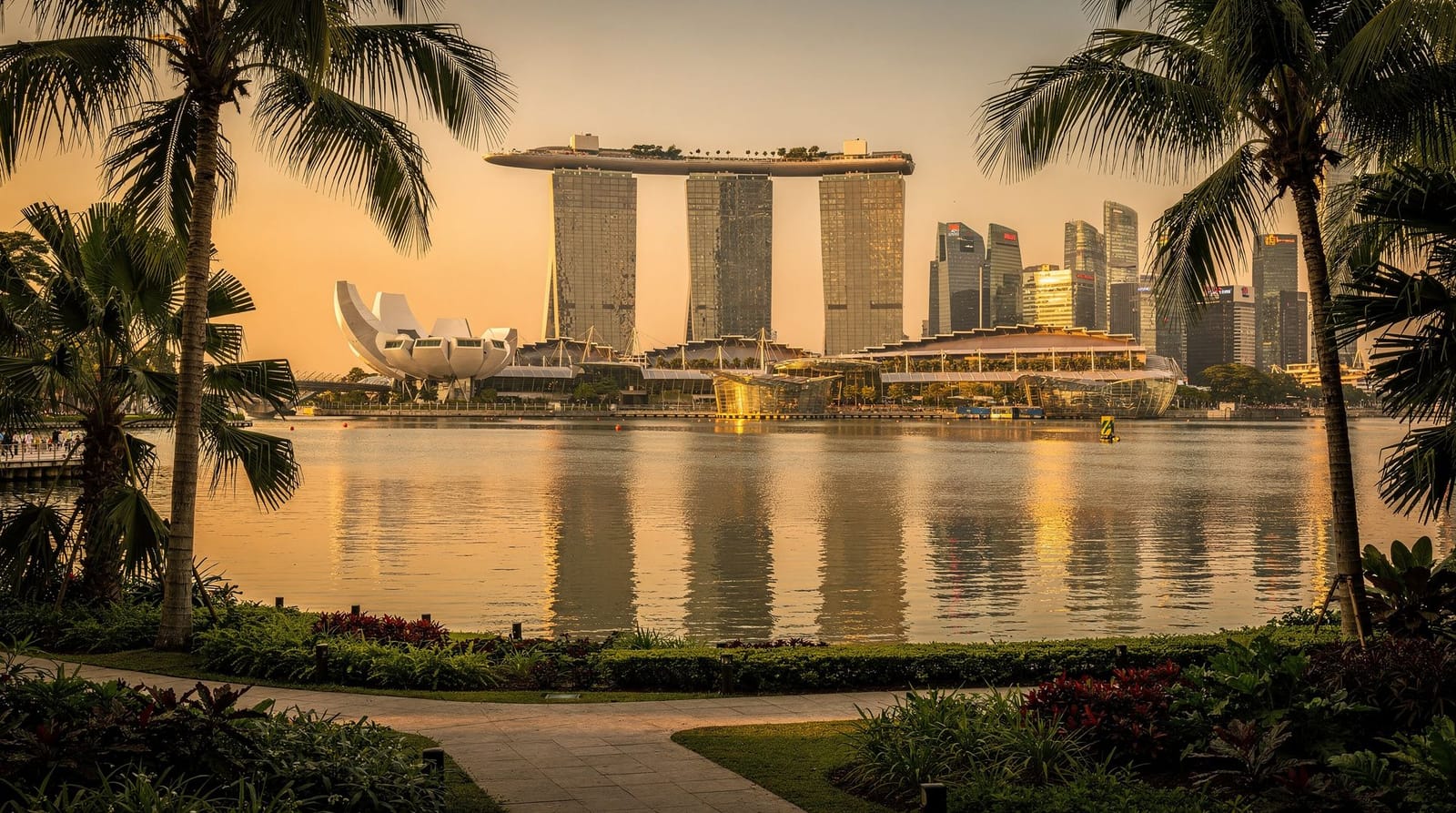
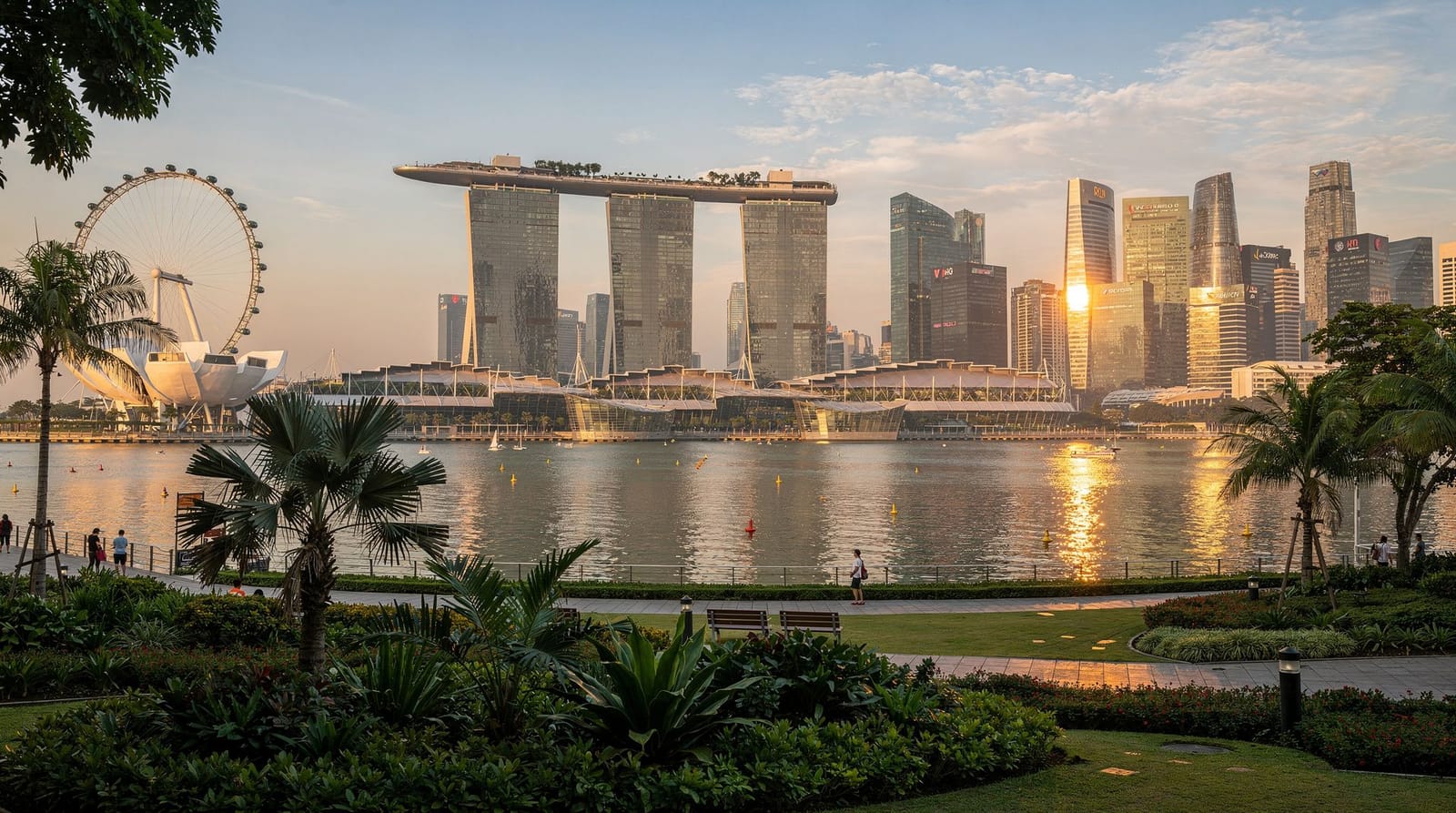
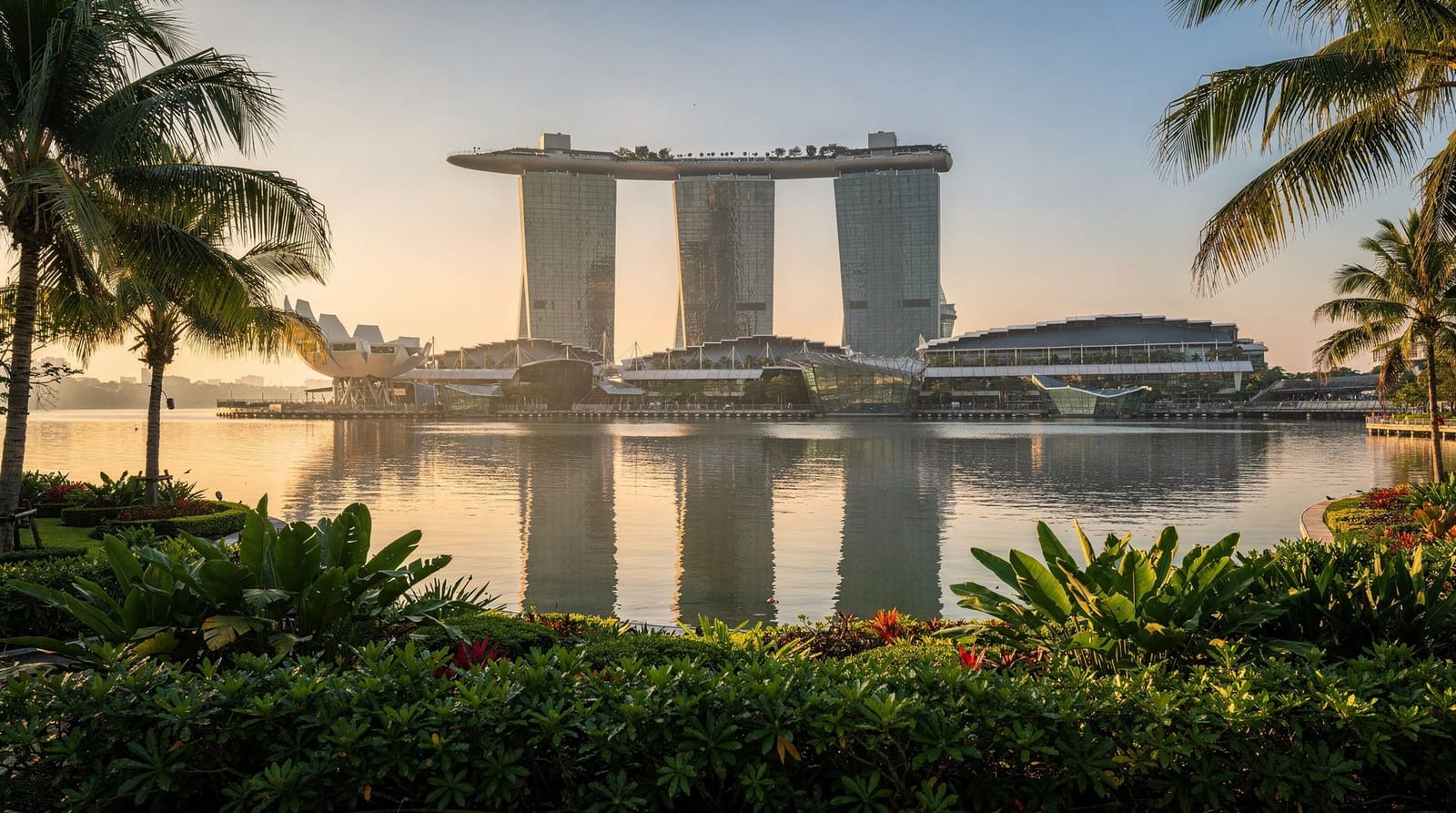
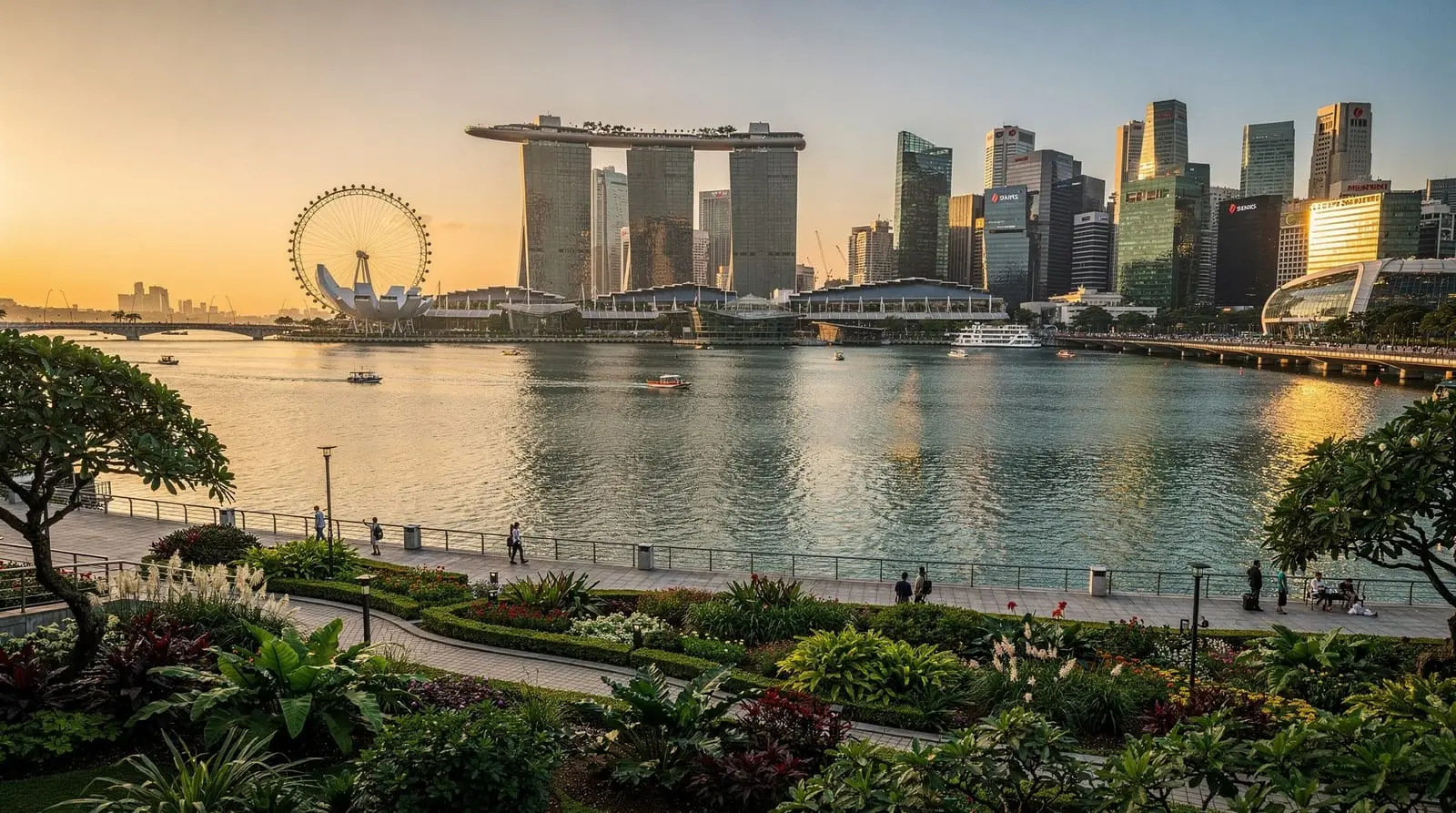
Marina Bay: The iconic skyline — Marina Bay Sands, the Helix Bridge, the Merlion, Gardens by the Bay. This is the front-page Singapore that visitors expect. Absolutely visit, but note: the views are best at dusk and after dark when the buildings light up.
Colonial Core / Civic District: Walking north from Marina Bay, you reach the colonial-era buildings — the Supreme Court, City Hall, the Esplanade, Raffles Hotel, the Singapore River. This is the historical administrative heart of Singapore and extremely walkable.
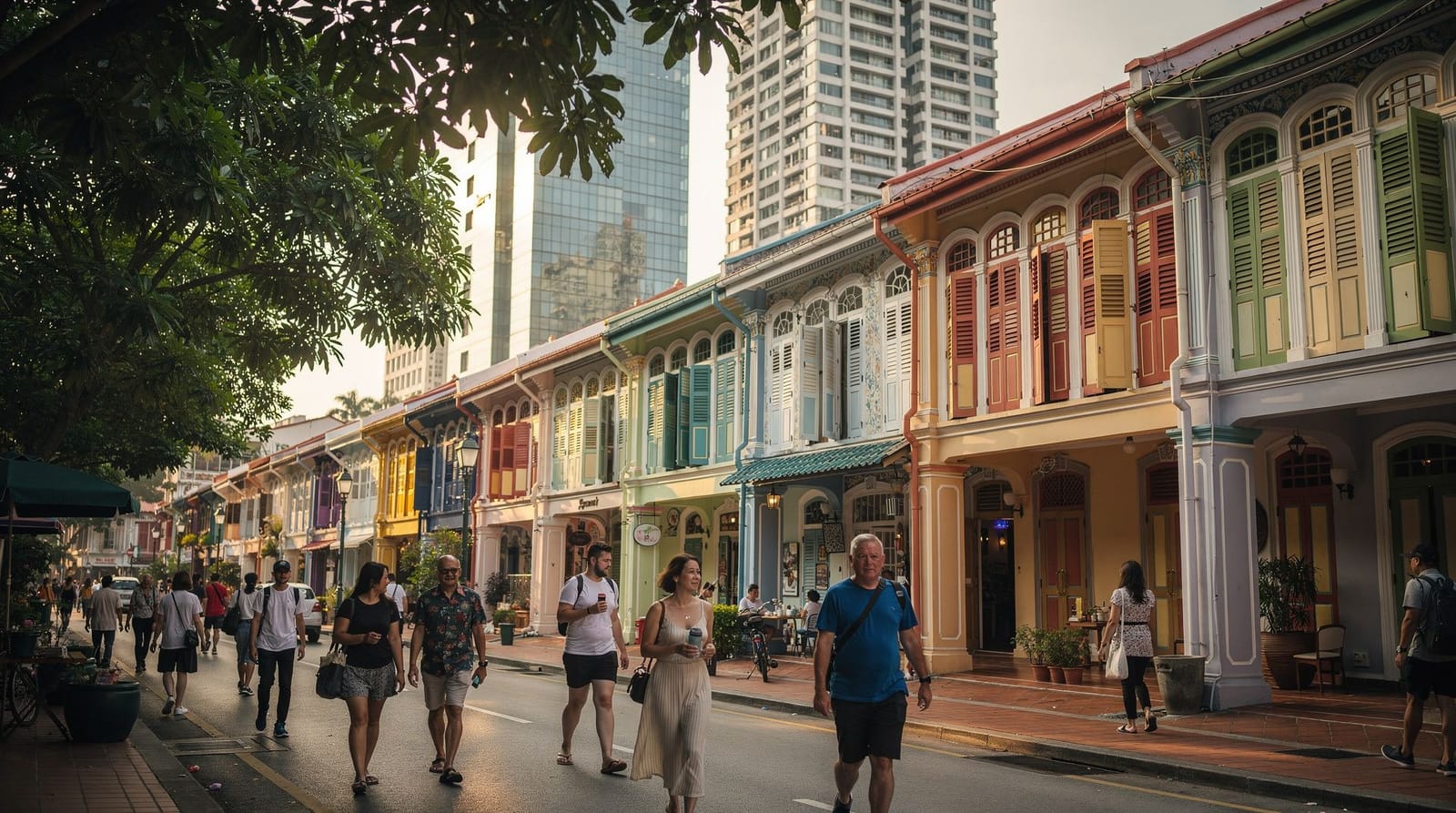
Chinatown: Southwest of the city centre (Chinatown or Tanjong Pagar MRT). The Buddha Tooth Relic Temple, Pagoda Street, and Maxwell Food Centre are the key draws. Best in the morning for hawker culture and late afternoon for atmospheric wandering.
Little India: North of Bugis (Little India MRT). Sri Veeramakaliamman Temple, Tekka Market, the chaos of Serangoon Road. Most vivid on weekends when the migrant worker community fills the streets. Genuinely unlike anywhere else in Singapore.
Kampong Glam: Between Bugis and Lavender MRT. Sultan Mosque, Arab Street, Haji Lane. Singapore’s Malay-Arab quarter — now gentrified but retaining distinct character. Best in the afternoon and evening.
Orchard Road: Singapore’s main shopping corridor (Orchard MRT). Malls, food courts, international retail. Worth walking once for the spectacle; not the priority for first-timers unless shopping is the goal.
Sentosa Island: 45 minutes from the city centre (HarbourFront MRT, then Boardwalk). The resort island — Universal Studios, beaches, cable car. Worth a day; not the priority before you have seen the city itself.
All of these areas are connected by MRT and short walking distances within each zone.
How to navigate Singapore: the honest MRT guide
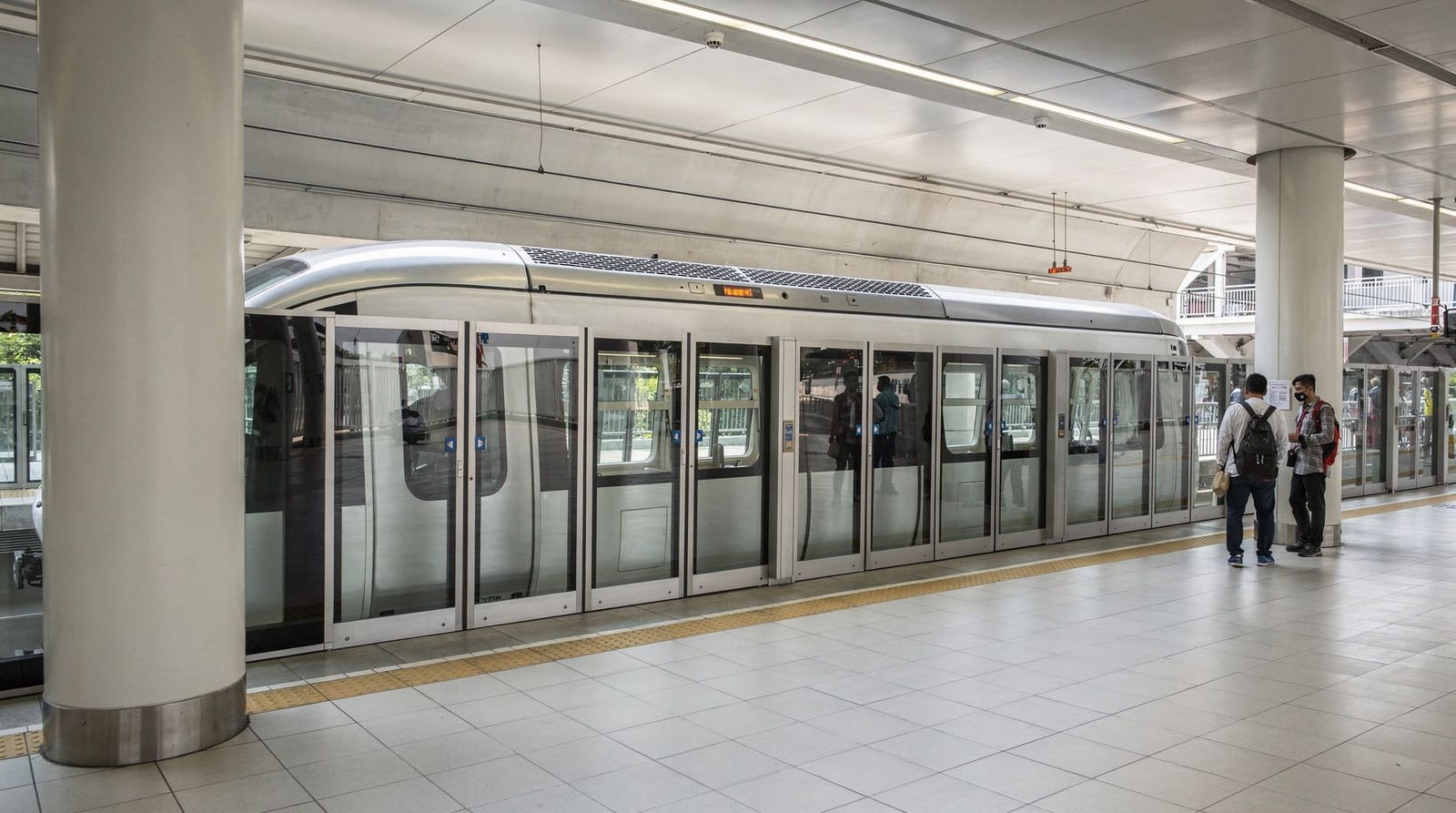
The MRT (Mass Rapid Transit) is how you get around. It is clean, air-conditioned, safe, fully English-signposted, and cheap. Most tourist journeys cost SGD 1.50–2.50.
How to pay:
- Buy an EZ-Link card (SGD 10, includes SGD 5 usable credit) at any MRT station ticketing machine — tap in and tap out at the card readers
- Use a contactless debit/credit card directly (Visa, Mastercard — SimplyGo system) — no card needed, just tap your bank card
- Singapore Tourist Pass: unlimited rides for SGD 17 (1 day), SGD 24 (2 days), SGD 29 (3 days)
Key lines for first-timers:
- East-West Line (green): Changi Airport → Paya Lebar → City Hall → Outram Park → Jurong
- North-South Line (red): Changi connects via EW → City Hall on NS → Orchard → Marina Bay
- Circle Line (yellow): connects Botanic Gardens → Holland Village → HarbourFront → Marina Bay → Dhoby Ghaut
- North-East Line (purple): Punggol → Serangoon → Little India → Dhoby Ghaut → Chinatown → HarbourFront
Use Google Maps — it gives precise MRT routing with costs. The MRT app (Singpass or MyTransport.SG) also works. Walk-up navigation is easy because stations are fully signposted.
See Singapore MRT guide: how to use it, pay for it, and love it for a complete guide.
The hawker centre imperative
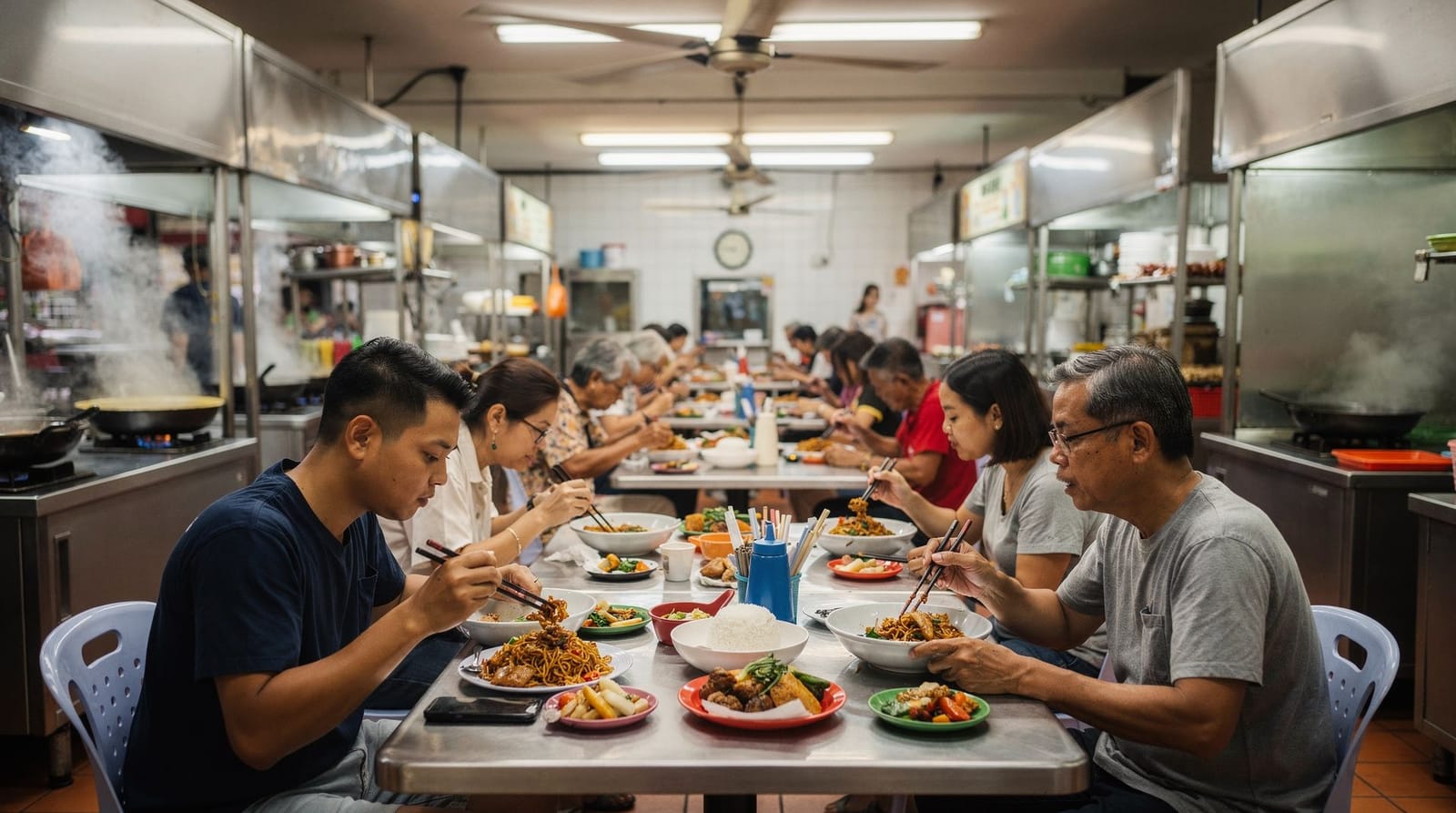
The single thing a first-time Singapore visitor must do — more than any paid attraction, more than any waterfront selfie — is eat at a hawker centre.
What hawker centres are: Government-subsidised covered food halls with dozens of independent stalls, each specialising in one or two dishes. They emerged from street food culture, were cleaned up and regularised, and remain the heart of Singapore eating culture. In 2020, Singapore hawker culture was added to UNESCO’s intangible cultural heritage list.
Why they matter: The food quality is genuinely extraordinary. Multiple hawker stalls hold Michelin recognition. The diversity — Chinese, Malay, Indian, Peranakan, Western-influenced Singaporean hybrids — in one open-air hall is a culinary education. And it costs SGD 5–10 per dish.
Which to visit first (honest priority):
Maxwell Food Centre (Tanjong Pagar MRT, 5 min walk): Best for Tian Tian Chicken Rice (queue expected, worth it), char kway teow, and chilli crab if you want to understand Singapore’s signature dishes in one centre. Popular with tourists but not overrun.
Tiong Bahru Market (bus from Tiong Bahru MRT, or 15 min walk): Two-level hawker centre in Singapore’s trendiest estate. Legendary chwee kueh (rice cakes with preserved turnip, breakfast food), excellent char siu bao. Best for morning breakfast.
Chinatown Complex (Chinatown MRT, Smith Street): The largest hawker centre in Singapore, possibly overwhelming for first-timers — hundreds of stalls. Best approached with a specific target or by simply wandering until something looks right.
Tekka Market (Little India MRT): Best for South Indian banana-leaf meals, roti prata, and teh tarik. The best market for understanding Indian-Singaporean food culture.
Practical hawker etiquette: Find an empty seat first (“choping” — reserving a seat by leaving a tissue pack is a local custom). Decide what you want, order from the stall, bring food back to your seat. Many centres have drink stalls separate from food stalls. Do not tip. See Hawker centre etiquette for the full etiquette guide.
What to prioritise in a limited visit
If you have three days, here is the honest priority order:
Priority 1 — Eat at two or three different hawker centres. One lunch at Maxwell, one dinner at Chinatown Complex, one breakfast at Tiong Bahru Market or Tekka. This is the irreducible Singapore experience.
Priority 2 — Walk the Marina Bay waterfront at dusk. From the Merlion Park along the promenade to the Helix Bridge. Take your time — the hour before and after sunset as the city lights up is Singapore at its most photogenic. Stay for the Spectra light show at 9 pm (free).
Priority 3 — Walk one cultural quarter properly. Do not rush through all three in one afternoon. Spend a proper 2–3 hours in either Chinatown (Maxwell food → Buddha Tooth Relic Temple → Pagoda Street), Little India (Tekka Market → Sri Veeramakaliamman Temple → Serangoon Road), or Kampong Glam (Sultan Mosque → Arab Street → Haji Lane). Each deserves more than a 30-minute walk-through.
Priority 4 — One paid major attraction. If your trip is 3 days, choose one: Gardens by the Bay Conservatories (indoor nature, among Asia’s best), Singapore Zoo (world-class), Night Safari (unique), or Sentosa. Do not try to fit all of them.
See Must-see Singapore for first-timers for the definitive first-timer attraction guide.
The things that surprise most first-timers
The heat
You have been told it is hot. You do not fully understand it until you exit Changi Airport at 11 am in July and feel the wall of 33°C at 85% humidity. The practical adjustment: avoid outdoor heavy exertion from 11 am to 3 pm, carry water constantly, wear sunscreen, and embrace the air conditioning inside malls and MRT as welcome refuge rather than excess. Most people adapt in 1–2 days.
The cold air conditioning
The second shock: stepping from 33°C into a shopping mall air-conditioned to 19°C. Singapore offices and retail spaces run at temperatures that require a layer for comfort. Pack a thin long-sleeved layer for indoor time.
How much greenery there is
The Singapore you see in photos — shimmering glass towers and the infinity pool — is real. What is less expected: how green it is. Tropical trees line every street, rooftop gardens cover buildings, the Southern Ridges park system is jungle. Gardens by the Bay is extraordinary partly because it is the most extreme expression of a city that genuinely treats plants as infrastructure.
How safe it is
Even visitors who have read about Singapore’s safety record are surprised by the ambient sense of calm. Leaving a phone on a hawker table while you queue at a stall, walking alone at 1 am in most neighbourhoods, using public transport at all hours — all feel routinely safe in a way that is uncommon in most major global cities.
The food at hawker centres
This is the most consistent first-timer surprise. People know hawker food is good. They do not know it is this good. Dishes refined over three generations by families running the same stall, using techniques that combine four distinct culinary traditions, at prices that feel impossible by Western standards. Visitors who budget for mostly restaurant dining and discover hawker centres on day two often restructure their entire approach to Singapore eating.
Money and realistic daily budgeting
Singapore has a reputation for being expensive, and by Southeast Asian standards it is — but a first-timer eating mostly at hawker centres and using the MRT can travel comfortably on a moderate budget. As a rough daily guide, excluding accommodation: budget SGD 60–80 (three hawker meals, MRT, one paid attraction spread across the trip), mid-range SGD 100–150 (hawker meals plus one restaurant meal, occasional Grab rides, one or two paid attractions per trip), and comfortable SGD 180+ (mixing restaurant dining, rooftop drinks, and multiple paid attractions).
The single biggest lever on cost is transport — MRT versus Grab — and the second is how many paid attractions you stack in. See Singapore travel costs for a full breakdown and Singapore on a budget for the tightest realistic version of a Singapore trip.
Should you book a guided orientation tour?
For visitors who want context on their first day rather than figuring out geography from scratch, a half-day guided city tour covering Marina Bay, Chinatown, and the colonial core can be a genuinely useful way to orient yourself before exploring independently for the rest of the trip. It is not essential — Singapore’s signage and Google Maps make independent exploration easy — but it removes the friction of a jet-lagged first day and gives useful historical context you would otherwise have to look up.
Half-day Singapore city highlights tourFor a more flexible option that lets you set your own pace across multiple neighbourhoods over a full day, a hop-on hop-off bus covers the main areas without requiring you to plan MRT connections on day one.
Big Bus hop-on hop-off SingaporeWeather and what to pack
Singapore is tropical and consistent year-round — expect 26–33°C and high humidity every day, with short, heavy downpours possible any month (slightly more likely November–January during the monsoon). There genuinely is no “bad season” to avoid the way there is in seasonal climates, though haze season (roughly August–October, from regional forest fires) can affect visibility and air quality in bad years. Pack light, breathable clothing, a compact umbrella or light rain jacket, comfortable walking shoes, and one thin long-sleeved layer for the aggressively air-conditioned malls and MRT. Modest dress (shoulders and knees covered) is expected at temples and the mosque in Kampong Glam. Full packing list: What to pack for Singapore.
Apps and connectivity to set up before you land
Beyond Grab, three apps make a first Singapore trip noticeably smoother: Google Maps (accurate MRT routing with live departure times), the MRT operator’s own app (SimplyGo or the relevant transit app, useful for checking fares and top-ups), and your chosen food delivery or reservation app if you plan to book restaurant tables in advance during peak dinner hours. Set these up with a working Singapore data connection — either a physical SIM from the arrivals hall kiosks or an eSIM activated before you land — so navigation works from the moment you land at Changi.
Tipping and service charges
Tipping is not expected in Singapore and can even feel odd to service staff at hawker centres, where it is simply not part of the culture — pay the listed price and move on. Restaurants typically add a 10% service charge plus 9% GST to the bill automatically, which covers the service; there is no need to tip on top of that unless you want to for exceptional service, and even then it is unusual. Taxi and Grab drivers do not expect tips, though rounding up a fare is fine and appreciated. The one place a small tip is sometimes given is for a hotel bellhop or a particularly attentive tour guide, and even that is optional rather than customary.
Common first-timer mistakes (and how to avoid them)
Mistake 1: Overloading the attraction itinerary. Trying to fit Universal Studios, the Zoo, Night Safari, two museum visits, and a cable car ride into three days is a recipe for exhaustion and dissatisfaction. Choose one or two major paid attractions. The rest of your time is best spent eating and exploring neighbourhoods.
Mistake 2: Skipping hawker centres for restaurants. Many visitors see the gleaming food courts inside Orchard Road malls or the chilli crab restaurants advertised at tourist spots and assume that is the real Singapore food scene. It is not. The hawker centres — loud, un-airconditioned, plastic-stool sitting — are the real Singapore food scene. The hawker equivalent is almost always superior and a fraction of the price.
Mistake 3: Spending the whole trip in Sentosa. Sentosa is a resort island attached to Singapore. It is not Singapore. Universal Studios and the beaches are fun, but visitors who structure their entire trip around Sentosa are missing the city that is the actual point.
Mistake 4: Using Grab for every journey. Grab from the airport costs SGD 25–45 versus SGD 2 on MRT. A day of Grab rides (SGD 10–25 per trip) versus a day of MRT (SGD 6–10 total) adds SGD 50–80+ to your daily cost. MRT is fast, comfortable, and the obvious choice for most city travel. Save Grab for the airport with bags, late nights, and genuinely inconvenient public transport situations.
Mistake 5: Ignoring the cultural quarters. Chinatown, Little India, and Kampong Glam are Singapore’s most distinctive and interesting neighbourhoods — multi-sensory, historically layered, and visually striking. First-timers who spend their time in Marina Bay and Sentosa and skip the neighbourhoods miss what makes Singapore a genuinely interesting city rather than just an impressive one.
Practical first-day logistics
From the airport: Take the MRT East-West Line from Changi Airport station (walking distance from T2 and T3, Skytrain from T1 and T4) to City Hall (SGD 2, 30 min) for central accommodation, or follow the line to your hotel’s nearest station. Alternatively, Grab from Changi costs SGD 25–45 but spares you luggage handling.
Check-in: Standard check-in time at Singapore hotels is 2–3 pm. If you arrive early, most hotels will store your luggage. Many budget hotels allow early check-in for an additional fee or if the room is ready.
First meal: If landing in the morning, head to a hawker centre for breakfast — Tiong Bahru Market for the classic Singapore breakfast experience (kaya toast, soft-boiled eggs, teh tarik) or Maxwell for a fuller meal. If landing in the afternoon or evening, Lau Pa Sat (open to midnight, central Marina Bay location) is a convenient first hawker dinner.
Currency: ATMs at Changi Airport dispense SGD. Money changers inside Changi Airport are fair for airport rates. City-centre money changers (Little India’s Mustafa Centre, Bugis’s Golden Landmark) offer 2–4% better rates for cash exchanges. Contactless card payment (Visa/Mastercard) works everywhere except many hawker stalls.
Frequently asked questions for Singapore first-timers
Is Singapore good for solo travel?
Excellent. See Solo travel Singapore for the full guide. Short version: Singapore is one of the best solo destinations in Asia — safe, English-speaking, easy to navigate alone, and with a hawker culture that means eating alone is totally normal and comfortable (solo dining at hawker tables is standard).
Can I see Singapore in a day?
One day gives you a genuine taste — Marina Bay waterfront, one hawker meal, one neighbourhood walk. It is not enough to feel like you have visited Singapore properly, but it is excellent as a layover day. See Changi Airport layover guide and Singapore in 1 day for the best single-day structure.
What is the best area to stay in as a first-timer?
Chinatown, the Marina Bay area, or Bugis/Little India. All offer MRT access to every attraction, walkable cultural context, and a range of accommodation prices. Orchard Road is convenient but more commercial and less atmospheric. Avoid accommodation in Sentosa unless you specifically need to be on the resort island. See Where to stay in Singapore.
Should I get the Go City Singapore Pass as a first-timer?
If you plan to visit 3+ major paid attractions (USS, Zoo, Night Safari, Gardens Conservatories), the Go City All-Inclusive Pass can save money. If you plan only 1–2 paid attractions (which is realistic for a 3-day first-timer focused on food and neighbourhoods), individual tickets are more economical. See Is Go City pass worth it in Singapore? Honest break-even analysis for the honest analysis.
What should I eat first in Singapore?
Hainanese chicken rice. It is Singapore’s national dish — poached or roasted chicken served over rice cooked in chicken stock, with ginger paste, dark soy, and a bowl of broth. At Tian Tian in Maxwell Food Centre, it costs SGD 5–6. It is one of those dishes where the execution at the best hawker stalls is astonishingly good relative to its simplicity. For everything else, see What to eat in Singapore and Must-try dishes in Singapore.
Top experiences
Bookable activities with verified prices and instant confirmation on GetYourGuide.