Hawker centre etiquette: how chope works and unwritten rules every visitor should know
Singapore: local hawker food tour with tastings
What does chope mean and how do you do it at a hawker centre?
Chope means to reserve a seat. Singaporeans place a packet of tissues, an umbrella, or any small personal item on a stool to signal it is taken. This tissue-chope system is unique to Singapore and is considered completely normal — do not remove someone's tissues from a seat. Arrive, chope your seats, then go order food from different stalls.
What makes hawker centre culture distinct
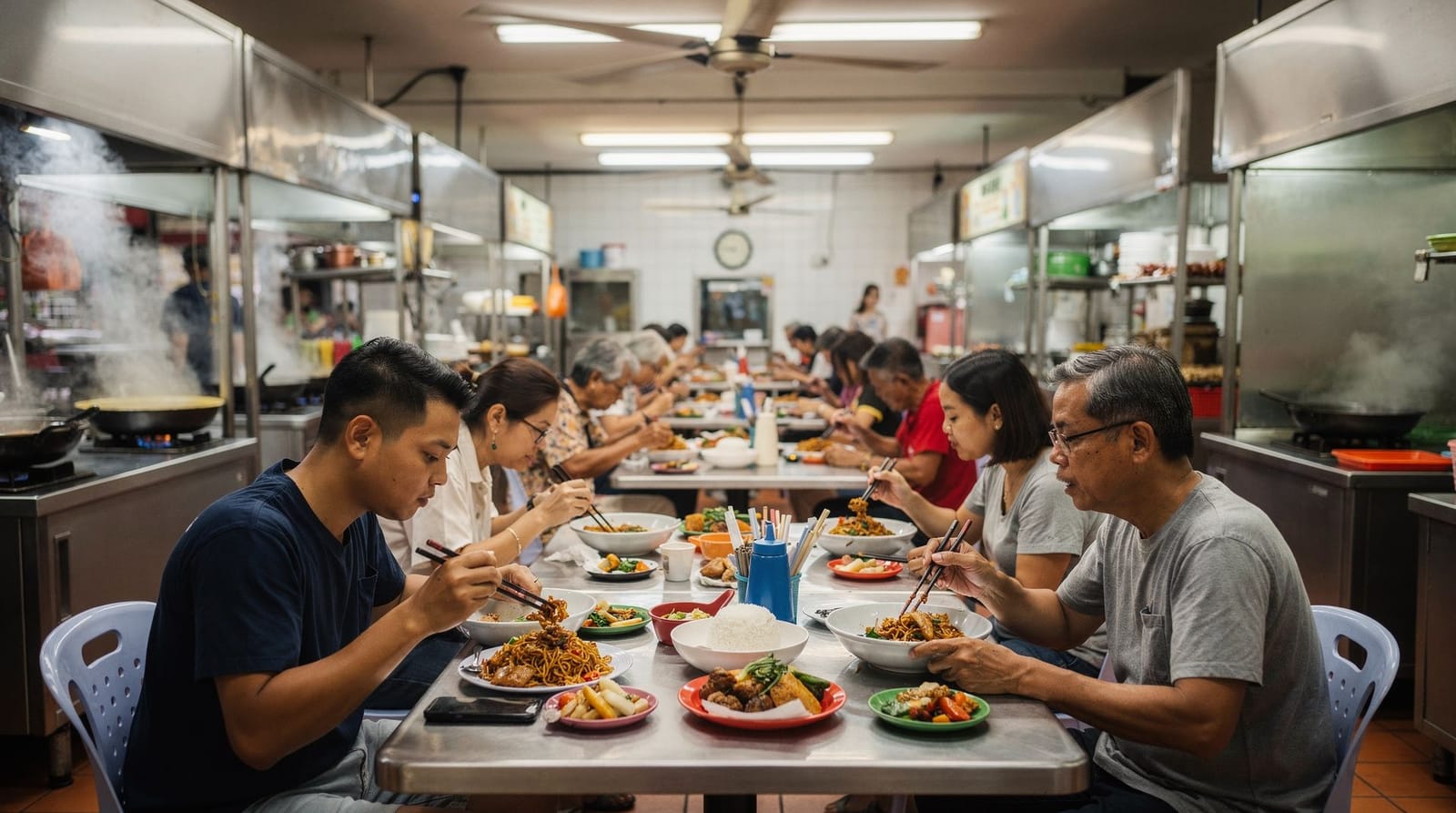
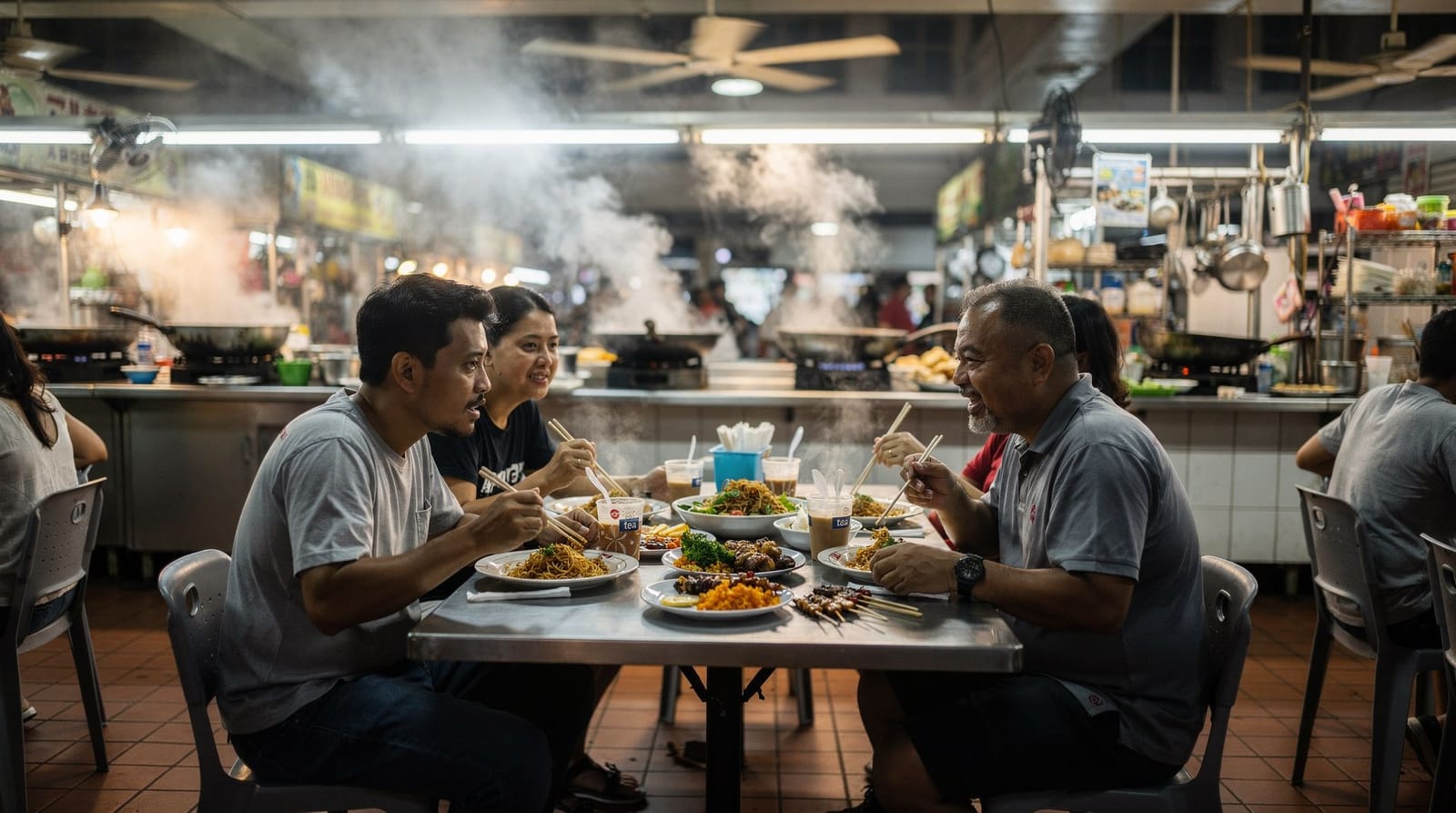
Singapore’s hawker centres are not merely food courts. They are the social and culinary backbone of the city — UNESCO-listed as intangible cultural heritage since 2020, open to everyone, priced for everyday meals, and operating by a set of informal but well-understood norms that evolved over generations. Visitors who understand these norms eat better, avoid friction with locals, and get far more from the experience.
This guide covers the practical and cultural rules that Singaporeans absorb growing up but that no guidebook ever bothers to explain in full.
| Where | Any hawker centre — Maxwell, Lau Pa Sat, Old Airport Road, Chinatown Complex, Tiong Bahru Market |
| Cost | Around SGD 5–10 per meal; drinks SGD 1–3 |
| Key rule | Chope with a small item (tissues), order at each stall separately, return your tray |
| Getting there | MRT to the nearest station — most major centres sit within a 5–10 minute walk |
| Best time | Off-peak: before noon, after 13:30, or before 18:00 for dinner |
The chope system explained
The word “chope” (pronounced roughly like “chop”) is Singaporean slang meaning to reserve or claim. At a hawker centre, you chope a table by leaving a small personal item on a seat or stool before you go to order.
The canonical chope item is a packet of tissues. Go to any 7-Eleven or provision shop, buy a small packet of tissues for SGD 0.50–1, and you have the official social currency of Singapore hawker centres. Other common chope items: an umbrella, a lighter, a wallet, a tote bag.
Why this system exists: Hawker centres — especially busy ones like Maxwell Food Centre, Lau Pa Sat, or Old Airport Road — have limited seating relative to the number of people wanting to eat. The stalls you want may be at opposite ends of the centre. The chope system allows people to secure a seat before joining a queue, which can be 10–15 minutes at popular stalls.
The rule: A choped table is reserved. Do not move the tissues or occupy a choped seat. If you are unsure whether tissues indicate a chope or were simply forgotten, look for context — is there food on the table? Is someone nearby? When in doubt, ask.
Practical tips:
- Chope first, then order
- Do not chope more seats than you have people in your group
- At very busy peak times (weekday lunch, weekend mornings), do not linger at your table once you have finished — other people need the space
- Some younger Singaporeans have debated whether choping is antisocial, but it remains universally practiced and universally understood
How to order at hawker stalls
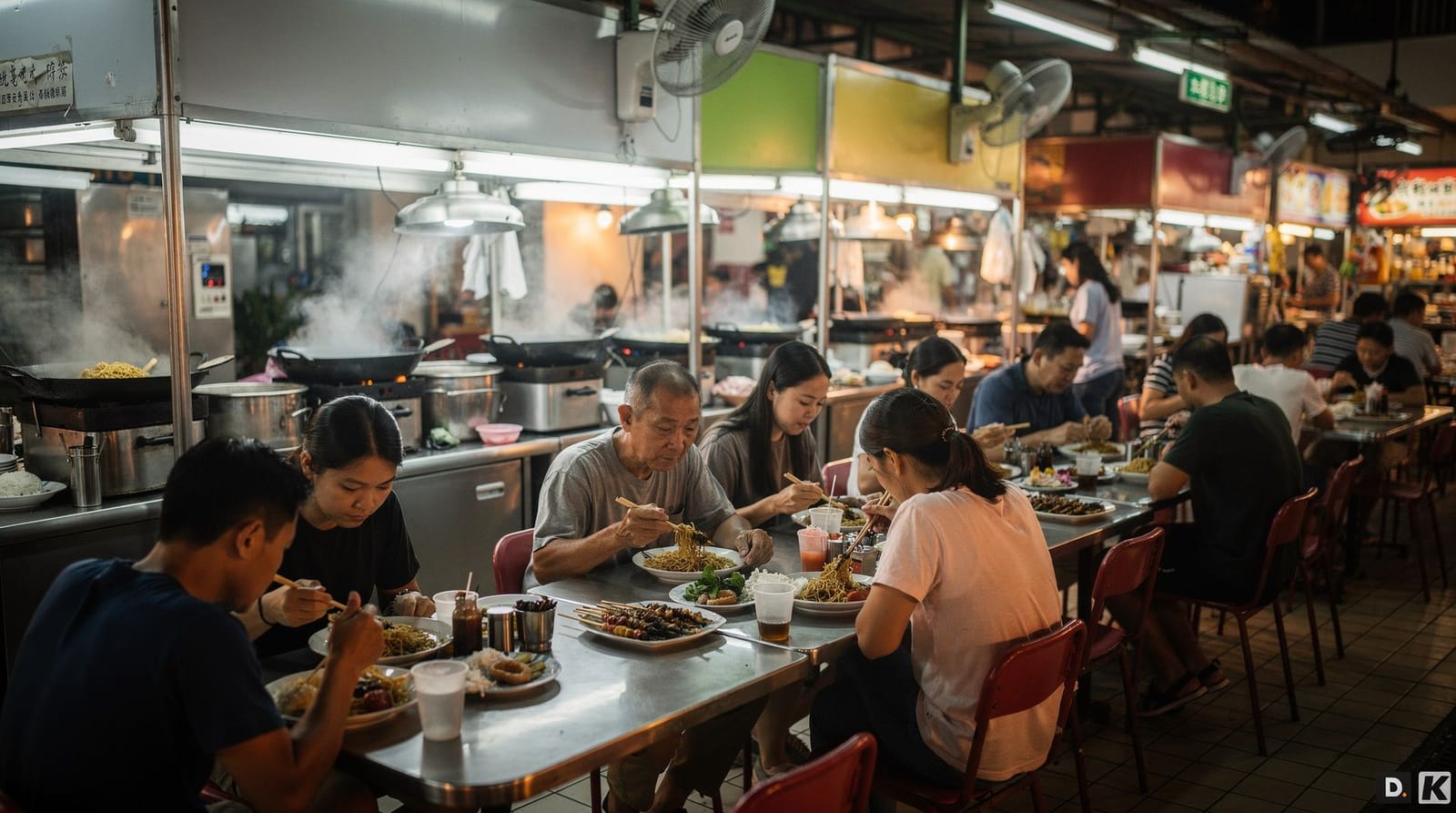
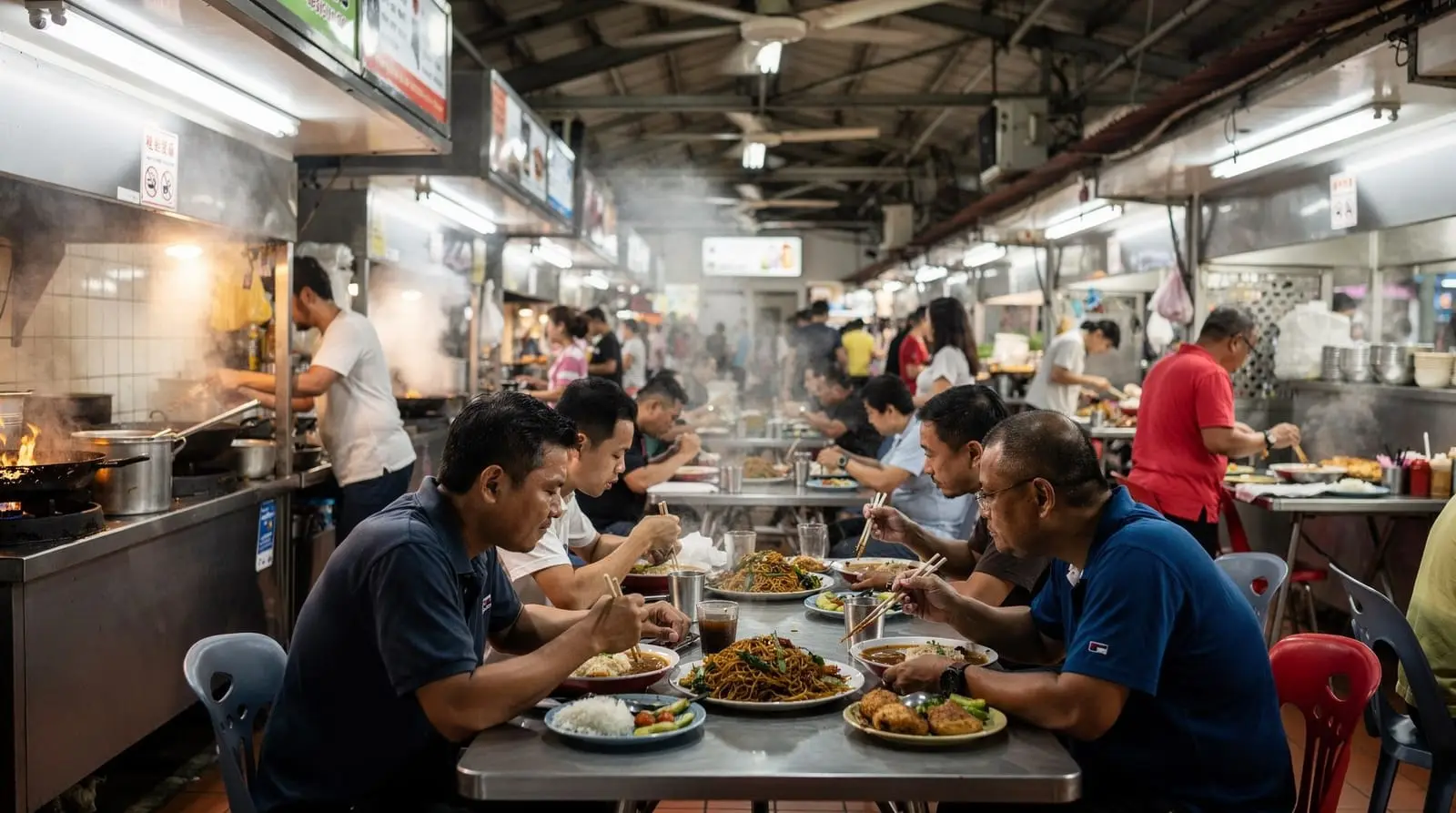
Each stall at a hawker centre is independently operated. You order and pay at the counter of each stall — not at a central register. This means:
- Identify what you want and from which stall
- Queue at that stall and order when it is your turn
- Pay at the stall (cash or QR scan)
- Wait for your food to be ready — some stalls give you a buzzer or a number, others simply call out when ready
- Collect your food and bring it to your table
- For drinks, approach the drinks stall separately
There is no table service in the traditional sense at most hawker centres. In busy centres, a drink uncle or auntie may circulate and take drink orders at your table — pay them directly.
On queue etiquette: Singaporeans queue seriously. Do not push in, do not skip the queue, do not hold a place in line while someone else in your group orders elsewhere. At very popular stalls like Tian Tian Chicken Rice at Maxwell, queues form at opening and can be 20–30 minutes.
The drinks stall
Almost every hawker centre has one or more drinks stalls that operate separately from the food stalls. These are your source for:
- Kopi — local coffee, robusta-based, strong and sweet unless you specify otherwise
- Teh — local tea, usually with condensed milk
- Kopi-O — black coffee with sugar
- Teh-O — black tea with sugar
- Kopi-C — coffee with evaporated milk
- Milo dinosaur — thick Milo with undissolved Milo powder on top (particularly popular)
- Barley and chrysanthemum tea — cooling, good with spicy food
- Fresh calamansi lime juice — SGD 1.50–2, excellent in the heat
The price: SGD 1–2 for most hot or cold drinks. SGD 2–3 for fresh juices. Order by approaching the counter or by flag-waving if the drink uncle is circulating.
Tray return is mandatory
Since 1 September 2021, returning your tray after eating is mandatory at hawker centres, food courts, and coffee shops in Singapore. This followed years of public campaigns that achieved partial compliance through persuasion alone.
How it works:
- Finish eating
- Stack your crockery, cutlery, and tray neatly
- Carry it to the nearest tray return station (labelled, often with green trolleys or a rack with bowls and trays)
- Return used tissues separately to the rubbish bins provided
Enforcement: NEA (National Environment Agency) officers conduct spot checks. First-time offenders receive a warning; repeat offenders can be fined. In practice, most locals comply without prompting. For visitors, it is a matter of basic respect for the hawkers and cleaners who run these centres.
Noise, pace, and table behaviour
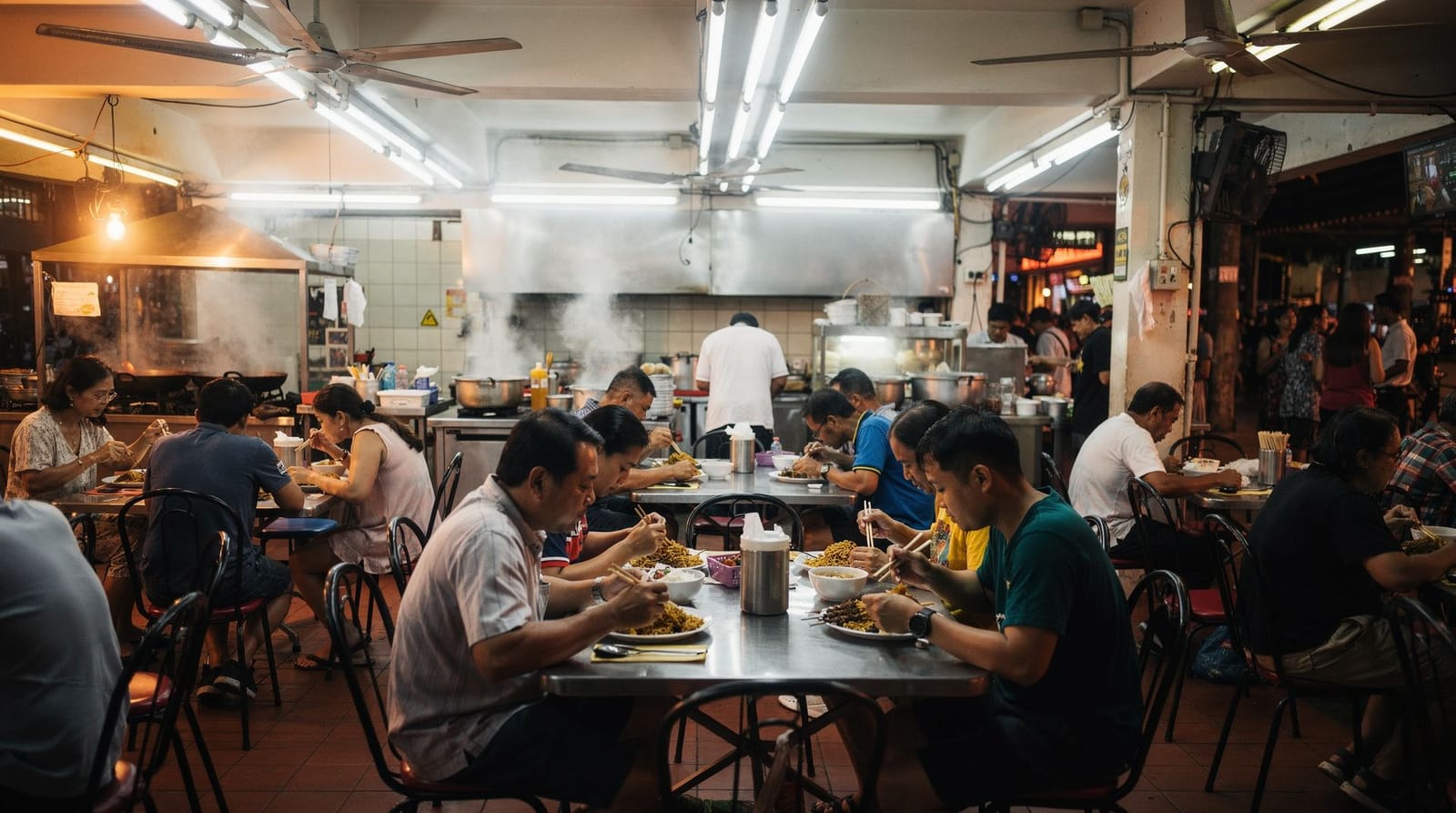
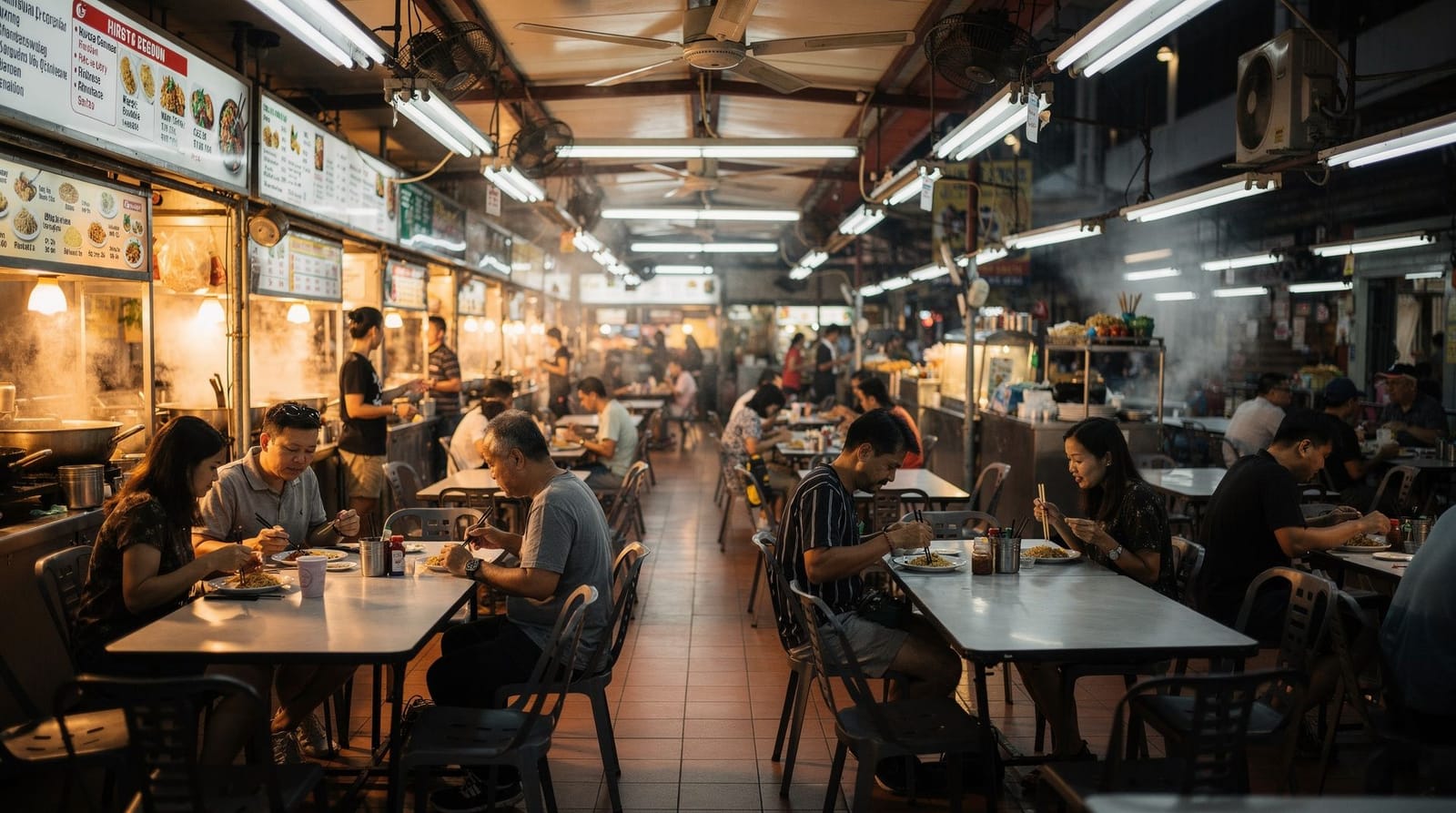
Hawker centres are loud, vibrant, and social. There is no expectation of quiet. Conversations at normal or elevated volume are standard. The pace is purposeful — most people eat in 15–30 minutes and move on. You are not expected to rush, but prolonged occupation of a table after finishing during peak hours (12–14:00, 18:30–20:00) is frowned upon.
A few further behavioural notes:
- Smoking is prohibited at most hawker centres under the Smoking (Prohibition in Certain Places) Act. Look for designated smoking areas outside if needed.
- Bringing young children is completely normal and expected — there is no concept of hawker centres being adult spaces.
- Dogs are not permitted inside enclosed hawker centres; open-air sections vary by centre.
- Dress code: none. Singlets, flip-flops, and shorts are completely acceptable.
Ordering like a local: useful phrases
Most hawker stall operators speak English or functional English. Singlish (Singapore English creole) is the natural register — you will hear and may use phrases like:
- “Can” — yes / understood / that works
- “Makan” — food / eating (Malay-origin, used colloquially)
- “Dabao” — takeaway (from Hokkien/Cantonese; tell the stall if you want your food packed)
- “Less spicy / no chilli” — perfectly understood at any stall
- “Add rice please” — most hawker dishes can be ordered with extra rice for SGD 0.50
- “Upsize” — larger portion, where available
For drinks: specifying how you want your kopi or teh is a local art form. “Kopi-O kosong” (black coffee, no sugar, no milk) is the slimmest option. “Kopi-peng” is iced coffee.
Peak hours and practical timing
The most useful local knowledge: avoid peak hours if you can. The busiest times at hawker centres are:
- Weekday lunch: 12:00–13:30 — office workers descend en masse; longest queues, most limited seating
- Weekend mornings: 08:30–10:30 — families and the kaya toast / dim sum crowd
- Weekend dinner: 18:30–20:00 — families, couples, post-work groups
Going at off-peak times — before noon, after 13:30 for lunch, before 18:00 for dinner — means shorter queues, easier seating, and less heat. Early morning (07:00–09:00) at markets like Tiong Bahru Market or Chinatown Complex is one of the most pleasant times to eat: the hawkers are fresh, the food is at its best, and the pace is unhurried.
For a deeper dive into specific centres, the best hawker centres guide ranks the top spots and explains what each is best known for.
If you would rather have someone show you the ropes on your first visit — how to chope, what to order, and which stalls are worth the queue — a guided hawker food tour removes the guesswork:
Local hawker food tasting tourThe cultural and heritage context
It is worth understanding why hawker culture is taken seriously in Singapore. Hawker centres emerged from colonial-era street hawking — itinerant food sellers were progressively licensed and resettled into government-built centres from the 1970s onwards as part of urban redevelopment. The system that resulted is a peculiar Singaporean success: affordable, diverse (Chinese, Malay, Indian, and fusion dishes coexist at the same centre), hygienically regulated, and socially egalitarian.
The UNESCO inscription in 2020 recognised hawker culture not just as food but as a living practice that brings together Singapore’s multicultural communities. When you eat at Maxwell Food Centre beside a construction worker and a suited office colleague, you are experiencing what Singaporeans call “social levelling” through food — something that the chope system, the shared tables, and the tray-return etiquette all reinforce.
To explore the food itself in depth, see what to eat in Singapore and must-try dishes Singapore.
Hawker centres for visitors: a brief practical summary
- Best introduction: Maxwell Food Centre (central, famous stalls including Tian Tian Chicken Rice)
- Most local atmosphere: Old Airport Road Food Centre (less tourist-heavy, excellent variety)
- Best for night eating: Lau Pa Sat (colonial building, satay street outside from ~19:00)
- Best weekend morning: Tiong Bahru Market (dim sum, kaya toast, neighbourhood crowd)
- Best in Chinatown: Chinatown Complex Food Centre (largest hawker centre in Singapore, hundreds of stalls)
For families bringing children, the kid-friendly hawker guide covers the most accessible choices and milder dishes. For the budget breakdown of a full day eating hawker food, see Singapore on a budget.
Putting the etiquette into practice
Once the rules are clear, the easiest way to absorb them is to pick one centre and watch how the regulars behave before you join in. Maxwell Food Centre is a forgiving first stop because so many visitors eat there, and Chinatown Complex shows the same habits at a more local, bustling scale. Both reward patience in the queue and a little curiosity about what the person ahead of you is ordering.
If your plans are still taking shape, the best cheap eats in Singapore guide helps you decide where to spend your meals, and the Michelin hawker stalls guide explains which famous names are worth a longer queue. Pairing a hawker lunch with a walk through the surrounding neighbourhood, such as Chinatown, makes the whole outing feel less like a transaction and more like part of the city.
Singapore: Chinatown hawkers food tour with 7 tastingsWeather and hawker centres
Many of Singapore’s older hawker centres are only partially air-conditioned or entirely open-air, which matters more than first-time visitors expect in a tropical climate. Midday heat (roughly 12:00–15:00) can make an un-airconditioned centre genuinely uncomfortable for a leisurely meal — factor this into when you go, not just how busy it is. Sudden tropical downpours are common year-round and especially frequent during the monsoon months; open-sided centres provide shelter but wind-driven rain can reach the outer tables, so a spot further from the edge is worth choosing if the sky looks heavy. Newer or redeveloped centres (parts of Chinatown Complex, some neighbourhood centres) have partial air-conditioning, which is a meaningful comfort upgrade if you’re visiting during the hottest part of the day.
Paying at hawker stalls: cash, cards, and e-wallets
Payment methods have shifted noticeably in recent years, and it’s worth knowing what to expect before you’re standing at the counter. Cash remains universally accepted — carry small notes (SGD 2, 5, 10) since exact change is appreciated at busy stalls. Contactless card payment and e-wallets (PayLah!, PayNow, GrabPay) are increasingly common, especially at newer or renovated hawker centres, but coverage is inconsistent stall-by-stall even within the same centre.
Look for a small QR code sticker or a card-reader terminal on the counter — if you don’t see one, assume cash-only. Older hawkers and smaller stalls are more likely to be cash-only than younger operators or stalls in redeveloped centres. It’s sensible to withdraw or carry SGD 30–50 in small notes if you’re planning a hawker-focused day, since running out of cash mid-meal at a cash-only stall is an avoidable inconvenience.
What first-time visitors get wrong
The single most common mistake visitors make is treating a hawker centre like a restaurant — waiting to be seated, expecting a menu to arrive, or assuming one bill covers the whole table. None of that applies. You seat yourself (after choping), you walk to each stall you want food from, and you pay stall-by-stall as you order. A second common mistake is over-ordering from one stall instead of spreading a meal across three or four — half the appeal of a hawker centre is sampling multiple cuisines in one sitting, something a single restaurant can never offer. A third: expecting fast service to mean queue-jumping is fine. It isn’t — Singaporean queues are taken seriously, and cutting in is one of the few things that reliably irritates locals at an otherwise very relaxed dining culture.
Singapore: authentic street food and hawker centre tourFrequently asked questions about hawker etiquette in Singapore
What is a packet of tissues for at a Singapore hawker centre?
Tissues are the most common chope item — placing a packet of tissues on a stool reserves the seat. This is a genuine cultural practice, not a joke. Any small personal item will do the same job, but tissues became the canonical option because they are cheap and disposable if left behind.
Can I sit at a table where someone has left tissues?
No. Tissues (or any chope item) on a seat signal it is reserved. If you are genuinely unsure whether the item is a chope or forgotten property, check whether anyone is nearby. If the table has been clearly choped but the people have been away more than 20–30 minutes, it is socially acceptable in practice (though not technically correct) to assume they are not returning — but this judgement call should be made carefully.
Is there a dress code for hawker centres?
None at all. Hawker centres are casual public spaces. Singlets, shorts, and flip-flops are standard. Air-conditioning varies — some are open-air and very hot, some have partial air-conditioning.
How do I know if a stall is halal?
Look for the MUIS (Majlis Ugama Islam Singapura) halal certification logo on the stall. Most hawker centres have a mix of halal and non-halal stalls. For a comprehensive guide to halal options, see halal food Singapore.
Are there vegetarian options at hawker centres?
Yes. Most hawker centres have at least one or two vegetarian stalls, typically serving Indian vegetarian food, yong tau foo (customisable, partially vegetarian), or economy rice (mixed dishes, pick vegetable options). See vegetarian Singapore for specific stall guidance.
What time do hawker centres open and close?
Hours vary by stall and centre. Most hawker centres have stalls that open from about 07:00 (for breakfast items) through to 22:00 or midnight. Individual stalls set their own hours and may close on different days — the popular ones often close on Mondays. 24-hour hawker centres include Chomp Chomp and several coffee shops. Maxwell Food Centre runs roughly 08:00–22:00.
Top experiences
Bookable activities with verified prices and instant confirmation on GetYourGuide.

Singapore: Chinatown hawkers food tour with 7 tastings

Singapore: UNESCO hawker culture Chinatown food tasting tour

Singapore: Little India, Tekka Centre and food tastings tour

Singapore: Katong local food and city highlights tour
Singapore: Lau Pa Sat night street food with Marina Bay walk