Kaya toast and kopi: Singapore's traditional breakfast, explained
Singapore: city highlights tour with coffee and kaya toast
What is kaya toast and where is the best place to eat it in Singapore?
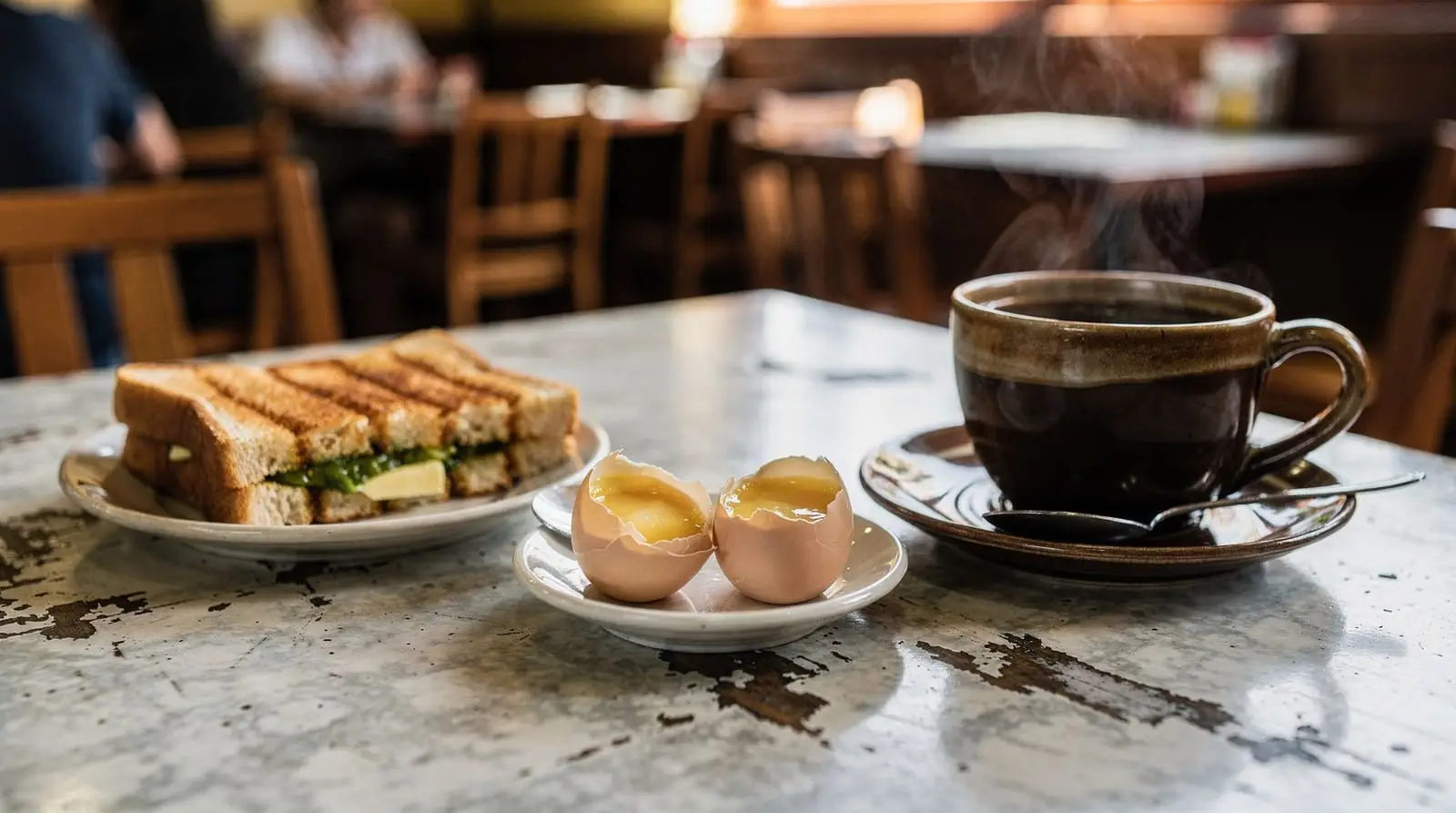
Kaya toast is thick white bread, toasted and spread with kaya (a coconut-pandan jam) and cold butter, served with soft-boiled eggs (seasoned with dark soy and white pepper) and a cup of kopi (local coffee). The complete set costs SGD 5–9. Ya Kun Kaya Toast and Killiney Kopitiam are the most reliable chains; Heap Seng Leong at North Bridge Road and specific old kopitiam (coffee shops) are the most atmospheric originals.
The Singapore breakfast that nobody skips
Kaya toast with soft-boiled eggs and kopi is so embedded in Singapore’s daily life that it appears in national museums, on commemorative postage stamps, and in virtually every food guide written about the city. It is simultaneously a quick breakfast, a morning ritual, and a piece of cultural heritage that connects contemporary Singapore to its Hainanese immigrant past.
It also costs SGD 5–9 for the complete set. Understanding what you are eating, and where to eat it well, adds something to the experience that no amount of queue-joining can substitute.
| Where | Kopitiams and chains islandwide — Ya Kun, Killiney, Chinatown, Tiong Bahru |
| Cost | around SGD 5–9 for the set (toast, 2 eggs, kopi) |
| Time needed | 20–40 minutes for the full ritual |
| Best time | 7:00–9:00am, before the lunch crowd |
| Getting there | Outlets near almost every MRT station and hawker centre |
The components
Kaya
Kaya (椰醬, also written “kaja” in some older romanisations) is a coconut-egg jam made from:
- Coconut milk
- Eggs (whole eggs or egg yolks)
- Sugar
- Pandan leaf juice
The pandan provides the characteristic green colour (in the traditional Singaporean version) and an aromatic quality — slightly floral, faintly vanilla-adjacent, unmistakably Southeast Asian. Pandan kaya is the Singapore standard; a browner, egg-forward version (closer to the Malaysian kaya) is also found and is preferred by some.
The texture is thick and smooth — it spreads like a soft butter. A thin, very precise layer on hot toast (not overloaded, not skimped) is the correct application.
Making kaya: Traditional kaya is made by double-boiling the mixture slowly while stirring constantly. The process takes 45 minutes to an hour. Many kopitiams still make their kaya in-house; the chain branches (Ya Kun, Killiney) use their own recipes. The difference between fresh-made and mass-produced kaya is detectable. This is why some older, independent kopitiams have dedicated followings.
The toast
Traditional kaya toast uses Gardenia-style white bread (soft, white, slightly sweet) — either thin sandwich slices or thick-cut bread. It is toasted on a charcoal grill at older establishments (producing slight char notes) or in a modern toaster at chain outlets.
The toast arrives as two pieces, each spread with kaya on the inside and a slice of cold salted butter between them. The contrast of hot toast, room-temperature kaya, and cold butter is intentional — the butter should not be melted when the toast arrives.
Variations:
- French toast variant: Thick bread soaked in egg and fried, served with kaya — available at some stalls
- Roti toast: Thicker artisan bread, less common, found at some newer kopitiam revivalist shops
- Kaya toast with cheese: A modern variation at some chains, not traditional
Soft-boiled eggs (half-boiled eggs)
The eggs in a traditional kaya toast set are cooked to a specific consistency: whites barely set, yolk liquid. The technique in original kopitiams was to pour boiling water over eggs in a covered container and leave them for a few minutes — a gentle set rather than hard cooking. Modern kopitiams use dedicated egg-steaming devices that maintain the consistency.
They arrive in a small bowl. The eating method:
- Crack both eggs into the bowl
- Add a few drops of dark soy sauce (provided on the table)
- Add a small pinch of white pepper
- Stir gently and eat directly with a spoon, or
- Use the liquid egg mix as a dipping sauce for the toast
Important: The traditional soft-boiled eggs in a kaya toast set are runny. If you have a health reason to avoid undercooked egg, skip this component and eat just the toast and kopi.
Kopi (coffee)
Singapore’s traditional coffee is made from robusta beans roasted in a wok with sugar and butter (or sometimes margarine) until dark and coated. The roasting style produces a different flavour profile from arabica espresso — deeper bitterness, more caramel, and a lower acidity. It is brewed by steeping in a sock-filter (a cloth bag suspended in a tall metal pot).
The result is strong and heavily sweetened with condensed milk. If you order “kopi” without modification, this is what arrives: hot, sweet, milky coffee.
The full ordering vocabulary:
- Kopi: hot, condensed milk
- Kopi-O: hot, sugar only (no milk)
- Kopi-C: hot, evaporated milk (less sweet than condensed)
- Kopi-peng: iced, condensed milk
- Kopi-O-kosong: hot, black, no sugar, no milk
- Kopi-gao: double-strength (gao = thick)
- Kopi-po: weaker (po = thin)
The teh (tea) system mirrors this exactly — teh, teh-O, teh-C, teh-peng, etc. Tea at kopitiams is Ceylon (black tea) with condensed milk — not the green tea or herbal teas found elsewhere.
Where to eat kaya toast
Ya Kun Kaya Toast
The most recognisable brand. Founded 1944 by Loi Ah Koon at the corner of Ann Siang Hill and Far East Square; current chain has approximately 60 outlets in Singapore. The flagship is at Far East Square (1 Nanson Road), retaining some original atmosphere. Branch outlets are at malls and hawker centres throughout the city.
The kaya recipe is consistent across outlets (proprietary). The toast is done on electric grills at chain outlets rather than charcoal. Coffee is brewed using the traditional sock-filter method.
Set price: SGD 7–8 for the kaya toast, two eggs, and kopi set.
Best outlet for atmosphere: Far East Square or the Chinatown (Smith Street) outlet.
Killiney Kopitiam
Founded 1919, which makes it one of the oldest operating kopitiams in Singapore. The flagship on Killiney Road (near Somerset MRT) retains an old-school interior — marble tabletops, traditional chairs, old photographs. Chain branches elsewhere.
Killiney’s kopi has a devoted following — considered by many to have a slightly more robust character than Ya Kun. The kaya recipe uses pandan; the toast is slightly thicker than Ya Kun’s standard.
Flagship: 67 Killiney Road (open 06:00–18:00 most days).
Heap Seng Leong — North Bridge Road
A genuinely old-school kopitiam (not a chain) that is often cited by food writers as one of the last authentic examples. Located at 10 North Bridge Road. Very basic, slightly rough around the edges, kopi made the traditional way. The uncle who runs it is often cited by name in profiles. Not Instagrammable in the typical sense — the draw is authenticity rather than aesthetics.
Worth visiting if: You want the closest thing to a 1970s Singapore kopitiam experience. Note it is genuinely small and informal — no menu in the modern sense, cash preferred, and seating is limited to a handful of tables, so arrive early if you want to sit rather than take away.
Tiong Bahru Market — upper floor
The wet market and food centre at Tiong Bahru (Seng Poh Road) has several excellent breakfast options including kaya toast stalls, dim sum (chee cheong fun, carrot cake), and kopi. The Tiong Bahru neighbourhood is one of the best-preserved pre-war housing estate areas in Singapore — breakfast here, then a walk through the art deco architecture, is one of the most pleasant morning combinations available in the city. See tiong bahru guide for full neighbourhood details.
Kopitiam (the brand) and various mall food courts
Most malls and office buildings have at least one kopitiam-style outlet serving kaya toast sets. The quality is consistent but lacks atmosphere. Good for a quick meal when convenience is the priority; not recommended as the primary kaya toast experience.
A guided route if you’d rather not hunt on your own
If you would prefer someone else to pick the stops and handle the ordering vocabulary on your first morning, a short guided breakfast walk covers the classics without the trial and error:
Singapore city highlights and kaya toast breakfast walk Local breakfast club — kopitiam experience with a Singaporean hostKaya toast versus other Singapore breakfast options
Singapore has no shortage of breakfast choices for visitors, and it helps to know how kaya toast stacks up against the alternatives before deciding where to spend your first morning:
| Option | Cost | Character | Best for |
|---|---|---|---|
| Traditional kopitiam kaya toast | SGD 5–7 | Authentic, unhurried, local ritual | first-timers wanting the real thing |
| Ya Kun / Killiney chain outlet | SGD 7–9 | Consistent, convenient, still genuine | reliability across the island |
| Hotel “Singapore breakfast” | SGD 18–30 | Same components, hotel-plated | those who prefer not to leave their hotel |
| Dim sum breakfast (Tim Ho Wan etc.) | SGD 15–30 | Different tradition, Cantonese | a change of pace from kaya toast |
| Western café breakfast | SGD 15–25 | Familiar, less distinctly Singaporean | jet-lagged mornings wanting something familiar |
The honest read: unless you have a specific reason to avoid it (soft-boiled egg concerns, wanting to sleep in past kopitiam hours), the traditional kopitiam set is both the cheapest and the most rewarding option on this list. For a wider look at what to eat across the rest of the day once you’ve had your kopi fix, see What to eat in Singapore.
Kaya toast as part of the Singapore food morning
The ideal sequence for a Singapore food morning:
- 07:00–08:00: Kaya toast set at a traditional kopitiam (Ya Kun flagship, Killiney, or Heap Seng Leong)
- 10:00–11:00: Walk to the nearest major hawker centre before the lunch queue builds
- 11:00–12:00: Early chicken rice or laksa before the peak crowds
This sequence gives you the two most important Singapore breakfast/brunch traditions in a single morning without competing with lunch-hour queues. For timing and logistics, the Singapore foodie itinerary provides a full day-by-day framework.
The cultural and heritage context
Kaya toast with soft-boiled eggs and kopi represents Singapore’s Hainanese immigrant heritage specifically. Hainanese men were heavily employed as cooks and stewards in British colonial households and clubs — they developed expertise in Western-adjacent food service (including white bread, which was a British introduction) and adapted it with local flavours (kaya, robusta kopi). The kopitiam (coffee shop) became the neighbourhood social hub for working-class Singapore in the 20th century.
The pandan kaya is a specifically Singaporean variation — the Malaysian version tends to be browner and egg-heavier. Singapore’s version was influenced by Peranakan cooking, which uses pandan extensively. This cross-cultural synthesis (Hainanese coffee technique, pandan from Peranakan tradition, toast from British influence) is entirely typical of how Singapore’s food culture developed.
The UNESCO recognition of hawker culture in 2020 includes the kopitiam tradition within its scope — the coffee shop as social infrastructure, not just a food venue.
Buying kaya to take home
Packaged kaya is sold at Ya Kun and Killiney outlets, at supermarkets (NTUC FairPrice, Cold Storage), and at airport departure halls. It is a legitimate and practical souvenir — shelf-stable, reasonably priced (SGD 5–8 for a jar), and genuinely representative of the Singapore food tradition.
Customs note: Most countries permit commercially packaged kaya (sealed, factory-produced) as an import. Handmade or freshly made kaya may face restrictions. Check your country’s customs rules for coconut-based products and egg-containing goods before buying.
The kaya toast ritual: why it matters beyond the food
Kaya toast is not primarily about the toast. It is about the ritual — the ordering sequence, the wait, the specific vocabulary of kopi customisation, the soft-boiled eggs cracked into a bowl and seasoned at the table. This ritual was the daily morning practice of working-class Singapore for decades before air-conditioned food courts and Instagram replaced most of it.
Eating kaya toast at a traditional kopitiam in 2026 is, in miniature, an act of cultural preservation. The younger generation of Singaporeans largely drinks third-wave specialty coffee and eats avocado toast; the uncles and aunties who still prefer kopi and kaya toast represent a continuity with the city’s immigrant past that is shrinking in real time. The kopitiam — the neighbourhood coffee shop — as a social institution is under pressure from mall development, rising rents, and changing tastes.
Several initiatives exist to preserve the kopitiam tradition: the National Heritage Board’s documentation projects, the hawker culture UNESCO nomination that explicitly includes the kopitiam tradition, and individual journalists and food writers who profile specific kopitiam owners. Eating at Heap Seng Leong or a similarly old-school kopitiam is, in a small way, participation in that preservation.
Kaya variations: beyond the standard set
Once you have eaten the standard kaya toast set — twice, at minimum, to get past the novelty — there are adjacent items worth exploring:
Kaya puff (curry puff with kaya): Some old-style bakeries sell a sweet kaya puff — choux or shortcrust pastry filled with kaya and sometimes a boiled egg. Old Chang Kee, a Singapore chain, sells curry puffs (savoury) rather than kaya puffs, but some older bakeries at Chinatown and Little India still make the sweet version.
Kueh salat: A Peranakan steamed rice cake with a green pandan-coconut custard top layer — adjacent to kaya in its flavour profile, more elaborate in preparation. Found at Peranakan kueh shops.
Pandan pancake (kueh dadar): A thin pandan crepe rolled around a filling of sweetened grated coconut. The pandan flavour is the same as kaya — the preparation is entirely different.
Ondeh-ondeh: Small glutinous rice balls filled with palm sugar and coated in grated coconut. The pandan colouring and coconut flavour are the same as kaya toast in different form. A good Peranakan kueh shop (Bengawan Solo is the most accessible chain) sells all of these.
Kaya toast as a souvenir and gift
Packaged kaya from Ya Kun (available in three flavours: original, Gula Melaka/palm sugar, and reduced-sugar) is among the most practical Singapore souvenirs. Small jars (280g) cost SGD 6–8. They keep well at room temperature for several months (check the expiry date on the jar) and are compact enough to pack in checked luggage.
At Changi Airport, Ya Kun outlets sell sealed packaged kaya and butter sets in gift packaging — convenient for last-minute buying. The airport retail shops (particularly in the departure halls) also stock Singapore-brand kaya from Prima Taste and smaller artisanal producers.
The butter used in traditional kaya toast (salted, cold, thinly sliced) can be brought home as anchor-brand salted butter from any Singapore supermarket — but this is less practical as a souvenir than the kaya itself.
For a complete picture of Singapore food-related souvenirs, see best souvenirs Singapore.
How kaya toast fits your wider food itinerary
Kaya toast is one small, cheap piece of a much bigger Singapore eating agenda. It pairs naturally with a broader hawker crawl later in the day — see Best hawker centres in Singapore and Must-try dishes in Singapore for what to eat once the sun is up and the queues have formed. If you are travelling on a tight budget, kaya toast is also one of the cheapest full meals in the city; Singapore on a budget has more on stretching a Singapore food budget without sacrificing quality. And if you want the full ordering etiquette for hawker-style dining beyond the kopitiam counter, Hawker centre etiquette covers the unwritten rules.
First-time visitor guide: what to do on your first morning
The best possible use of your first morning in Singapore — assuming you arrive the evening before and have recovered from jet lag:
- Wake up at 07:00–07:30 (jet lag may help with this in the direction of Europe → Singapore)
- Walk to the nearest traditional kopitiam — Google Maps will show you local options within 10–15 minutes
- Order: kaya toast set, two soft-boiled eggs, kopi (or teh) — specify your kopi type if you have one, or just say “kopi” for the default
- Eat slowly, season the eggs at the table, watch the morning activity around you
- Pay SGD 7–9 and walk to the nearest MRT station
This sequence costs less than the cheapest hotel breakfast and gives you an immediate, unmediated encounter with Singapore’s daily life. The quality of a genuine kopitiam set is higher than it sounds — the kaya on charcoal-toasted bread with cold butter and a properly brewed kopi is a genuinely good breakfast by any standard, not just an interesting local experience.
Frequently asked questions about kaya toast and kopi in Singapore
How much does a kaya toast set cost?
At Ya Kun and Killiney chain outlets: SGD 7–9 for the set (kaya toast, two eggs, one drink). At independent kopitiams: SGD 5–7 for equivalent. In high-end hotels that offer a “Singapore breakfast” version: SGD 18–30. The kopitiam version is the authentic experience at the correct price.
Is kaya vegetarian?
The kaya jam itself contains eggs — it is not vegan. It is vegetarian (lacto-ovo). The toast is bread (vegetarian). The soft-boiled eggs obviously contain eggs. The kopi/teh is made with condensed or evaporated cow’s milk unless you specify kopi-O or teh-O.
What is the difference between pandan kaya and Hainanese kaya?
Pandan kaya (the Singapore version) uses pandan leaf juice, giving it a green colour and distinctive floral aroma. Hainanese kaya (as made in some Malaysian versions) uses caramelised sugar and eggs without pandan — it is browner, more intensely eggy, and lacks the pandan fragrance. Singapore-style kopitiam kaya is almost always pandan.
Can I get kaya toast at Changi Airport?
Yes — Ya Kun has outlets in multiple Changi Airport terminals, including the airside (post-security) zones. This is a legitimate and convenient option for a final Singapore breakfast before departure, or for a transit meal if you have a Changi layover. See changi layover guide for what is available during a transit.
What is the traditional glassware for kopi?
Traditional kopitiam kopi and teh are served in thick glass cups (not mugs) — the glass retains heat while allowing you to see the colour of the drink. Iced versions (peng) come in larger glasses with ice. The saucer under the glass is part of the presentation. Some Singaporeans pour hot kopi into the saucer to cool it before drinking — a practice that is traditionally acceptable at old-school kopitiams.
Are there any Michelin-recognised kaya toast spots?
Ya Kun and Killiney both appear in Michelin’s Bib Gourmand lists for Singapore’s street food category. The recognition is for the overall experience — quality, consistency, and price — rather than technical complexity.
The kaya toast ritual: why it matters beyond the food
Kaya toast is not primarily about the toast. It is about the ritual — the ordering sequence, the wait, the specific vocabulary of kopi customisation, the soft-boiled eggs cracked into a bowl and seasoned at the table. This ritual was the daily morning practice of working-class Singapore for decades before air-conditioned food courts and Instagram replaced most of it.
Eating kaya toast at a traditional kopitiam in 2026 is, in miniature, an act of cultural preservation. The younger generation of Singaporeans largely drinks third-wave specialty coffee and eats avocado toast; the uncles and aunties who still prefer kopi and kaya toast represent a continuity with the city’s immigrant past that is shrinking in real time. The kopitiam — the neighbourhood coffee shop — as a social institution is under pressure from mall development, rising rents, and changing tastes.
Several initiatives exist to preserve the kopitiam tradition: the National Heritage Board’s documentation projects, the hawker culture UNESCO nomination that explicitly includes the kopitiam tradition, and individual journalists and food writers who profile specific kopitiam owners. Eating at Heap Seng Leong or a similarly old-school kopitiam is, in a small way, participation in that preservation.
Kaya variations: beyond the standard set
Once you have eaten the standard kaya toast set — twice, at minimum, to get past the novelty — there are adjacent items worth exploring:
Kaya puff (curry puff with kaya): Some old-style bakeries sell a sweet kaya puff — choux or shortcrust pastry filled with kaya and sometimes a boiled egg. Old Chang Kee, a Singapore chain, sells curry puffs (savoury) rather than kaya puffs, but some older bakeries at Chinatown and Little India still make the sweet version.
Kueh salat: A Peranakan steamed rice cake with a green pandan-coconut custard top layer — adjacent to kaya in its flavour profile, more elaborate in preparation. Found at Peranakan kueh shops.
Pandan pancake (kueh dadar): A thin pandan crepe rolled around a filling of sweetened grated coconut. The pandan flavour is the same as kaya — the preparation is entirely different.
Ondeh-ondeh: Small glutinous rice balls filled with palm sugar and coated in grated coconut. The pandan colouring and coconut flavour are the same as kaya toast in different form. A good Peranakan kueh shop (Bengawan Solo is the most accessible chain) sells all of these.
Kaya toast as a souvenir and gift
Packaged kaya from Ya Kun (available in three flavours: original, Gula Melaka/palm sugar, and reduced-sugar) is among the most practical Singapore souvenirs. Small jars (280g) cost SGD 6–8. They keep well at room temperature for several months (check the expiry date on the jar) and are compact enough to pack in checked luggage.
At Changi Airport, Ya Kun outlets sell sealed packaged kaya and butter sets in gift packaging — convenient for last-minute buying. The airport retail shops (particularly in the departure halls) also stock Singapore-brand kaya from Prima Taste and smaller artisanal producers.
The butter used in traditional kaya toast (salted, cold, thinly sliced) can be brought home as anchor-brand salted butter from any Singapore supermarket — but this is less practical as a souvenir than the kaya itself.
For a complete picture of Singapore food-related souvenirs, see best souvenirs Singapore.
First-time visitor guide: what to do on your first morning
The best possible use of your first morning in Singapore — assuming you arrive the evening before and have recovered from jet lag:
- Wake up at 07:00–07:30 (jet lag may help with this in the direction of Europe → Singapore)
- Walk to the nearest traditional kopitiam — Google Maps will show you local options within 10–15 minutes
- Order: kaya toast set, two soft-boiled eggs, kopi (or teh) — specify your kopi type if you have one, or just say “kopi” for the default
- Eat slowly, season the eggs at the table, watch the morning activity around you
- Pay SGD 7–9 and walk to the nearest MRT station
This sequence costs less than the cheapest hotel breakfast and gives you an immediate, unmediated encounter with Singapore’s daily life. The quality of a genuine kopitiam set is higher than it sounds — the kaya on charcoal-toasted bread with cold butter and a properly brewed kopi is a genuinely good breakfast by any standard, not just an interesting local experience.
Top experiences
Bookable activities with verified prices and instant confirmation on GetYourGuide.

Singapore: Chinatown hawkers food tour with 7 tastings

Singapore: UNESCO hawker culture Chinatown food tasting tour

Singapore: Little India, Tekka Centre and food tastings tour

Singapore: Katong local food and city highlights tour

Singapore: Lau Pa Sat night street food with Marina Bay walk