Fort Canning
Fort Canning Hill spans Malay kings to WW2 surrender. The Battlebox underground bunker is Singapore's most honest and affecting paid heritage experience.
Singapore: Fort Canning 2-hour guided walking tour
Duration: 2h
Quick facts
- MRT access
- Fort Canning (Downtown Line) — exit leads directly to the hill base
- Hill entry
- Free, open 24 hours; 10 themed heritage gardens
- Battlebox
- WW2 command bunker tours, SGD 27 adults; pre-booking required
- Walking time
- Summit in ~10 min from the Hill Street entrance; hill loop ~45 min
- Setting
- Forested hill in the heart of the civic district, largely peaceful even at peak hours
| Where | Fort Canning MRT (Downtown Line), 10 min walk from Clarke Quay |
| Cost | Hill free; Battlebox tour around SGD 27/adult |
| Time needed | Half a day, including a Battlebox tour |
| Getting there | Direct MRT exit at the hill’s north base, or 15 min walk from City Hall |
| Best time | Early morning (7–9 am) for the coolest, quietest hill visit |
Fort Canning Hill is the most historically layered spot in Singapore — a 63-metre hill that has served successively as the seat of Malay kings, the site of Raffles’ first residence, a British colonial fort and cemetery, and the subterranean command centre from which the fall of Singapore was directed in February 1942. It is also one of the city’s best free green spaces. The Battlebox underground bunker is the most sobering and most worthwhile paid attraction in the entire civic district area.
The hill itself — free and underused
Fort Canning Park covers 18 hectares on the hill. The main entrance from the Civic District side is via the Gothic gate on Canning Rise (10 min walk from City Hall MRT); the Fort Canning MRT station (Downtown Line) has a direct exit at the base of the hill’s north slope.
What is up there (all free):
Fort Canning Lighthouse — the squat white lighthouse at the summit has been a Singapore landmark since 1903. No longer operational, but the summit area gives a clear 360-degree view over the surrounding rooftops, with a particularly good angle toward the Civic District and the Singapore River below.
Spice Garden — a recreation of Raffles’ 1822 experimental botanical garden, which introduced nutmeg, cloves, pepper, and other spice plants to the hill. Modest but well-maintained. Raffles was attempting to break the Dutch spice monopoly; the garden was eventually abandoned and the spice trade moved elsewhere, but the idea was consequential.
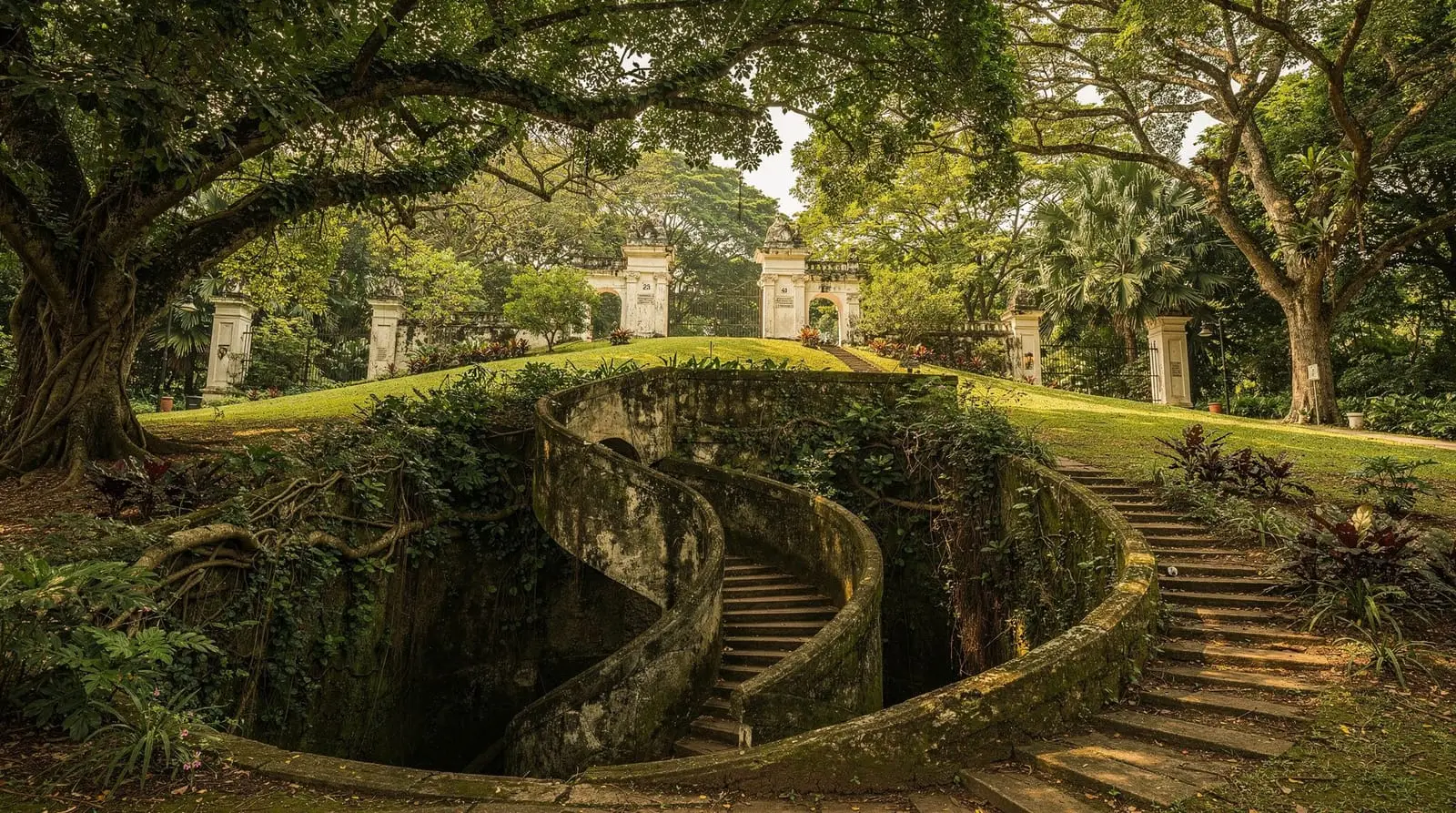
Fort Gate — the restored stone gate from the original British fort, dating to 1846. One of the few surviving elements of the colonial fortification.
Keramat Iskandar Shah — a Malay shrine at the top of the hill, believed to mark the burial site of the last king of ancient Singapore (Iskandar Shah, 14th century). The shrine is a genuine active religious site, not a tourist installation — treat it accordingly.
Heritage Walk plaques throughout the park connect the historical layers: pre-Raffles Malay settlement, colonial administration, WW2 use.
The Battlebox — why it matters
In the basement of Fort Canning, dug 9 metres into the hillside, is the Battlebox — the British military command bunker from which Lieutenant General Arthur Percival coordinated the defence of Singapore before surrendering to the Japanese on 15 February 1942. Singapore’s fall was one of the worst military defeats in British history; roughly 85,000 Allied soldiers became prisoners of war.
The bunker was sealed after the war and rediscovered in 1988. It has been preserved and developed as a heritage attraction that tells the story of the last days of the Malaya Campaign with considerable honesty — not triumphalist, not whitewashed.
The guided tours use the original rooms: the signals room, the operations room, the cipher room, and the room where the final conference to discuss surrender was held. Life-size figure recreations and audio dramatisations convey the atmosphere of those final hours. It is more affecting than most military museums because the physical space is real and unchanged.
Fort Canning Hill and Battlebox history tour — 2.5 hours with guided underground bunker accessThe Battlebox story of strategy and surrender tour focuses specifically on the command decisions and the final surrender itself — recommended for visitors with a particular interest in WW2 military history. Both tours require pre-booking and run at fixed times; capacity is limited.
Adult prices: approximately SGD 27 (Battlebox entry and tour). The site is managed by the National Heritage Board. No children under 6 are admitted.
Sang Nila Utama — the mythological origin
Fort Canning Hill’s earliest recorded significance is as the site of the legendary founding of Singapura (Sanskrit for “Lion City”) by a Srivijayan prince, Sang Nila Utama, in the late 14th century. According to the Malay Annals (Sejarah Melayu), he landed on the island, saw an animal he took to be a lion (probably a Malayan tiger — there were no native lions), and considered this an auspicious sign. The name “Singapore” derives from this event.
The Malay kings who ruled this settlement (five in total, according to the Annals) are believed to have lived on the hill. The Keramat Iskandar Shah shrine marks the burial site of the last of them — he was eventually driven out by a Majapahit attack from Java in the 1390s and retreated north to found the Malacca Sultanate, which became the dominant power of the Malay world for the following century.
This pre-colonial history is genuinely ancient by Singapore standards and easy to overlook because the 19th-century colonial and 20th-century WW2 layers are so dominant. The Fort Canning walking tour connects these threads if you want the full picture.
The guided walk option
The Fort Canning 2-hour guided walking tour covers the hill’s above-ground history without entering the Battlebox — useful for visitors who want the full Malay kingdom to colonial arc without the WW2-specific focus. It covers the Keramat shrine, the Spice Garden, the fort gate, and the colonial cemetery. Good introduction before a Battlebox visit, or as a standalone.
For a broader walking tour of the Civic District and surrounding area, the best walking tours in Singapore guide has options combining Fort Canning with the colonial district below.
Fort Canning events
The Fort Canning Green (the grassy amphitheatre area on the slope) hosts regular concerts, theatre performances, and public events — Fort Canning Live is an annual outdoor music series, and Shakespeare in the Park runs periodically. Check the calendar before your visit; attending a performance in this setting is genuinely pleasant.
The annual Sentosa Spooktacular (Halloween) event has also been hosted on the hill. The green is also the setting for outdoor film screenings during certain festivals.
The colonial cemetery
The Fort Canning Christian Cemetery (open area on the western slope) holds the graves of European colonists who died in early colonial Singapore, from 1822 to 1865. Approximately 600 people were buried here; the stones were later removed and used as construction material (as was common practice), with the inscriptions preserved as wall-mounted plaques. The cemetery is simultaneously a functioning heritage site and a pleasant, quiet garden area with mature trees.
Combining Fort Canning with the surrounding area
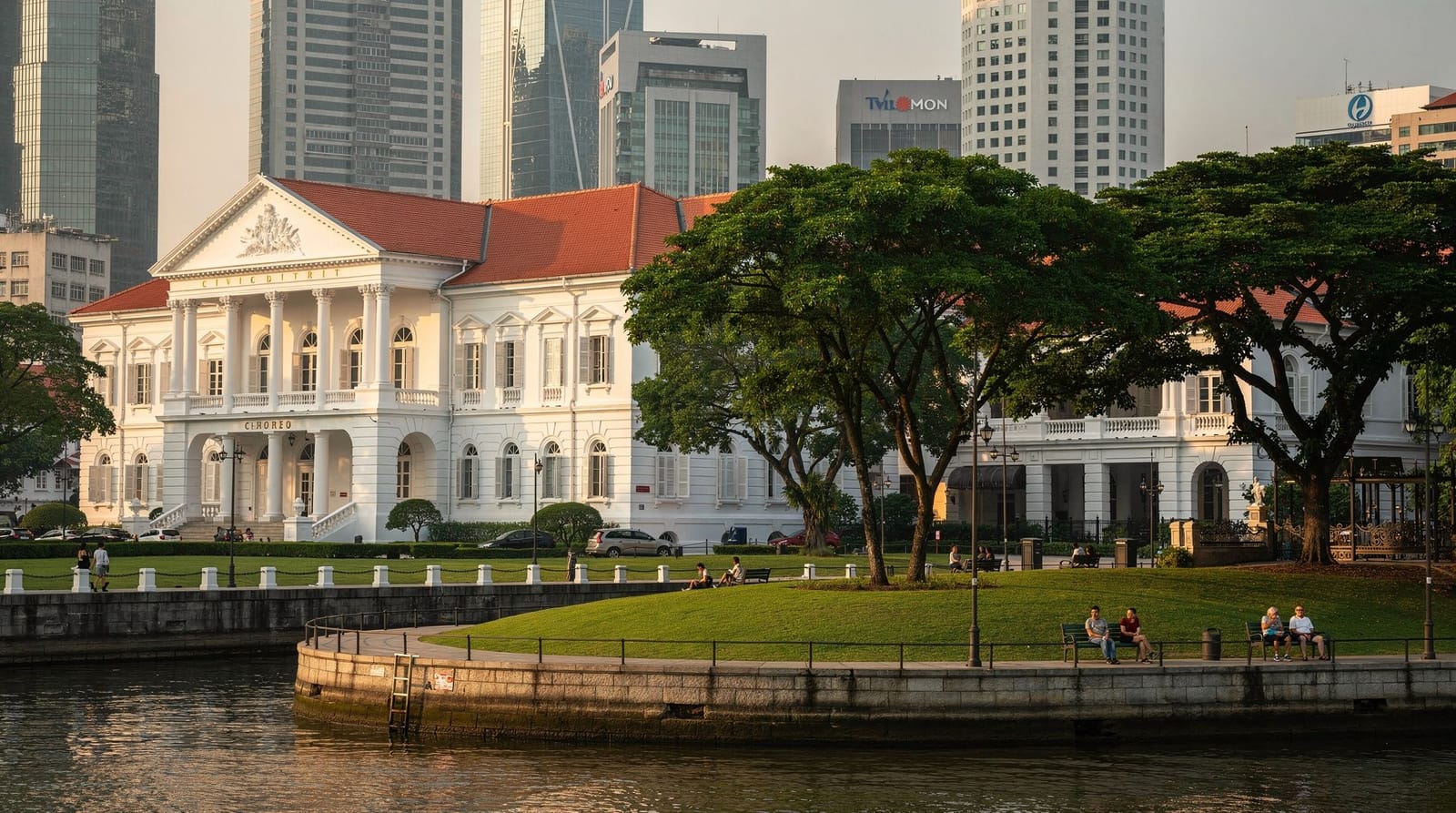
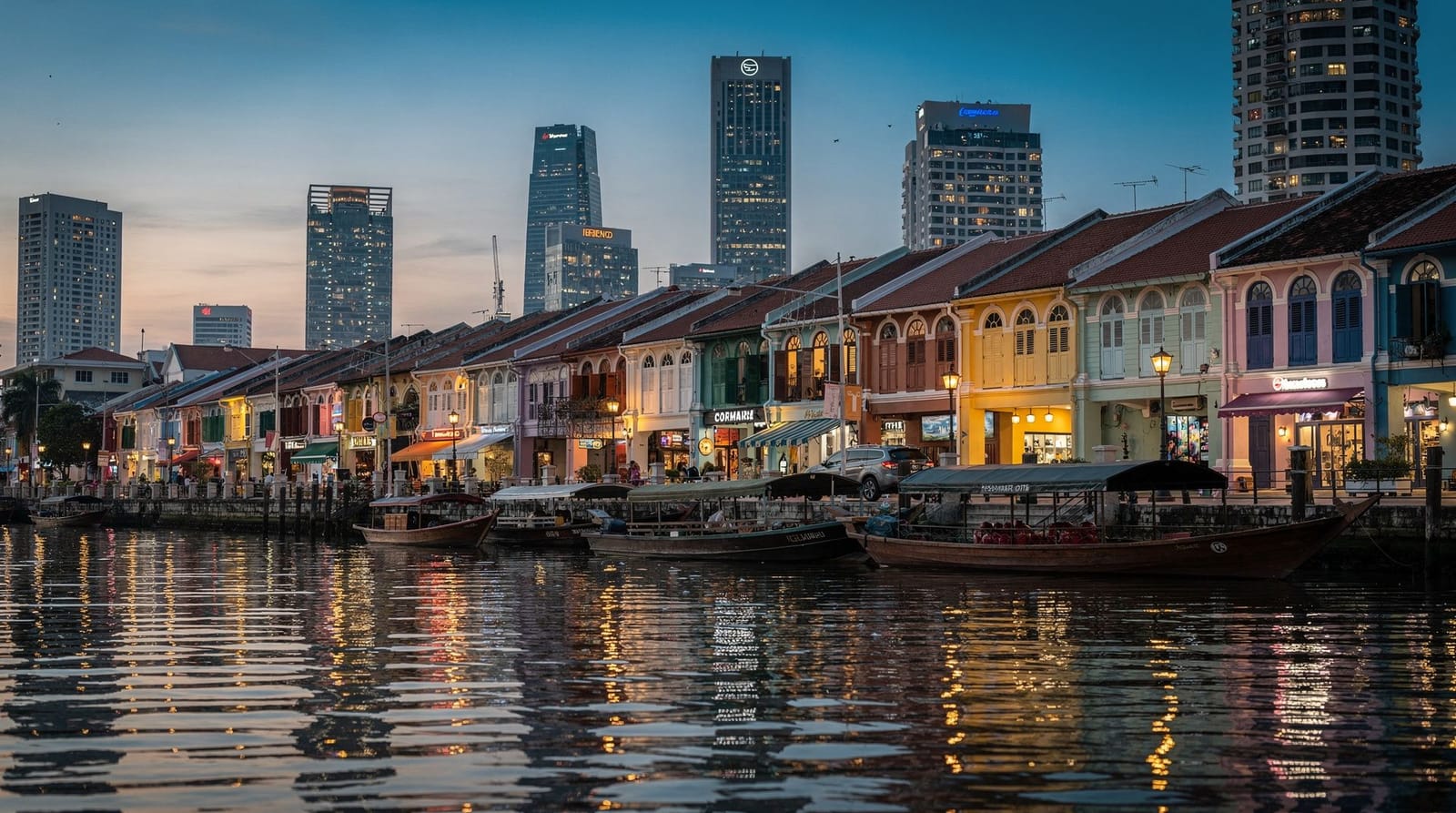
Fort Canning sits between three other significant areas: the Civic District (10 min walk east/south), Clarke Quay (10 min walk south to the river), and Orchard Road (15 min walk north/west). This central position makes it a logical connector rather than a standalone destination.
A practical morning itinerary: arrive at Fort Canning MRT at 9 am, walk up the hill, visit the Spice Garden and summit, take the 10 am or 11 am Battlebox tour, then walk down to the Civic District for the National Gallery in the afternoon. This covers the historical arc from colonial Fort Canning to the National Gallery’s Southeast Asian collections.
For Singapore in one day, Fort Canning can replace one of the paid attractions in favour of a free morning green space experience. See also the Singapore for kids itinerary — children enjoy the hill climb and the non-violent aspects of the Battlebox story if they are old enough (the recommended minimum is around 8–10 years old).
Each neighbour has its own pace. The Civic District is where the colonial buildings and museums cluster, so it pairs naturally with the hill’s history. Clarke Quay and the riverside suits a late lunch or an evening drink once the climb is done. Orchard Road is the place to head if you want air-conditioning and shops after a morning outdoors. For the museum leg of the day, the National Gallery guide and the National Museum guide help you decide which one deserves your afternoon. If the weather turns, the rainy-day itinerary shows how to swap the open-air parts of the hill for indoor stops.
The fall of Singapore — context for the Battlebox
Understanding why the Battlebox matters requires some historical context. The British defence of Malaya and Singapore in 1941–42 was one of the most comprehensive Allied failures of the Second World War. The Japanese invasion from Thailand, which began on 8 December 1941 (same day as Pearl Harbor, though the Malay Peninsula attack came first due to time zones), swept down the Malay Peninsula in 55 days — a campaign that General Yamashita Tomoyuki executed with roughly 30,000 troops against a defending force that ultimately numbered over 85,000 British, Indian, and Australian soldiers.
The British strategic error was almost total: fixed defences oriented toward a naval attack from the south, inadequate air cover, poor supply lines, and command decisions made in the Fort Canning bunker with incomplete intelligence. The surrender on 15 February 1942 — Chinese New Year of that year — was the largest capitulation in British military history. Churchill called it “the greatest disaster and capitulation of British history.”
Singapore spent 3.5 years under Japanese occupation (called Syonan-to, “Light of the South”), ending with Japan’s surrender in August 1945. The British colonial administration returned briefly but the psychological and political authority of colonial rule never fully recovered. The fall of Singapore is widely considered a catalyst for the broader decolonisation of Southeast Asia.
The Battlebox tells this story from inside the command structure. Visiting it is one of the more honest heritage experiences Singapore offers — neither triumphalist nor unnecessarily grim, but historically frank.
Live events and performances at Fort Canning
Fort Canning Green hosts Singapore’s best outdoor performance venue. The amphitheatre-style lawn with the hill as a backdrop has been used for Fort Canning Live (annual music series), Shakespeare in the Park (Singapore Repertory Theatre), Ballet Under the Stars, and multiple international touring acts. Events are concentrated in March–May and September–November, avoiding the wettest monsoon months.
Tickets for performances typically run SGD 30–100 depending on the act. Bring a picnic mat — BYO food and drinks is standard practice at outdoor Fort Canning events. The atmosphere on a clear evening with the city skyline visible above the trees is one of the more pleasant entertainment settings in the region.
Practical information
Fort Canning MRT (Downtown Line): exit directly at the north base of the hill. Follow signs to the park entrance; the hill path is clearly marked.
City Hall MRT alternative: walk north along St Andrew’s Road, then up Canning Rise — about 15 minutes total. This approach gives a better view of the colonial buildings en route.
Opening hours: the park is open 24 hours. Toilets are available near the main summit area.
Facilities: no food stalls on the hill itself. Nearest options are at Clarke Quay (south), the Dhoby Ghaut area (north), or bring water from any 7-Eleven near the MRT stations.
Weather: the hill has good tree cover but open areas get hot. Early morning visits are considerably more comfortable.
Walking to Fort Canning from Clarke Quay
The 10-minute walk from Clarke Quay to Fort Canning is one of the better short urban walks in Singapore. The route goes north from Clarke Quay MRT along River Valley Road or Hill Street, through the conservation shophouse area of Mohamed Sultan Road, and up to the park entrance. Along the way you pass through a quietly residential stretch that contrasts with both the riverside bar district below and the civic institutions above.
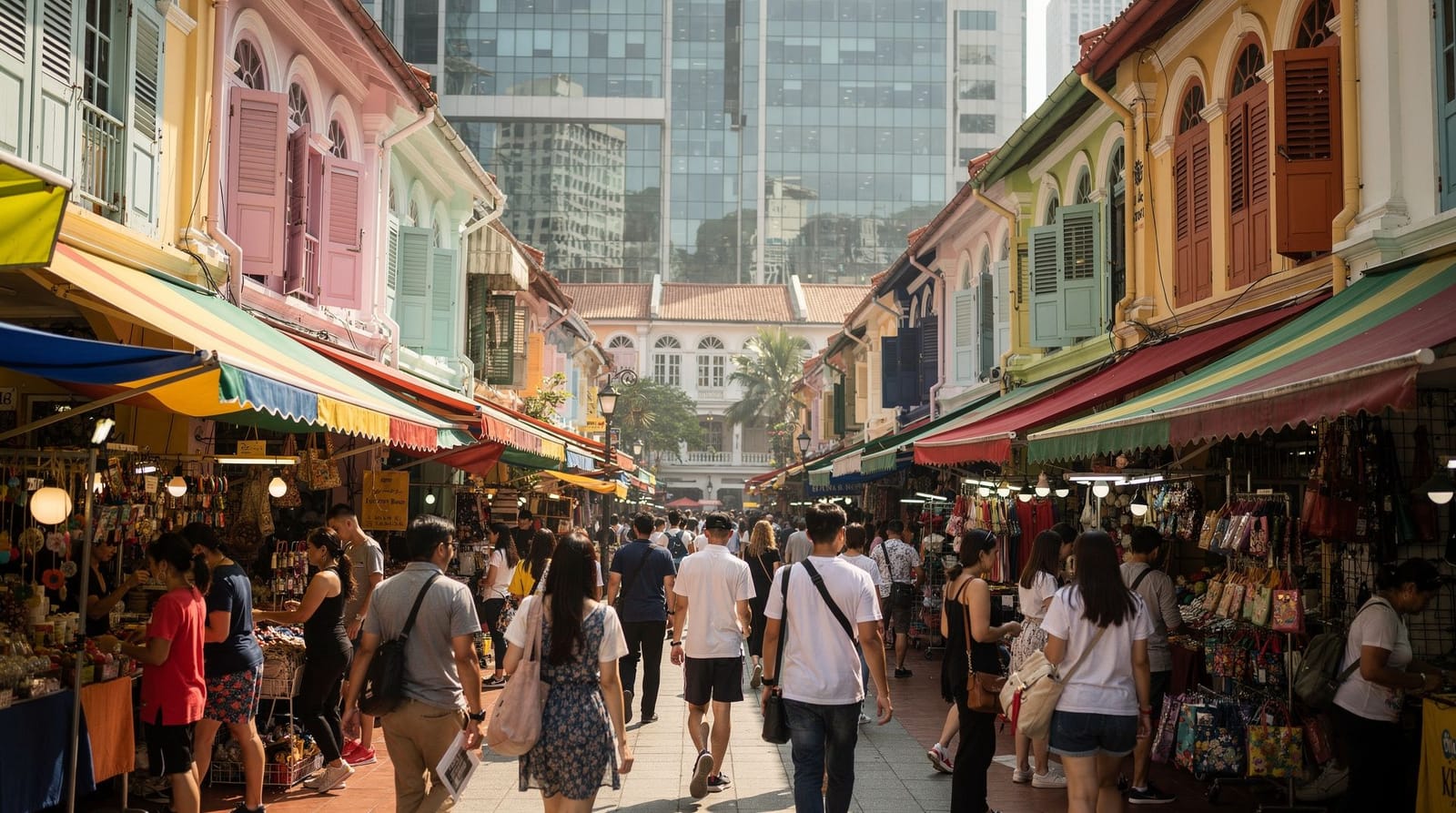
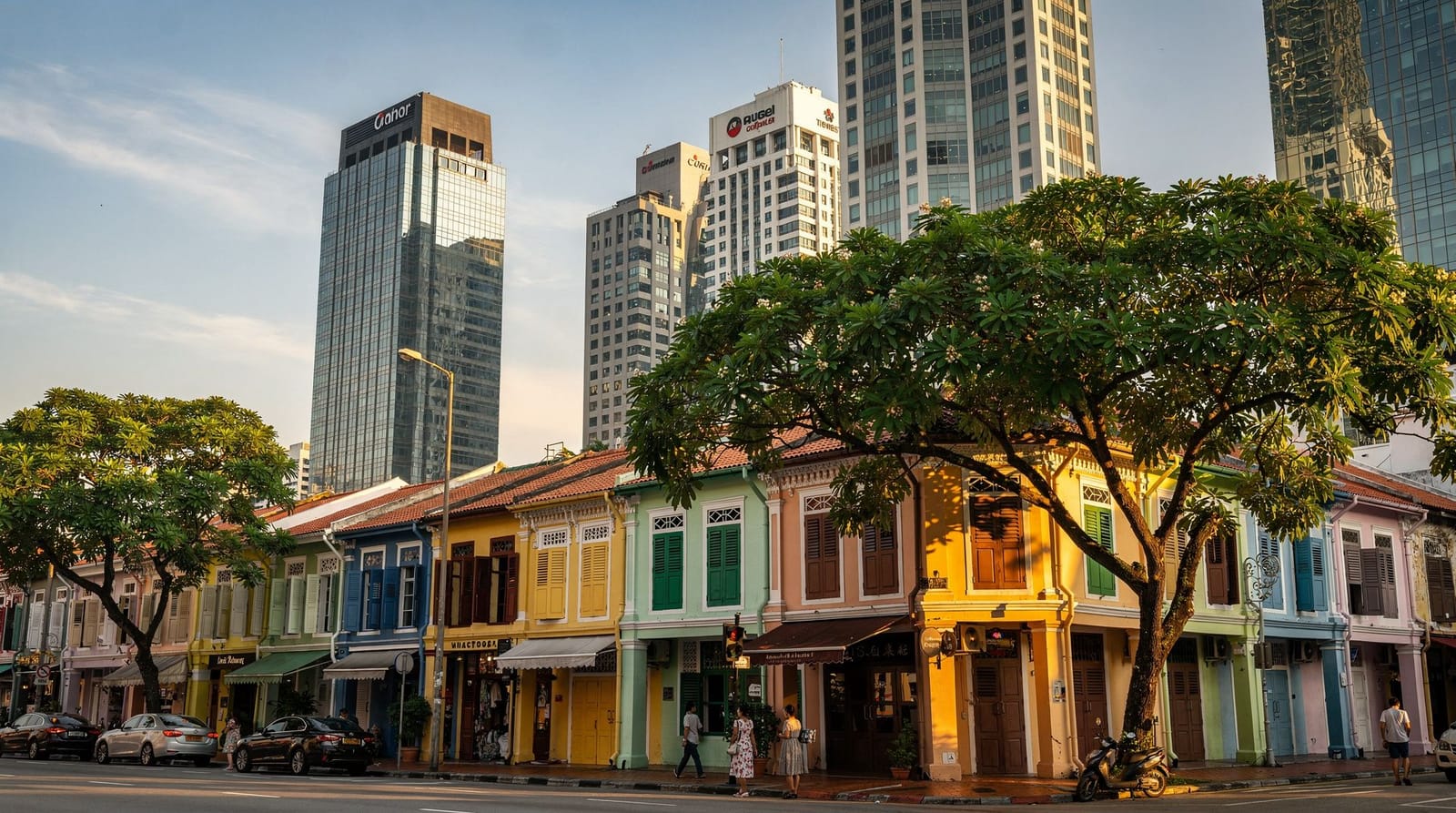
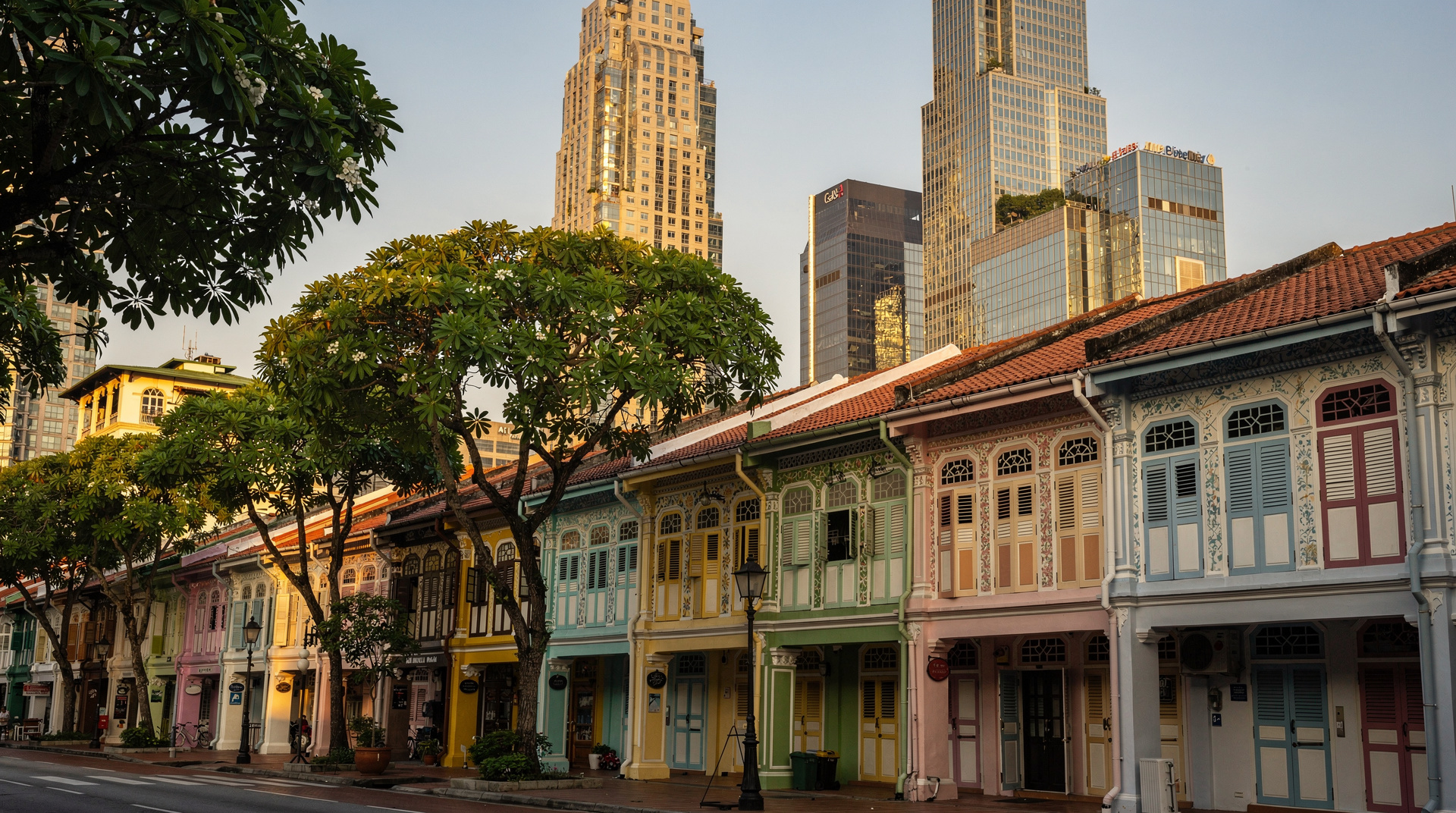
Hill Street itself has a line of conservation shophouses painted in vivid stripes — one of Singapore’s more photographed streetscapes, often used in tourism imagery. The Central Fire Station (built 1908) at the corner of Hill Street is the oldest functioning fire station in Singapore, still operational, and architecturally notable in a Baroque-influenced colonial style. Both are on the walking route between Clarke Quay and Fort Canning and worth a brief stop.
For visitors who want free things to do
Fort Canning Hill is one of the strongest entries on any Singapore free-activities list: no entry fee, open 24 hours, ten themed gardens, a summit view, and a genuine historical narrative running through it — the Battlebox is the only paid element. If your Singapore budget is tight, the hill alone (skip the Battlebox) is a full, satisfying morning. The free things to do in Singapore guide covers Fort Canning alongside the city’s other no-cost attractions, and the colonial Singapore guide puts the hill’s fort and cemetery in context with the wider colonial-era sites across the city.
Fort Canning versus other WW2 sites in Singapore
Singapore has several WW2-related attractions, and the Battlebox is widely considered the strongest of them for depth of storytelling, because the physical space — the actual bunker rooms — survives largely intact. Other sites tend to be reconstructed museums or memorial markers rather than the original operational space. If you can only fit one WW2 site into a Singapore trip, the Battlebox is the one to prioritise; pair it with the broader Singapore history guide for the fuller national story before or after your visit.
Frequently asked questions about Fort Canning
Is the Fort Canning Battlebox worth visiting?
Yes, if you have any interest in WW2 history or the specific story of the fall of Singapore. It is one of the more honest and affecting military heritage sites in the region. The physical reality of the bunker and the quality of the tour materials justify the admission cost. If WW2 history is not your focus, the hill itself is free and worth a 45-minute walk regardless.
Do I need to book the Battlebox in advance?
Yes. Tours run at fixed times with limited capacity. Walk-up entry is sometimes possible but not guaranteed. Advance booking is strongly advised, especially on weekends and during school holidays.
Can children visit the Battlebox?
Children under 6 are not admitted. For children aged 6–12, the experience can be intense — the dramatisations are realistic and the themes include military defeat and imprisonment. Parental judgment required. The outdoor hill and gardens are entirely family-friendly.
Is Fort Canning good for a morning walk or run?
Very much so. The paved paths are used daily by local joggers and walkers, especially before 9 am when the heat is manageable. The loop around the hill takes about 30–45 minutes at a walking pace. There are outdoor exercise stations at several points.
How does Fort Canning connect to the rest of the city?
Fort Canning MRT (Downtown Line) connects directly to Bugis (2 stops east), Little India (3 stops east), and Promenade/Marina Bay direction (south). The hill is also walkable from Clarke Quay (10 min), the Civic District (10 min), and Orchard Road (20 min via the hill’s north slope to Penang Road).
Is Fort Canning worth it if I only have one day in Singapore?
It depends on your priorities. For a first and only day, the Civic District, Marina Bay, and Gardens by the Bay usually take precedence — see the Singapore in one day itinerary for how Fort Canning fits as an optional early-morning add-on before those bigger sights. If WW2 history is a specific interest, it’s worth prioritising even on a tight schedule.
What should I combine with a Fort Canning visit?
Clarke Quay (10 minutes downhill) works well for lunch or an evening after a morning at Fort Canning, and the Civic District’s museums are a short walk in the other direction. The best walking tours in Singapore guide lists guided options that link Fort Canning with the surrounding colonial district for a fuller half-day route.
Top experiences
Bookable activities with verified prices and instant confirmation on GetYourGuide.