Best walking tours in Singapore: neighbourhood guides by foot
Singapore: private walking tour with a local
Are walking tours worth it in Singapore?
Yes — Singapore rewards foot travel far more than many visitors expect. A private walking tour with a local guide (SGD 70–150 for 2–3 hours) covers depth and neighbourhood context that buses and ride-hailing skip entirely. Free walking tours exist in the colonial district. The ethnic quarters — Chinatown, Little India, Kampong Glam — are compact and make excellent self-guided walks. For a first visit, a 2–3 hour guided walk pays back significantly in contextual understanding.
Quick answer: Walking tours are one of the best ways to understand Singapore’s layered history and culture. For maximum depth, hire a private local guide (SGD 70–150 for 2–3 hours). For free or low-cost alternatives, the STB Journeys app and NHB heritage walks are excellent. The ethnic quarters — Chinatown, Little India, Kampong Glam — reward self-guided exploration with a good guide in hand.
| Cost (guided) | SGD 70–150/person, or SGD 150–300 private |
| Cost (self-guided) | Free (STB Journeys app, NHB brochures) |
| Time needed | 2–3 hours per neighbourhood |
| Best time | 8:30–11:30 am, or 4:30–7:00 pm |
| Getting there | MRT to each district, then on foot |
Why walking tours work well in Singapore
Singapore is smaller than many visitors expect — the central tourist areas cover a compact geography that rewards walking. More importantly, Singapore’s heritage is architectural and street-level: colonial shophouses, Hindu temples, mosques, and traditional medical halls that reveal themselves only when you slow down and look closely.
A moving vehicle (bus or taxi) misses the temple doorways, the incense smoke from clan associations, the century-old trade signs above shop fronts, and the street hawker who has been selling the same dish for 40 years. A walking tour finds all of these.
Singapore also has well-maintained shaded walkways, cooling tree canopies in the heritage districts, and enough air-conditioned detours (coffee shops, shops, museums) to make walking manageable even in the heat — if you time it correctly.
Private walking tours with a local
A private walking tour with a local Singaporean guide is the most efficient way to gain contextual understanding of Singapore’s neighbourhoods in a short visit.
What it costs: Private group tours (for 2–6 people, single flat price) typically run SGD 150–300 for 2–3 hours. Per-person rates on group walking tours run SGD 70–120 per adult. Rates vary significantly by guide, specialisation, and duration.
What a good local guide adds:
- Personal history and family stories that connect the heritage to living memory
- Access to spots not on standard tourist maps — the back alley temple, the old coffeeshop where locals still eat, the shophouse interior visible only to those who know to ask
- Current neighbourhood context — what has changed, what has survived, what the community thinks of the tourism
- Language connections to shop owners and hawkers
Specialist walking tours available in Singapore:
- Colonial and civic district heritage
- Chinatown food and heritage
- Peranakan culture (Katong/Joo Chiat area — see Katong and Joo Chiat)
- Little India and Tamil heritage
- Kampong Glam and Malay-Muslim heritage
- Ghost walk / night heritage tours
Almost nothing standing here predates the 1970s outside the conservation districts, so a walking tour lives or dies on what the guide can point at and explain: a history and culture highlights walk is built around the surviving fabric rather than around a route.
Free walking tours in Singapore
Singapore Tourism Board Journeys app: The STB’s Journeys mobile app provides self-guided walking routes with audio commentary for the colonial district, Chinatown, and several other heritage zones. Free to download and use. The audio quality and historical content are good for a government-produced resource.
National Heritage Board tours: The NHB runs guided heritage walks on selected weekends, often free or low-cost. These cover the civic district, ethnic quarters, and occasionally more specialist routes (Singapore’s wartime heritage, colonial trading history). Check the NHB website for the current calendar.
Tip-based free tours: Several commercial operators run tip-based (pay-what-you-want) walking tours of the colonial district and Chinatown. These typically depart from Raffles Hotel or the Merlion area and run 2–2.5 hours. The guides are generally knowledgeable; the tip is at your discretion. Look for postings at hostels and tourism boards.
The best walking routes by neighbourhood
Colonial Civic District (2–3 hours, 3–4 km)
This is Singapore’s most architecturally coherent walking route — the legacy of Raffles’ 1823 town plan.
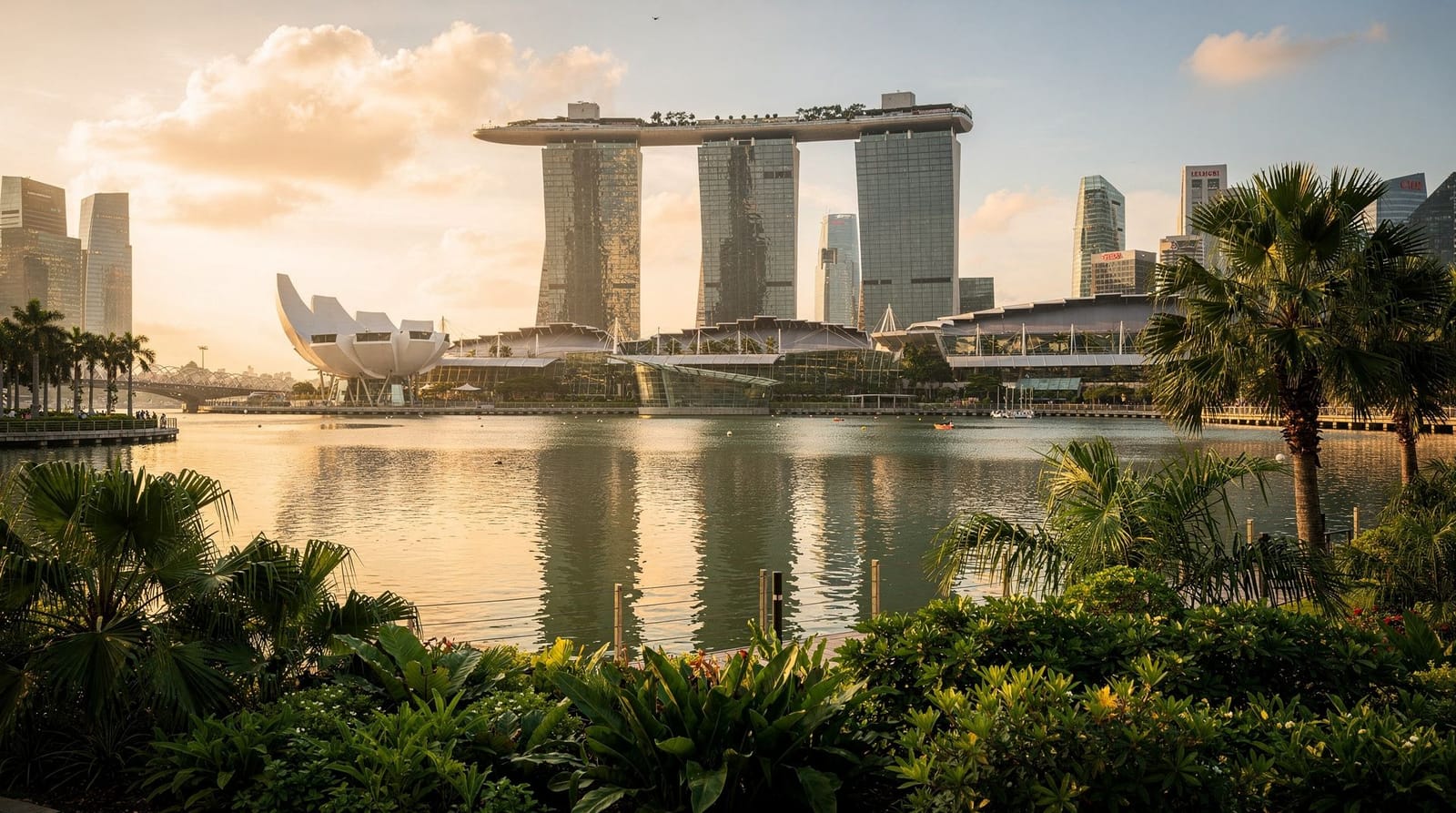
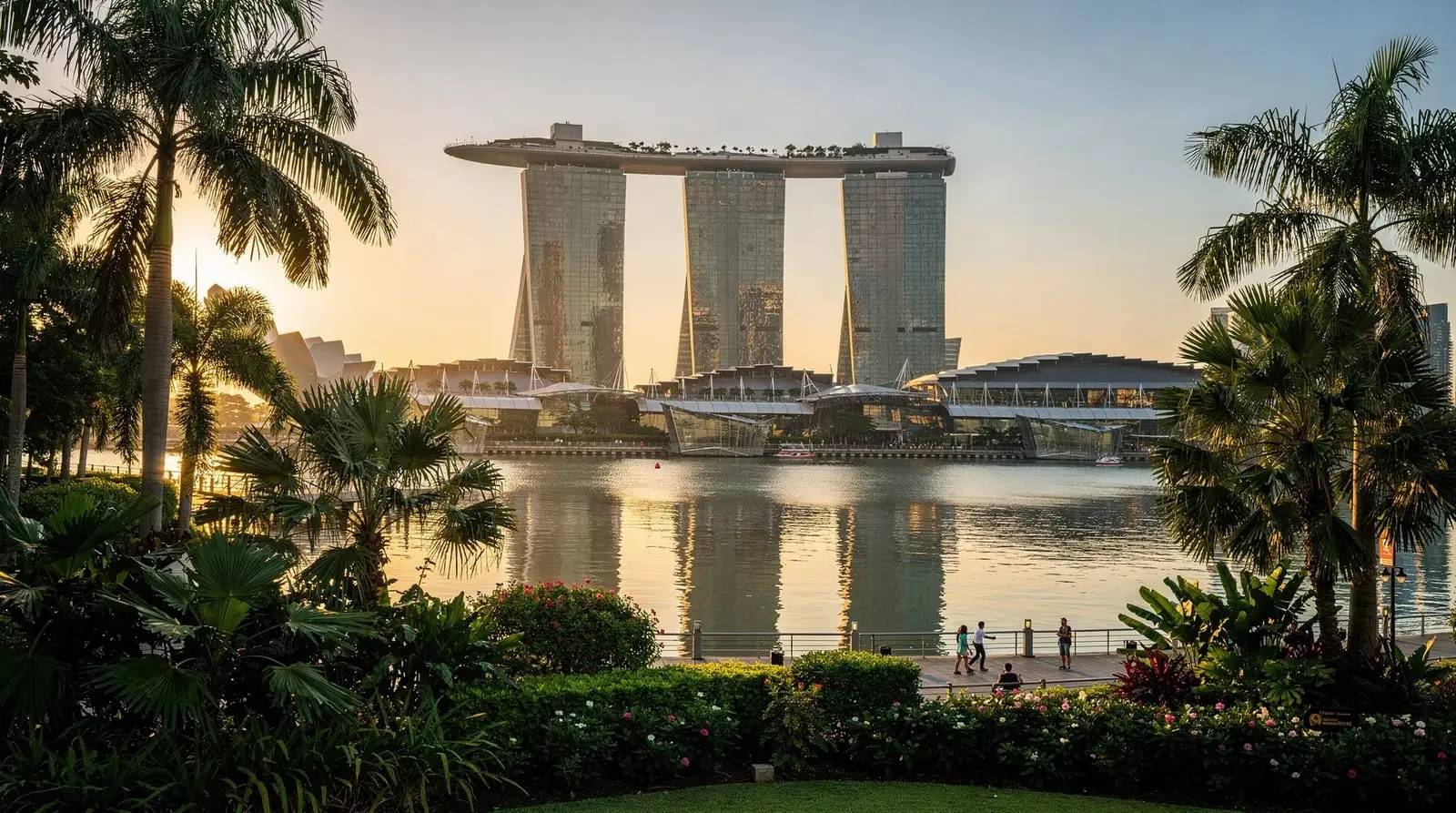
Starting point: Raffles Hotel (North Bridge Road) Route: Raffles Hotel → St. Andrew’s Cathedral → Padang (the cricket ground, still in use) → City Hall and Supreme Court (now National Gallery Singapore) → Old Parliament House (now The Arts House) → Cavenagh Bridge → Boat Quay riverside → Merlion Park → Esplanade Theatres by the Bay
What you see: The full sweep of British colonial civic architecture, the restored Singapore River, and the juxtaposition of colonial grandeur against the modern CBD towers. The Merlion Park guide covers the endpoint in detail.
Best time: 9:00 am start before the heat builds. The Padang and river walk have limited shade.
Singapore’s old colonial district walking tourChinatown (2–3 hours, 2–3 km)
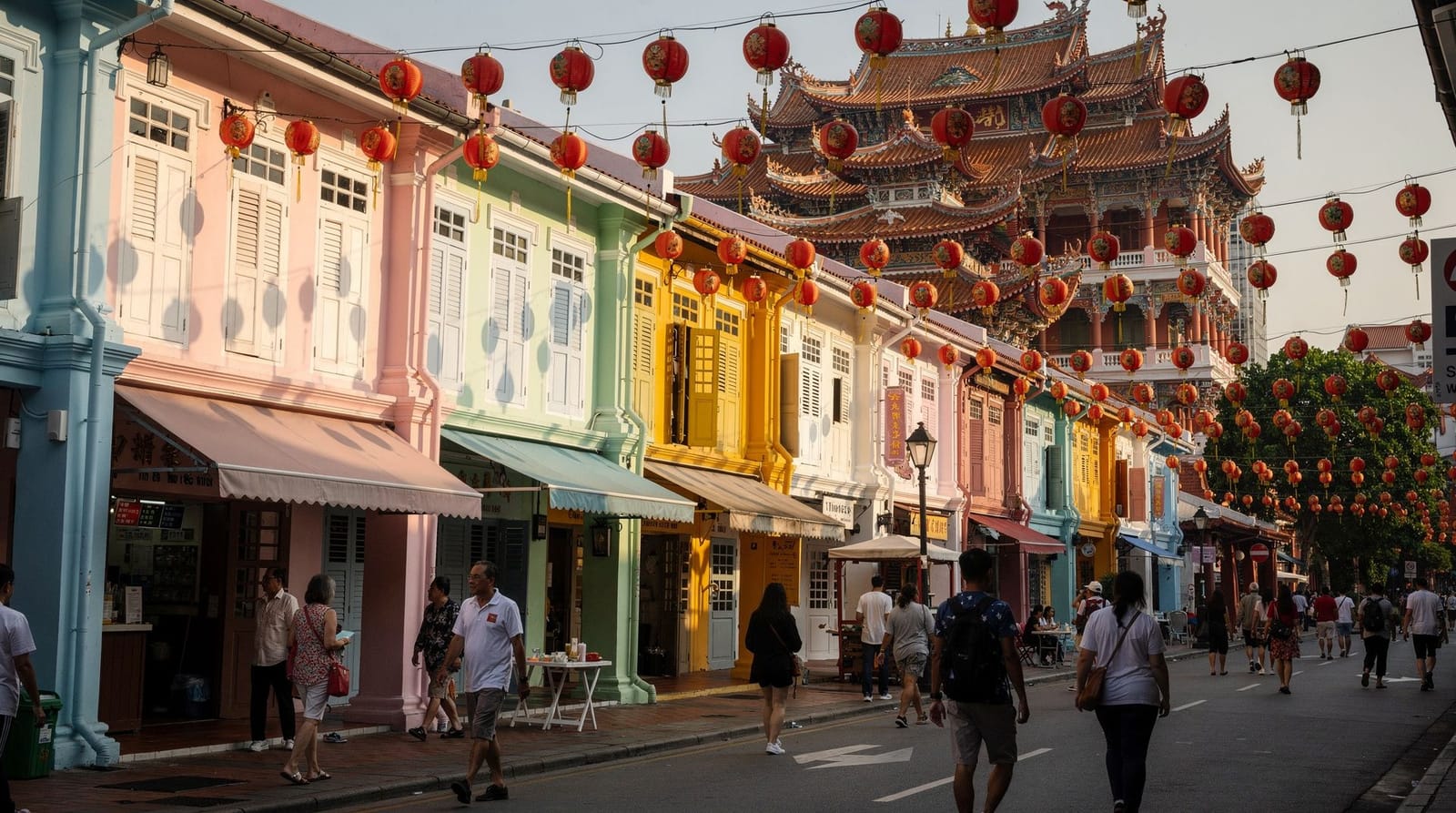
Chinatown’s preserved shophouse streets are Singapore’s densest heritage architecture — and the neighbourhood has survived modernisation better than most.
Key areas: Smith Street, Pagoda Street, Trengganu Street (the preserved 1840s–1950s shophouses), Ann Siang Hill (hilltop shophouses and bars), Club Street, Keong Saik Road (now trendy cafe strip, retaining original facades), Buddha Tooth Relic Temple (free entry, genuinely impressive 4-storey temple), Sri Mariamman Temple (Singapore’s oldest Hindu temple, active).
Best time: 9:00–11:00 am before the tourist crowd thickens and before the heat peaks.
See Chinatown Singapore for full neighbourhood detail.
Kampong Glam and Haji Lane (1.5–2 hours, 2 km)
Singapore’s Malay-Muslim heritage quarter is compact and photogenic.
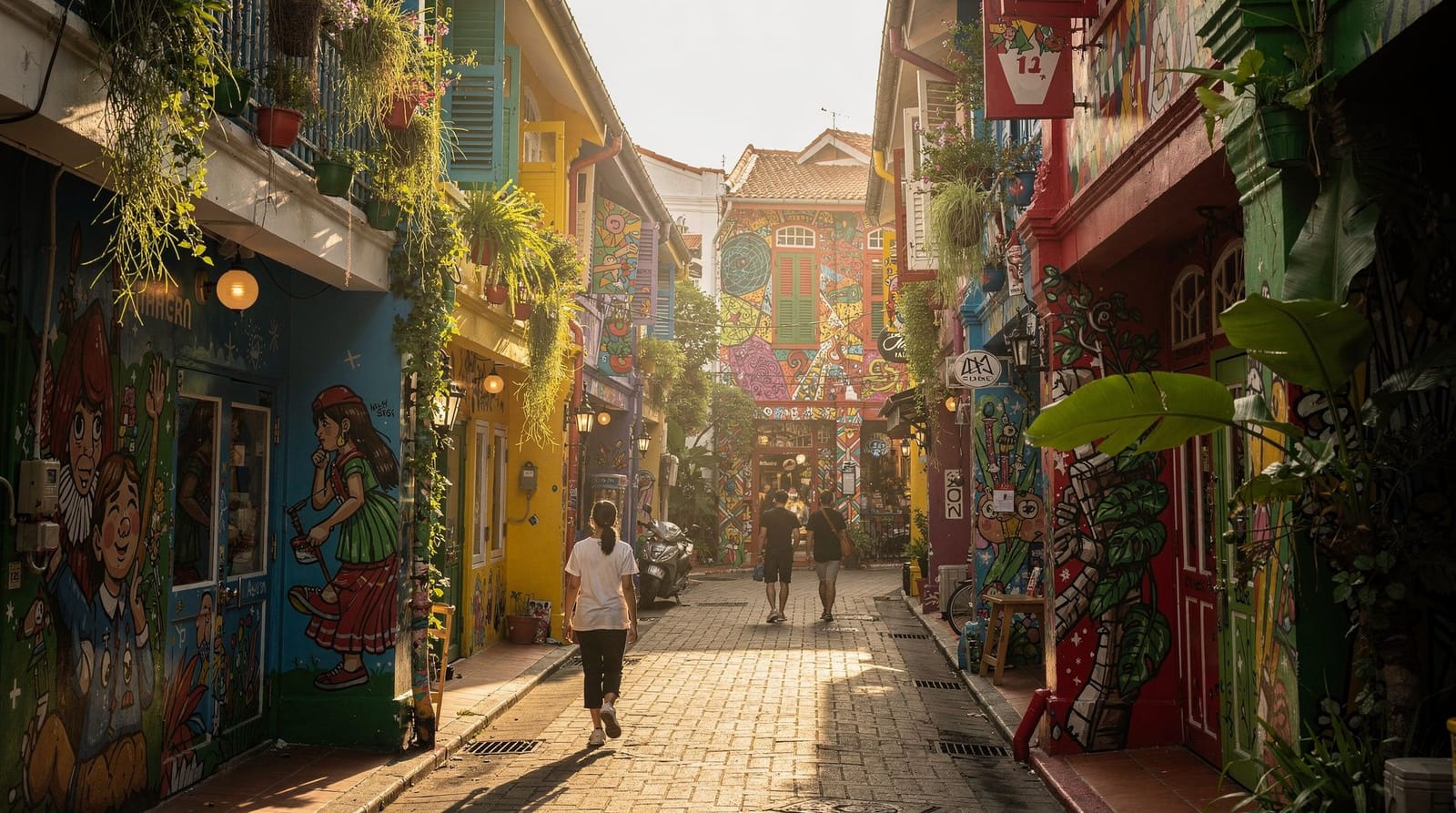
Route: Sultan Mosque (golden dome, free entry to courtyard) → Bussorah Street (mosque-facing street with souvenir and café strip) → Arab Street (textiles and fabric shops) → Haji Lane (narrow street with indie cafes, boutiques, street art murals) → Kampong Glam Palace (now Malay Heritage Centre, free entry to grounds).
Best time: Morning for photography (light on Sultan Mosque’s dome is best before noon). The cafes on Haji Lane open mid-morning and are good for a rest stop.
See Kampong Glam and Haji Lane for the full guide.
Little India (2–2.5 hours, 2–3 km)
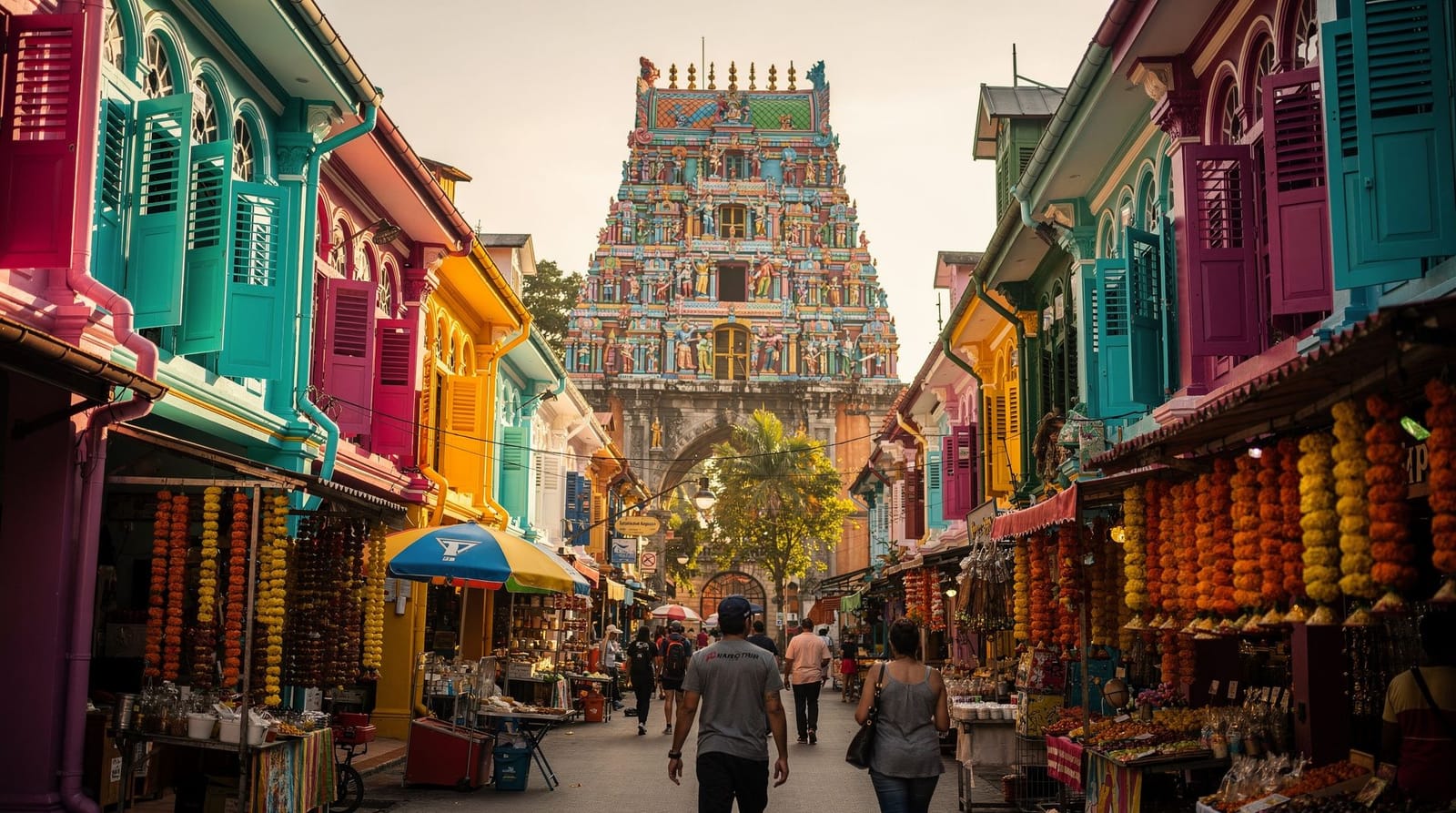
Little India is the most sensory of Singapore’s ethnic quarters — colour, incense, Tamil music, flower garlands, and the scent of coconut oil. Best experienced slowly on foot.
Key areas: Serangoon Road (main artery), Tekka Centre market (food, produce, textiles), Sri Veeramakaliamman Temple (active worship, intricate gopuram tower), Sri Srinivasa Perumal Temple (tall elaborate tower), Buffalo Road and surrounding lanes (traditional shops — textiles, incense, goldwork), Mustafa Centre (24-hour department store on the neighbourhood’s edge).
Best time: Tuesday to Thursday mornings for an authentic, less-crowded experience. Avoid Sunday afternoons (peak crowds). During Deepavali festival season (October–November), the light-up transforms the entire neighbourhood. See Little India Singapore.
Singapore River and Boat Quay (45–60 min, 1.5 km)
A shorter riverside walk with historical depth, best combined with the colonial district or Clarke Quay evening plans.
Route: Cavenagh Bridge → Boat Quay (restored 19th-century godowns and shophouses, now restaurants) → Read Bridge → Clarke Quay.
The original trade functions of these buildings — godowns storing goods from bumboats on the river — are still visible in the architecture even through restaurant signage. The historical plaques along the river walk are worth reading. See Singapore River cruise for the water-level perspective on the same route.
Fort Canning and Tiong Bahru (2–2.5 hours, 2.5–3 km)
A quieter, greener alternative for repeat visitors or anyone who wants heritage without the tourist density of Chinatown.
Route: Fort Canning Park (Singapore’s oldest hill fort, spice garden, and the site of Raffles’ original residence) → Fort Canning Green → down toward River Valley Road → Tiong Bahru, Singapore’s first public housing estate, with Art Deco walk-up flats, independent bookshops and cafes, and the classic wet market at Tiong Bahru Market.
Best time: Morning, before the market’s hawker stalls sell out of their best dishes (many close by early afternoon).
Singapore: Fort Canning 2-hour guided walking tourHow the routes compare
| Route | Duration | Distance | Best for |
|---|---|---|---|
| Colonial Civic District | 2–3 hrs | 3–4 km | First-time visitors, architecture |
| Chinatown | 2–3 hrs | 2–3 km | Heritage, temples, food |
| Kampong Glam / Haji Lane | 1.5–2 hrs | 2 km | Photography, boutique shopping |
| Little India | 2–2.5 hrs | 2–3 km | Sensory immersion, festivals |
| Singapore River / Boat Quay | 45–60 min | 1.5 km | Short add-on, evening pairing |
| Fort Canning / Tiong Bahru | 2–2.5 hrs | 2.5–3 km | Quieter, local-feel alternative |
Walking tour tips for Singapore’s heat
Timing: 8:30–11:30 am is the best walking window. After 11:30 am, the combination of heat and humidity becomes challenging for extended outdoor walking. Late afternoon (4:30–7:00 pm) is the second-best window.
Hydration: Water from convenience stores (7-Eleven, FairPrice) costs SGD 1–2. Carry at least 750ml. Public drinking fountains exist at major parks and transport hubs.
Shade strategy: Singapore’s colonial districts have mature rain trees and angsana trees providing canopy cover on many streets. The covered five-foot ways (covered pavements mandated by Raffles in front of shophouses) provide shade along the shophouse streets.
Footwear: Comfortable walking shoes or sandals. The heritage streets have uneven paving in some areas. Avoid high heels on the historic neighbourhood streets.
Frequently asked questions about Singapore walking tours
How long should I book a walking tour for?
Two to three hours is the standard and recommended duration. Less than 2 hours is not enough to cover a neighbourhood properly. More than 3 hours is physically demanding in Singapore’s heat and concentration wanes. If you want to cover multiple neighbourhoods, book a half-day tour (4 hours) with a meal break built in.
Are walking tours accessible for people with limited mobility?
The colonial Civic District is largely flat and accessible. Chinatown and Kampong Glam have some sloped areas (Ann Siang Hill, for example). Little India is predominantly flat. The Singapore Tourism Board’s website lists accessible heritage trails. For visitors with significant mobility limitations, a private car tour covering the same landmarks with brief stops may be more practical — see Private tours in Singapore.
Is it safe to walk around Singapore at night?
Singapore is consistently ranked among the world’s safest cities. Walking at night in all tourist areas — Marina Bay, Chinatown, Kampong Glam, Orchard Road, Clarke Quay — is safe. The main consideration is comfort: some areas are less interesting or busy after 10 pm. Clarke Quay and Boat Quay are specifically more lively in the evening.
How do I find a reputable local walking guide?
The Singapore Tourism Board (STB) maintains a register of licensed tour guides. Look for guides with the Singapore Accredited Tour Guide badge. Several platforms offer vetted local guides for private tours. Asking your accommodation for recommendations often surfaces well-regarded local guides with neighbourhood specialisms.
Can children do walking tours in Singapore?
Children manage shorter walking tours (1.5–2 hours) well in the morning. The colourful temple architecture of Little India and Chinatown, and the dramatic exterior of Sultan Mosque, hold children’s attention reasonably well. For families with young children, the morning timing and water/snack management are the key factors for success. The Singapore with kids guide has more family-specific planning advice.
Top experiences
Bookable activities with verified prices and instant confirmation on GetYourGuide.