Singapore history 101: from fishing village to global city
Singapore: story of Singapore
What is the key history a visitor needs to know about Singapore?
Singapore was a modest fishing settlement when Stamford Raffles established a British trading post in 1819. It grew rapidly as a colonial entrepôt, suffered under Japanese occupation (1942–45), merged briefly with Malaysia (1963–65), then became independent in 1965. Under Lee Kuan Yew's 31-year government, it transformed from a developing economy into one of the world's wealthiest nations. Today it is a city-state of 5.8 million with no natural resources and a GDP per capita among the world's highest.
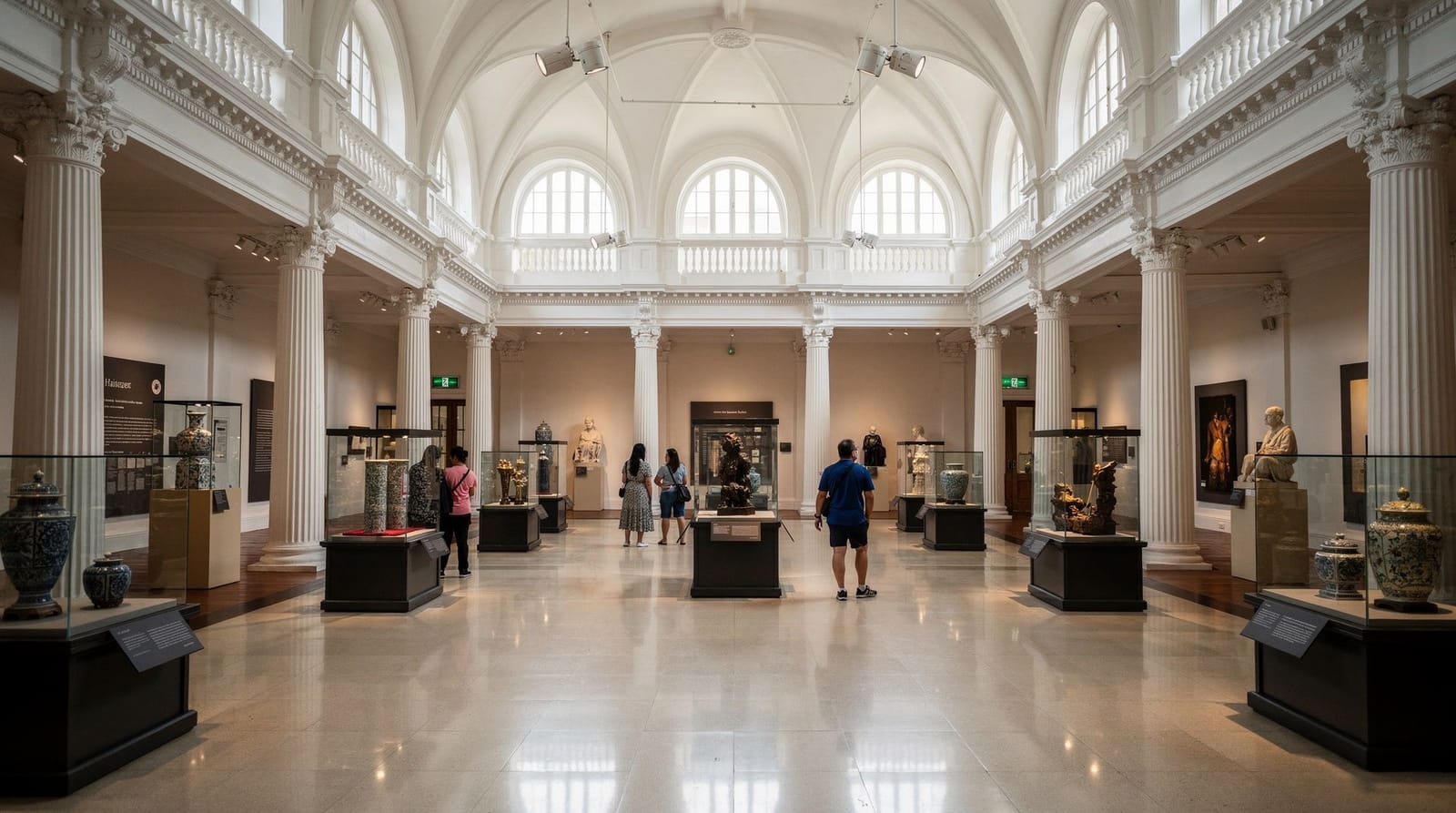
| Best starting point | National Museum of Singapore, around SGD 20 |
| Time needed | Half a day for the museum; a full day with Chinatown/Fort Canning |
| Free option | Former Ford Factory museum, Civic District walk |
| Getting around | MRT — City Hall, Bras Basah, or Fort Canning stations |
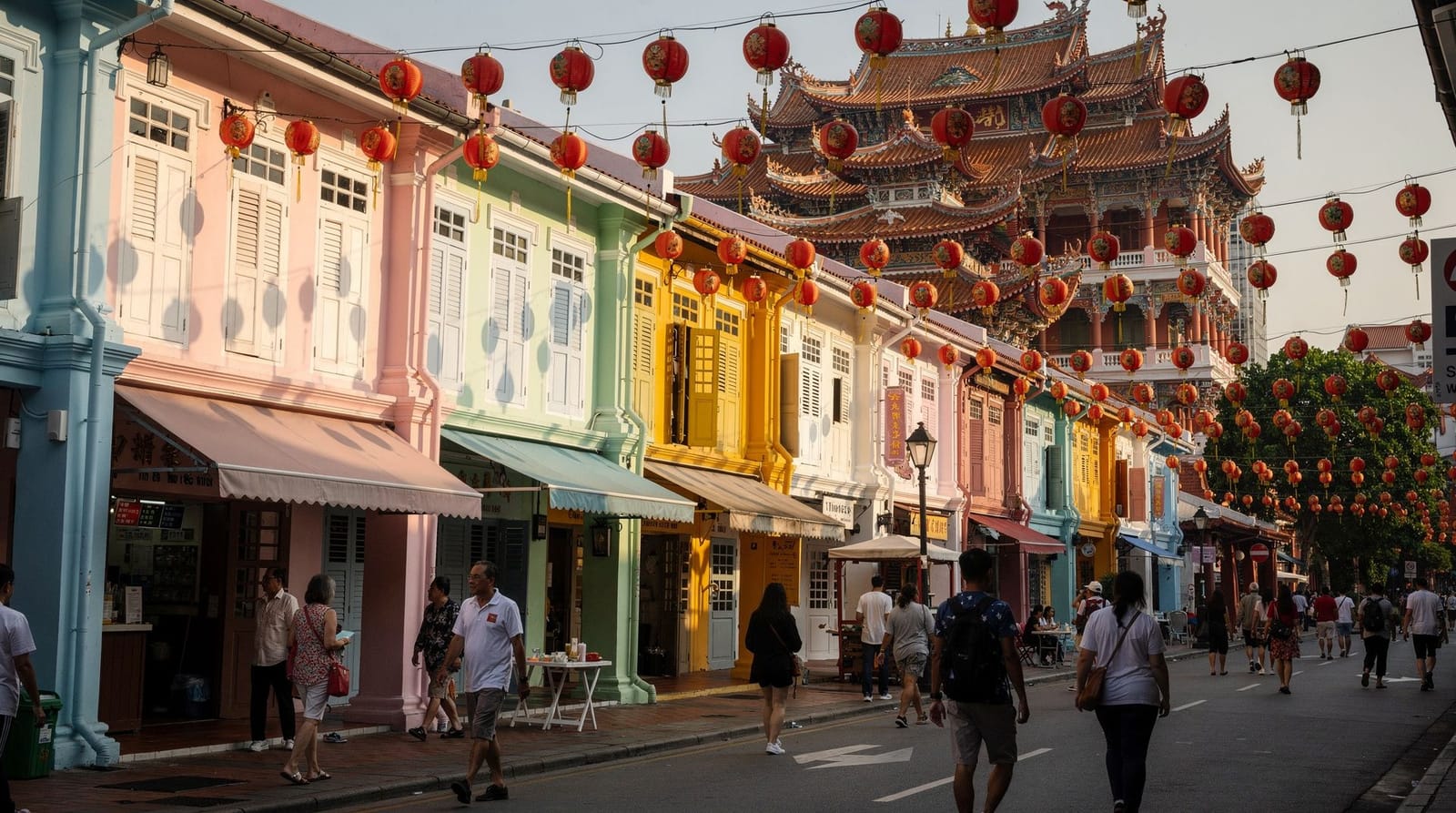
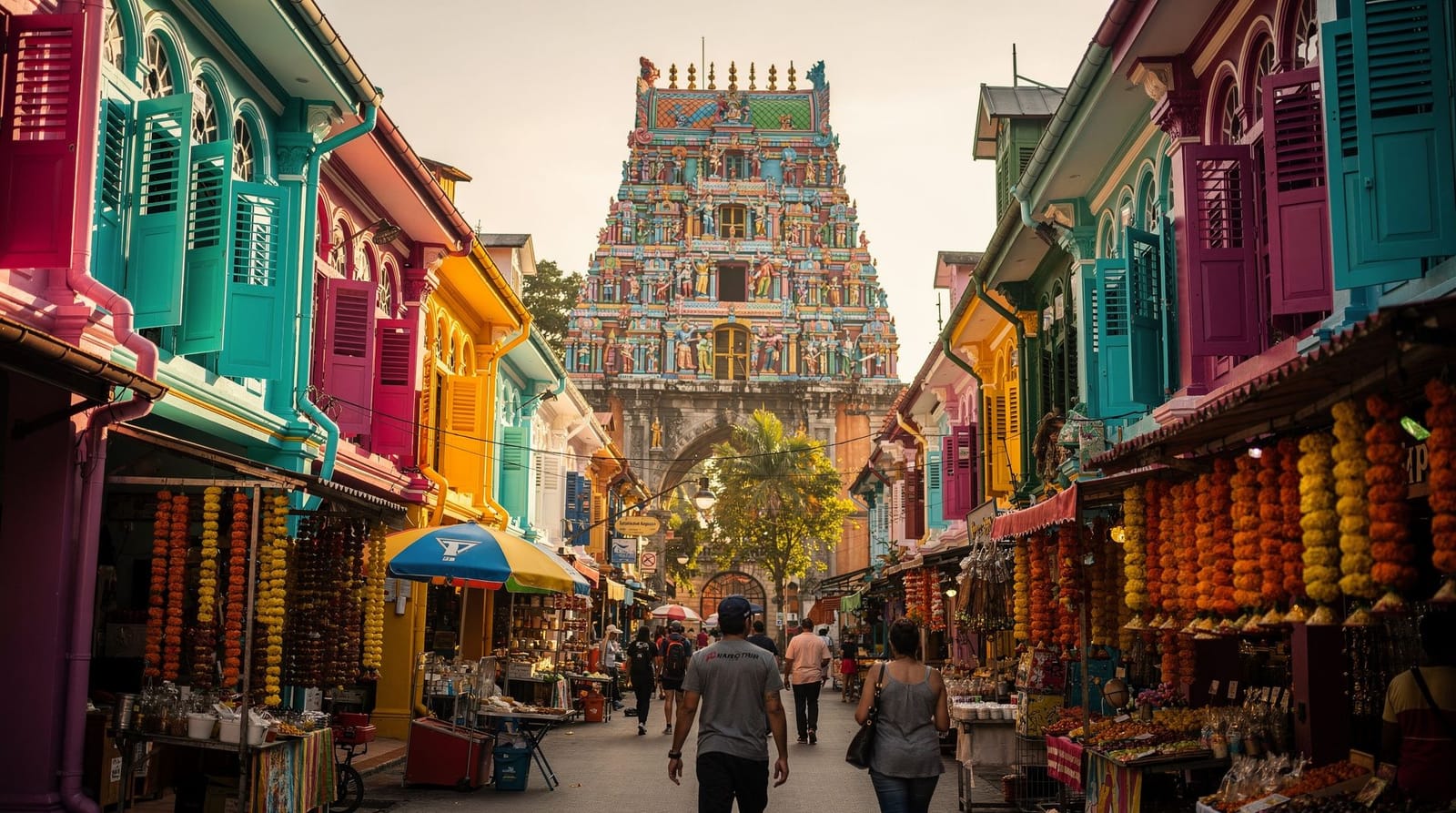
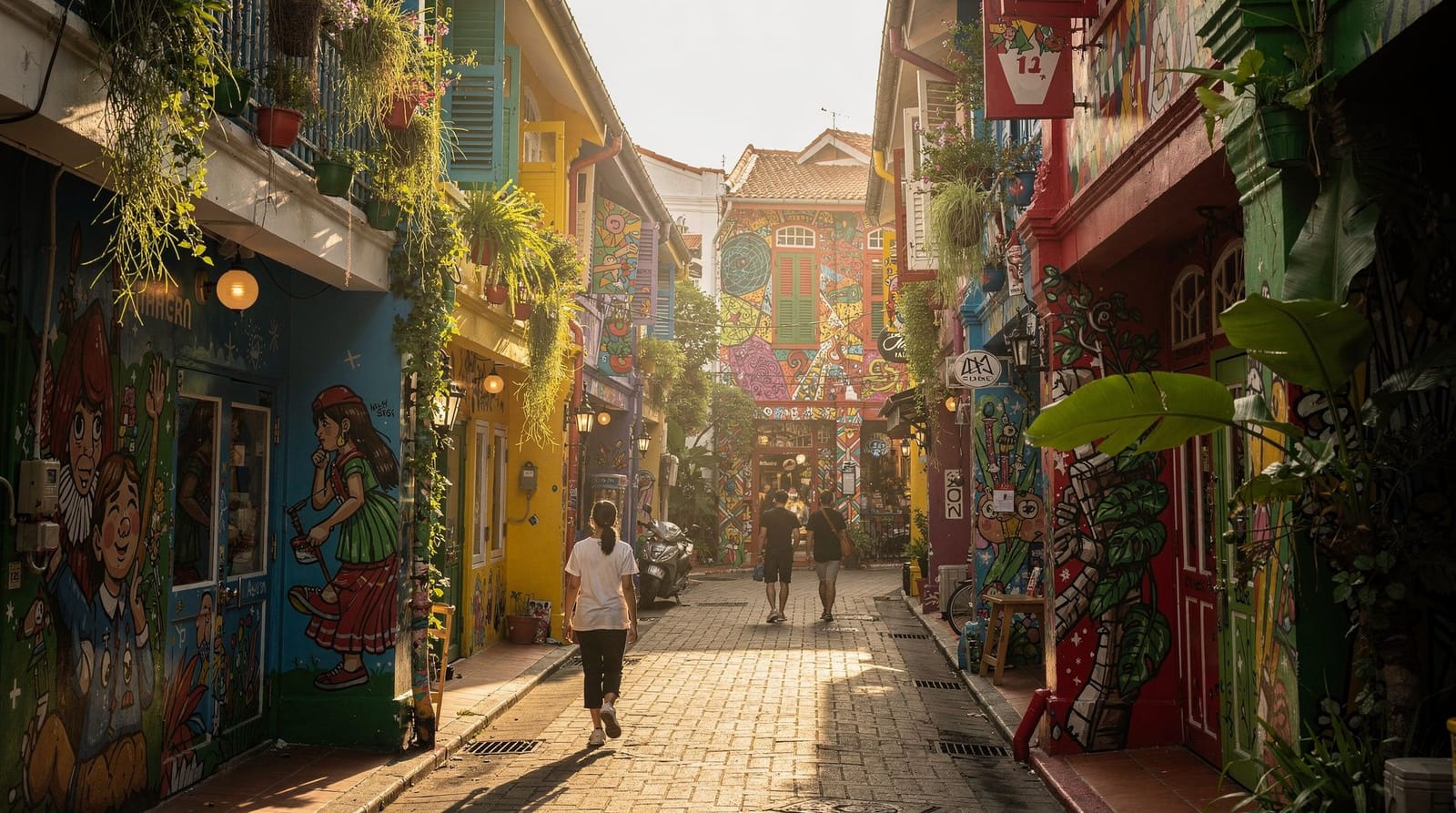
| Best paired with | A walk through Chinatown, Little India, or Kampong Glam |
Why history matters in Singapore
Singapore is a remarkably young country — not yet 60 years independent — and yet it carries layers of history that shaped not just this island but the entire region. Walking Chinatown without knowing why it exists, or visiting Raffles Hotel without knowing who Raffles was, means missing roughly half the picture — the buildings and street patterns are not neutral backdrop, they are the direct physical trace of specific decisions made two centuries ago.
This guide covers the essential history a visitor needs: enough to understand what you are looking at and why it looks that way, without pretending to be a textbook or requiring a history degree to follow. For depth, the National Museum of Singapore does the job properly.
Temasek: the forgotten first city
Long before Raffles, there was Temasek — a small trading port mentioned in 14th-century Javanese chronicles as a dependency of the Majapahit Empire. The island sat at a strategically critical junction where trade routes from China, India, and the Malay Archipelago converged.
In the late 13th or early 14th century, a prince from Sumatra — Sang Nila Utama, according to Malay legend — landed on the island and saw a lion. He renamed the place Singapura, meaning “Lion City” in Sanskrit. Historians note that lions never lived in Singapore; the animal was likely a Malayan tiger or a misidentified large cat. The name endured regardless.
Temasek was a minor but real settlement. The Singapore Stone — a partial sandstone inscription found at the river mouth in 1819 — dates from this era, though its script remains undeciphered. In 1613, Portuguese forces sacked the settlement, and the island largely reverted to jungle and small Orang Laut (sea nomads) communities for two centuries.
Raffles and the founding of modern Singapore (1819)
By the early 19th century, Britain and the Netherlands were competing for control of trade routes through maritime Southeast Asia. Thomas Stamford Raffles, Lieutenant Governor of Bencoolen in Sumatra, was determined to establish a British base south of Penang to counter Dutch control of the Malacca Strait.
On 29 January 1819, Raffles arrived at the southern tip of the Malay Peninsula. After negotiating with the Temenggong of Johor and Hussein Shah (the legitimate sultan), he signed a preliminary treaty on 6 February 1819. The island had an estimated population of around 150 Malay fisher-folk at the time.
The free-port policy was key: Raffles declared Singapore a free port, charging no import duties. In a region where the Dutch taxed almost everything, this was revolutionary. Ships and traders arrived immediately. Within a year, the population exceeded 5,000. Within five years, it had passed 10,000.
Raffles himself spent relatively little time on the island — his total time in Singapore across multiple visits amounted to less than a year. His legacy is the town plan: the ethnic zones he designated (Chinese kampong, Indian bazaar, Arab quarter, European commercial district) remain visible in the geography of Chinatown, Little India, and Kampong Glam today.
The colonial era: entrepôt and empire (1819–1942)
Singapore grew faster than any British colonial settlement since Hong Kong. Its value was almost entirely geographic — as a transshipment hub, it required no plantation economy or extractive industry. Goods arrived from China, India, the Malay Peninsula, and the Indonesian archipelago, were processed and re-exported, and taxed minimally. Merchants got rich. Britain got a strategic base.
The immigrants came in waves. Chinese labourers and merchants, primarily Hokkien and Teochew, dominated trade. Tamil workers (brought as indentured labour) built roads, docks, and government buildings. Arab merchants from Hadramawt (Yemen) established themselves in the Kampong Glam area. Europeans — British administrators, merchants, and their families — occupied the colonial district around Padang, Fort Canning, and the river.
Key colonial-era buildings still standing: the Supreme Court (now the National Gallery), St Andrew’s Cathedral (1856–1862), Raffles Hotel (1887), the Victoria Theatre and Concert Hall (1862 and 1905), and the Fullerton Building (1928, now the Fullerton Hotel). Walking the Civic District is essentially walking through colonial Singapore.
Rubber and tin transformed Singapore in the late 19th century. As demand for rubber (automobile tyres) and tin (food canning) exploded globally, Singapore became the processing and export hub for Malayan production. The port handled more cargo than any other in Asia outside Shanghai.
The fall: Japanese occupation (1942–1945)
The Japanese invasion of Southeast Asia began on 8 December 1941 — one hour before Pearl Harbor. Japanese forces moved rapidly south through Malaya, using bicycles and local roads in a strategy the British had dismissed as impossible. British defences were oriented seaward, assuming any attack would come by naval assault.
Lieutenant General Arthur Percival surrendered Singapore to General Yamashita Tomoyuki on 15 February 1942 at the Ford Factory in Bukit Timah — now a preserved museum at the Former Ford Factory. The British garrison of 80,000–100,000 soldiers (outnumbering the Japanese force) surrendered to an army that had essentially run out of ammunition and supplies.
The subsequent occupation lasted until September 1945. The period known as Sook Ching (February–March 1942) saw systematic massacres of the Chinese community — the Japanese identified and executed those considered anti-Japanese. Estimates of deaths range from 25,000 to 50,000. The Chinese community’s trauma from this period shaped Singapore politics for decades.
The fall of Singapore remains the most discussed military defeat in British history. The myth of Singapore’s impregnability was destroyed. Trust in British colonial protection collapsed. This psychological rupture accelerated the decolonisation movements across Asia in the postwar years.
Decolonisation and the road to independence (1945–1965)
After Japan’s surrender, Britain returned to Singapore but the colonial relationship was fundamentally changed. Political parties formed rapidly: the People’s Action Party (PAP), founded in 1954 with Lee Kuan Yew as secretary-general, won the 1959 elections and Singapore became a self-governing state within the Commonwealth.
Merger with the Federation of Malaysia in 1963 seemed logical — Singapore depended on Malaya for water, food, and a hinterland. But the merger created immediate political friction. The PAP’s ambitions for a “Malaysian Malaysia” (equal treatment of all races) clashed with the United Malays National Organisation’s vision of Malay political supremacy.
Communal riots in 1964 — the worst racial violence in Singapore’s modern history — killed at least 23 people and injured hundreds. Kuala Lumpur and Singapore could not resolve their political differences.
On 9 August 1965, Tunku Abdul Rahman, Malaysia’s Prime Minister, announced Singapore’s expulsion from the federation. Lee Kuan Yew announced independence in a televised broadcast, visibly distressed. The statement “We are on our own” captured both the political reality and the vulnerability of a tiny island with no natural resources, no guaranteed water supply, and a population divided by ethnicity and class.
The Lee Kuan Yew years (1959–1990) and the Singapore miracle
What happened between 1965 and 1990 is the “Singapore miracle” — a term used without irony by economists and political scientists. GDP per capita rose from approximately USD 500 at independence to over USD 15,000 by 1990. By 2024, it exceeded USD 88,000 — among the highest in the world.
How? Several interlocking factors:
Anti-corruption: The PAP government prosecuted corruption aggressively, including of its own members. Singapore went from highly corrupt (as was typical of postcolonial Asia) to consistently ranked among the world’s least corrupt countries. This enabled foreign investment.
Education and housing: The Housing Development Board (HDB) rapidly built subsidised public housing. By 1980, over 60% of Singaporeans lived in government-built flats. Today it exceeds 78%. Education was heavily invested in and conducted primarily in English, creating a workforce that could engage the global economy.
Pragmatic economics: Lee’s government was ideologically non-dogmatic — it would work with multinational corporations, state-owned enterprises, or private enterprise depending on what produced results. Export manufacturing, then finance and services, then technology and biomedical research came in sequence.
Strategic location: Singapore made itself indispensable — first as a port (it remains one of the world’s busiest), then as an aviation hub, then as a financial centre, then as a technology and pharmaceutical hub.
Authoritarian governance: This is where the international assessment diverges sharply from the domestic one. Lee’s government suppressed political opposition through defamation lawsuits, jailed journalists and activists, controlled the press, banned public protests, and used the Internal Security Act (detention without trial) against perceived threats. Most Singaporeans traded certain political freedoms for prosperity and safety and consider the trade well worth it. Outside observers remain divided.
Modern Singapore (1990–present)
Lee stepped down as Prime Minister in 1990, handing over to Goh Chok Tong, then to Lee Hsien Loong (Lee’s son) in 2004. Lawrence Wong became Prime Minister in May 2024.
The physical transformation of Singapore has been extraordinary. Marina Bay was largely open water in the 1980s; it is now a world-famous skyline with Marina Bay Sands (2010), the double-helix Helix Bridge, the supertrees at Gardens by the Bay (2012), and the Jewel at Changi Airport (2019).
Singapore’s population of 5.8 million includes approximately 1.7 million non-residents (foreign workers and expatriates). The economy runs on services, finance, trade, petrochemicals, and a growing technology sector. Singapore has no army of cheap labour, no oil, no agricultural land. It runs on competence, law, and geography.
The current political challenges — housing affordability, population ageing, tensions between the foreign workforce and citizens, the pace of change — are real. But Singapore remains, by most measurable standards, one of the best-run places on earth.
Singapore history at a glance: the timeline
| Period | What happened |
|---|---|
| 13th–14th century | Temasek trading port; Sang Nila Utama legend; Singapore Stone inscription |
| 1613 | Portuguese raid; island largely abandoned for two centuries |
| 1819 | Raffles establishes a British trading post; free-port policy begins |
| 1867 | Singapore becomes a formal British Crown Colony |
| 1942–1945 | Japanese occupation; Sook Ching massacres; renamed Syonan-to |
| 1959 | Self-government; Lee Kuan Yew becomes Prime Minister |
| 1963–1965 | Merger with Malaysia, then expulsion; independence on 9 August 1965 |
| 1965–1990 | Rapid economic transformation under Lee Kuan Yew (“Singapore miracle”) |
| 1990–present | Marina Bay redevelopment; leadership transitions to Goh, Lee Hsien Loong, Lawrence Wong |
A practical history-focused route
If you want to spend a half-day tracing this timeline physically rather than just reading about it, a workable route runs: start at the National Museum of Singapore (2–3 hours for the Singapore History Gallery), walk 10 minutes to Fort Canning for the Raffles bungalow site and the Battle Box, then continue downhill toward the Civic District to see the Supreme Court (now National Gallery), St Andrew’s Cathedral, and the Padang. Finish at the Asian Civilisations Museum on the river, a short walk further. This covers Temasek-era context, the colonial founding, the wartime command centre, and the immigrant cultures that shaped modern Singapore in roughly half a day, entirely on foot or by short MRT hops between City Hall, Bras Basah, and Raffles Place stations.
Story of Singapore heritage walking tourCommon myths worth correcting
“Singapore was empty before Raffles.” Not true — Temasek was a functioning trading port centuries earlier, and around 150 Malay fisher-folk and Orang Laut communities lived on the island when Raffles arrived in 1819. Raffles founded the modern colonial city, not the island’s first settlement.
“Singapore chose independence.” The opposite — Singapore was expelled from Malaysia in 1965, not seeking independence on its own terms. Lee Kuan Yew’s televised announcement, visibly distressed, reflects genuine anxiety about a tiny resource-poor island’s survival prospects, not celebration.
“The Japanese occupation is a footnote.” It is one of the most consequential periods in Singapore’s modern history — the trauma of the Sook Ching massacres and the collapse of British colonial credibility directly accelerated the political movements that led to self-government and eventual independence twenty years later.
Where to see history in Singapore
National Museum of Singapore: The most comprehensive overview of Singapore history, from prehistoric evidence to the present. The Singapore History Gallery (permanent) is excellent. Entry SGD 20 for adults.
Fort Canning: Raffles’ original bungalow site, later British military headquarters, and the site where Percival made his final decisions before surrender. The Battle Box (underground command centre) can be visited on guided tours.
Asian Civilisations Museum: Covers the broader cultural origins of Singapore’s communities — Chinese, Indian, Islamic, and Southeast Asian art and artefacts. On the Singapore River waterfront.
Former Ford Factory (Bukit Timah Road): Where the surrender took place on 15 February 1942. Preserved as a museum with excellent exhibits on the occupation period. Free entry.
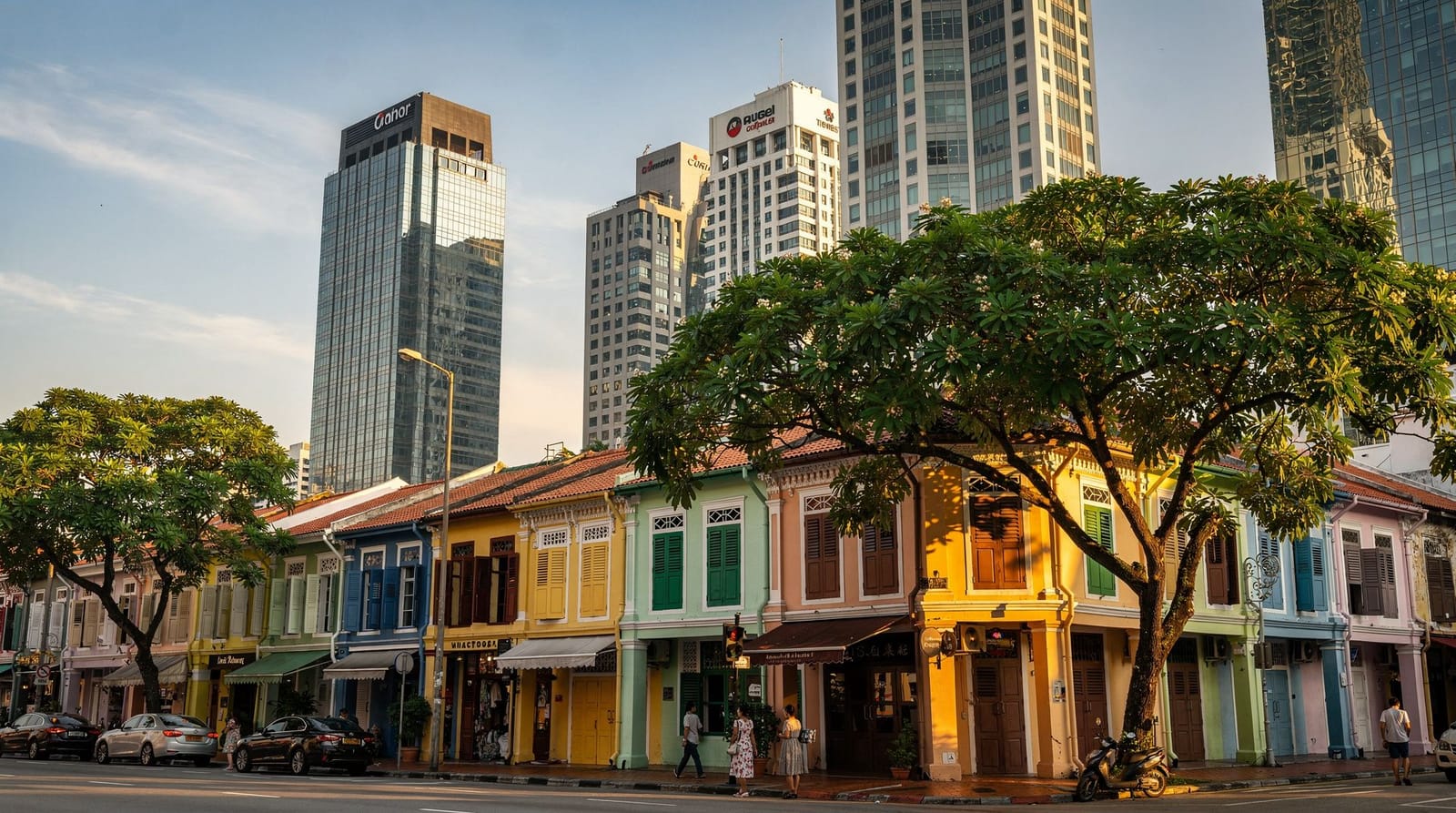
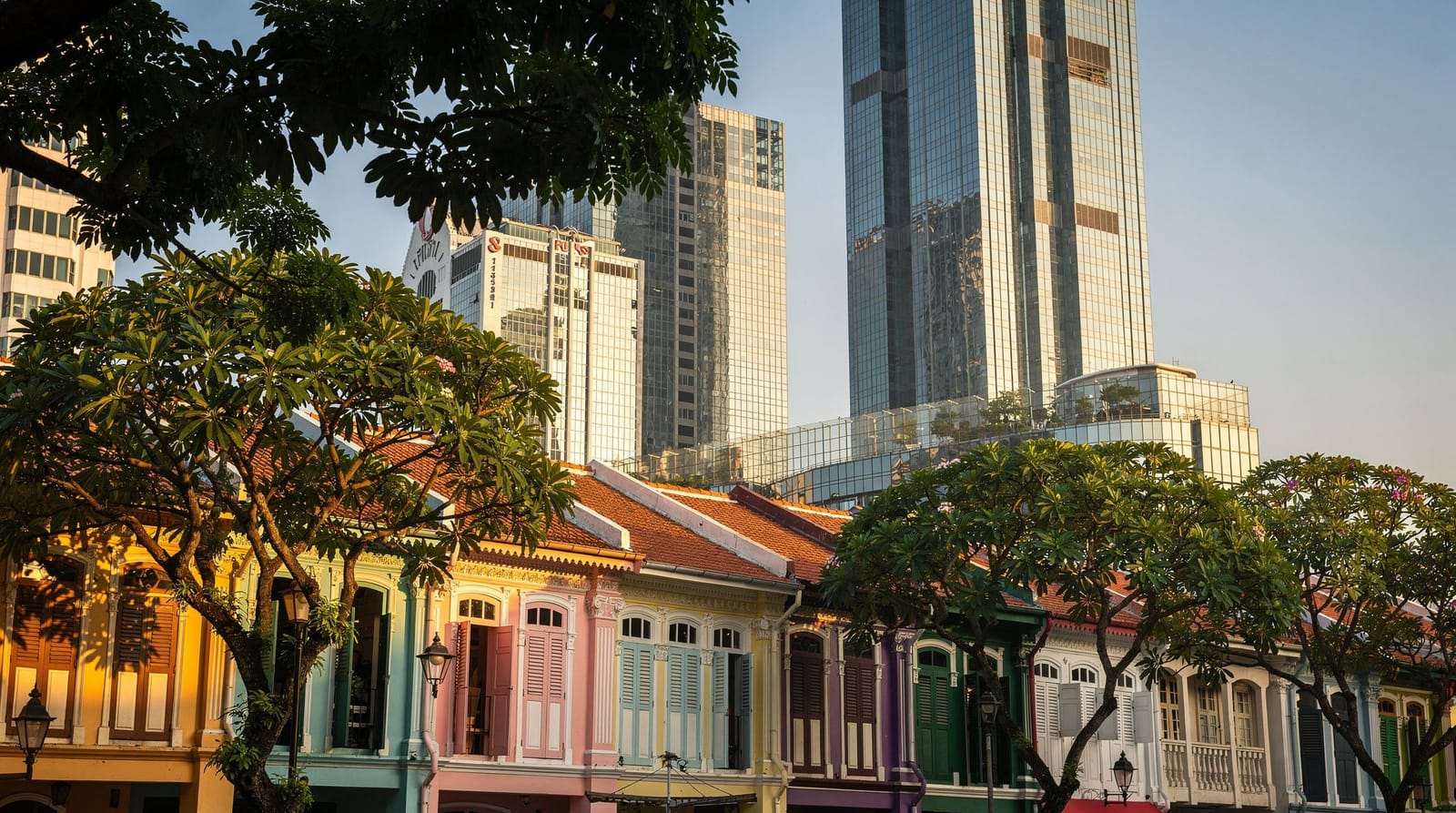
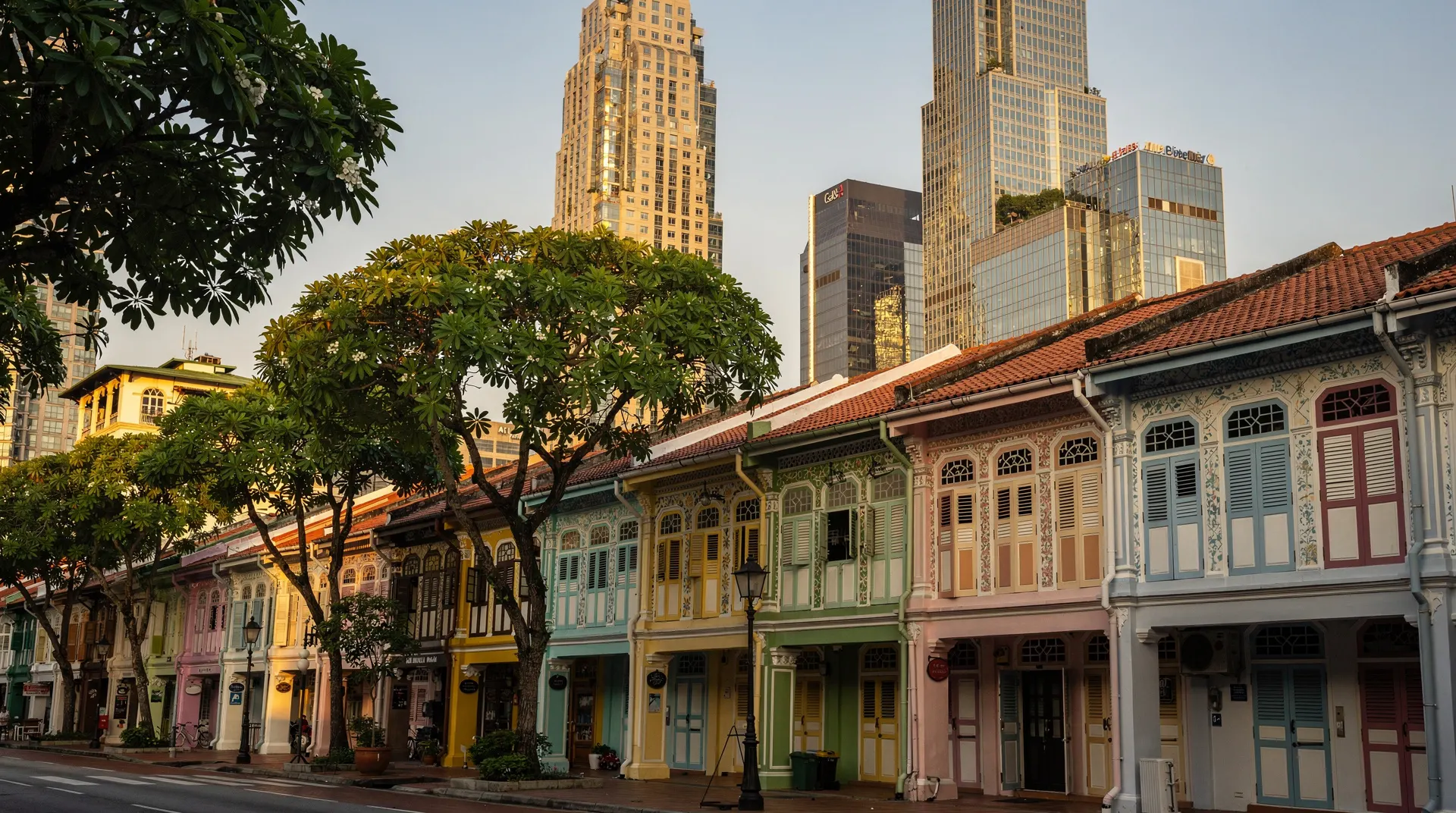
Chinatown, Little India, Kampong Glam: Living history. The ethnic quarter system Raffles established is still intact and functioning.
Peranakan Museum: Covers the Straits Chinese (Peranakan) culture — the culturally blended Chinese-Malay community that emerged from centuries of mixing. Beautifully curated. See also Katong and Joo Chiat for Peranakan heritage in context.
Singapore: 3 ethnic quarters harmony discovery tourHow the history connects to what you see today
Several everyday Singapore features trace directly back to this history. The strict cleanliness laws and famous fines are Lee Kuan Yew-era policy, not colonial inheritance. The ethnic quarters — Chinatown, Little India, Kampong Glam — are Raffles’ 1822 town plan, still functioning as living neighbourhoods two centuries later rather than becoming museum pieces. English as the working language is a deliberate postcolonial choice to create a neutral, globally competitive lingua franca rather than favouring any one ethnic community’s language.
Even the housing estates (HDB blocks) that most Singaporeans live in are a direct product of the 1960s nation-building programme, built partly to physically integrate the different ethnic communities that colonial-era zoning had kept separate. Recognising these threads turns a walk through any neighbourhood into something closer to reading the city’s own explanation of itself.
The honest historical perspective
Singapore’s history is often told as a triumphant narrative — from fishing village to global city in 200 years. That story is true, and the achievement is real.
What gets less emphasis: the exploitation of indentured labour in the colonial era; the brutality of the Japanese occupation and its long suppression in official memory; the authoritarian methods of the PAP government; the displacement of communities during urban renewal programmes (entire kampong villages were demolished between the 1960s and 1980s); and the ongoing democratic deficit in what is formally a parliamentary democracy but practically a one-party state.
Singapore itself is increasingly capable of holding these contradictions — the National Museum and the Former Ford Factory are genuinely honest about difficult chapters. History here is not sanitised so much as compressed into a narrative of progress that can skip uncomfortable details.
Knowing some of this context makes the physical city more legible: why Chinatown looks the way it does, why the CBD is where it is, why housing policy is the way it is, why laws are strict, why English is dominant. History explains Singapore.
Frequently asked questions about Singapore history
When did Singapore become a British colony?
Singapore became a formal British Crown Colony in 1867, after the Straits Settlements (Singapore, Penang, and Malacca) were transferred from the East India Company to direct British government control following the company’s dissolution in 1858. Before 1867, Singapore was administered as part of the East India Company’s territories. The original trading post was established in 1819.
What was Singapore before the British arrived?
The island was a minor Malay fishing settlement and a territory of the Johor Sultanate, with a small population of Malay fisher-folk (Orang Laut) when Raffles arrived. Historically, it had been the site of Temasek, a 13th–14th century trading port, before being largely abandoned after Portuguese raiders attacked in 1613.
Was Singapore always part of Malaysia?
No. Singapore was part of the Federation of Malaysia for only two years — from 1963 to 1965. Before that (1955–1963), it was a British Crown Colony progressing toward self-governance. Singapore became fully independent when it was expelled from Malaysia on 9 August 1965 — not by its own choice.
Why is Singapore so strict about laws and fines?
The strict legal environment was deliberately designed by Lee Kuan Yew’s government as part of the social contract: in exchange for prosperity, order, and personal safety, citizens and visitors accept a constrained set of personal freedoms. The famous fines (jaywalking, littering, chewing gum) reflect a philosophy that public order and cleanliness are collective goods worth enforcing. The death penalty for drug trafficking reflects zero tolerance for what Lee considered existential social threats.
Is Singapore politically diverse?
In practice, no — though in form it is a parliamentary democracy with elections. The PAP has won every general election since 1959 with supermajorities. The 2020 general election saw the opposition Workers’ Party win 10 seats, its best result, in what was widely interpreted as Singaporeans signalling a desire for more parliamentary debate. The media remains largely state-aligned and political opposition faces structural disadvantages.
Top experiences
Bookable activities with verified prices and instant confirmation on GetYourGuide.