National Museum of Singapore: the honest visitor guide
Singapore: National Gallery entry tickets
Is the National Museum of Singapore worth visiting?
Yes — it is Singapore's best museum for understanding the city's history, from its founding as a British trading port to independence and rapid modernisation. The Singapore History Gallery is honest and well-curated; the Living Galleries on Singaporean culture and daily life are engaging. Allow 2–3 hours. Admission SGD 15 adults, free for Singapore residents.
Singapore’s National Museum on Stamford Road is the oldest museum in the country, founded in 1887 as the Raffles Library and Museum. It tells Singapore’s story from a small Malay kingdom through to one of the world’s wealthiest city-states in a space that is itself part of the story — a 19th-century Neoclassical building extended by a 21st-century glass rotunda that is a physical metaphor for the city’s relationship with its colonial past and its modernising present.
| Where | 93 Stamford Road, Bras Basah-Bugis |
| Cost | Around SGD 15 adult, free for residents |
| Time needed | 2–3 hours |
| Getting there | Bras Basah MRT (5 min) or Dhoby Ghaut MRT (8 min) |
| Best time | Weekday mornings — quietest |
Getting there
Bras Basah MRT (CC2, Circle Line) is the closest station — Exit B leads to a 5-minute walk to the museum. Dhoby Ghaut MRT (NS24/NE6/CC1) is equally accessible, about 8 minutes walk via Fort Canning Road.
Address: 93 Stamford Road, Singapore 178897. The museum faces the Singapore Art Museum (SAM) across Bras Basah Road, with Fort Canning Park rising behind it.
The building
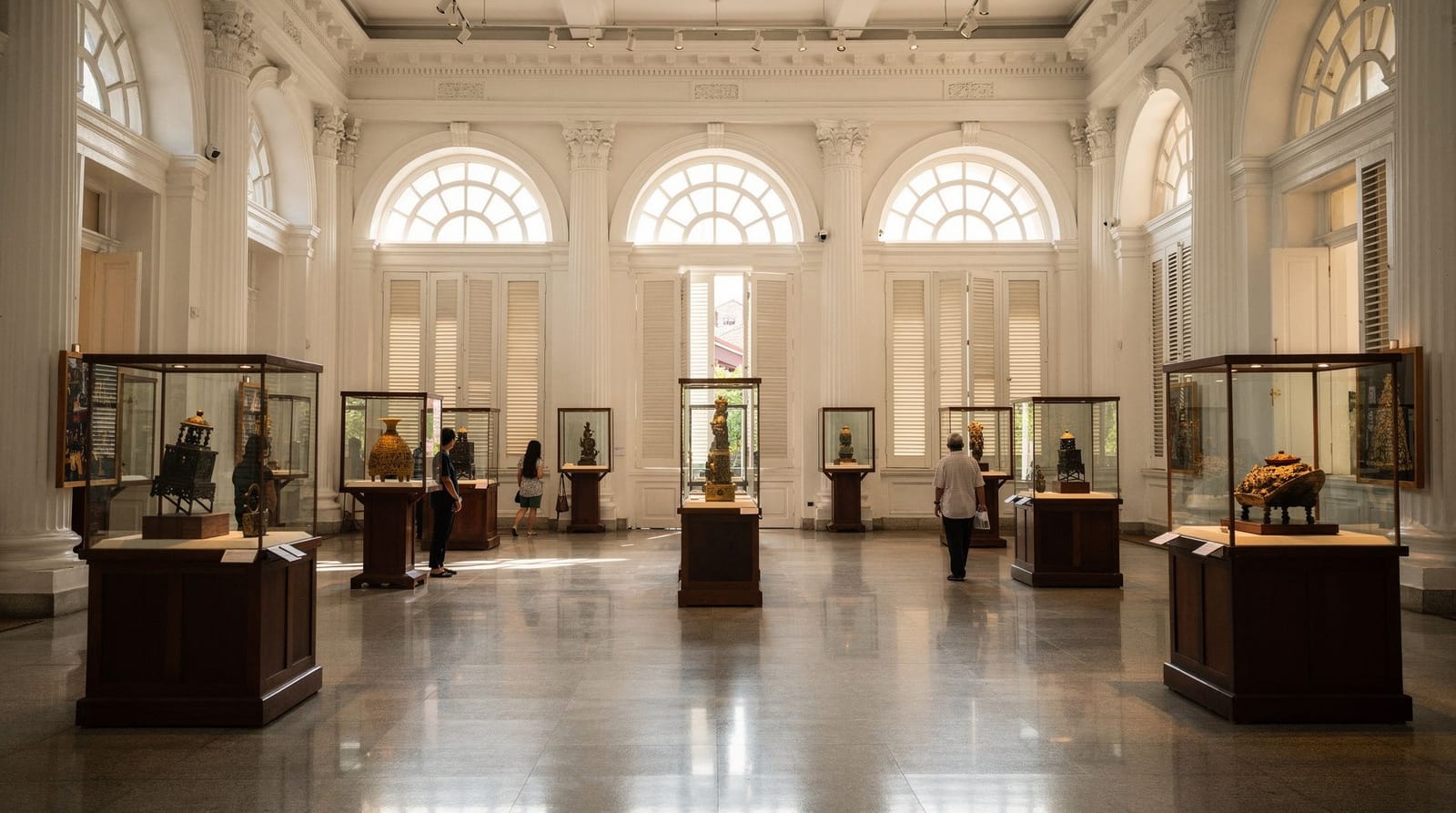
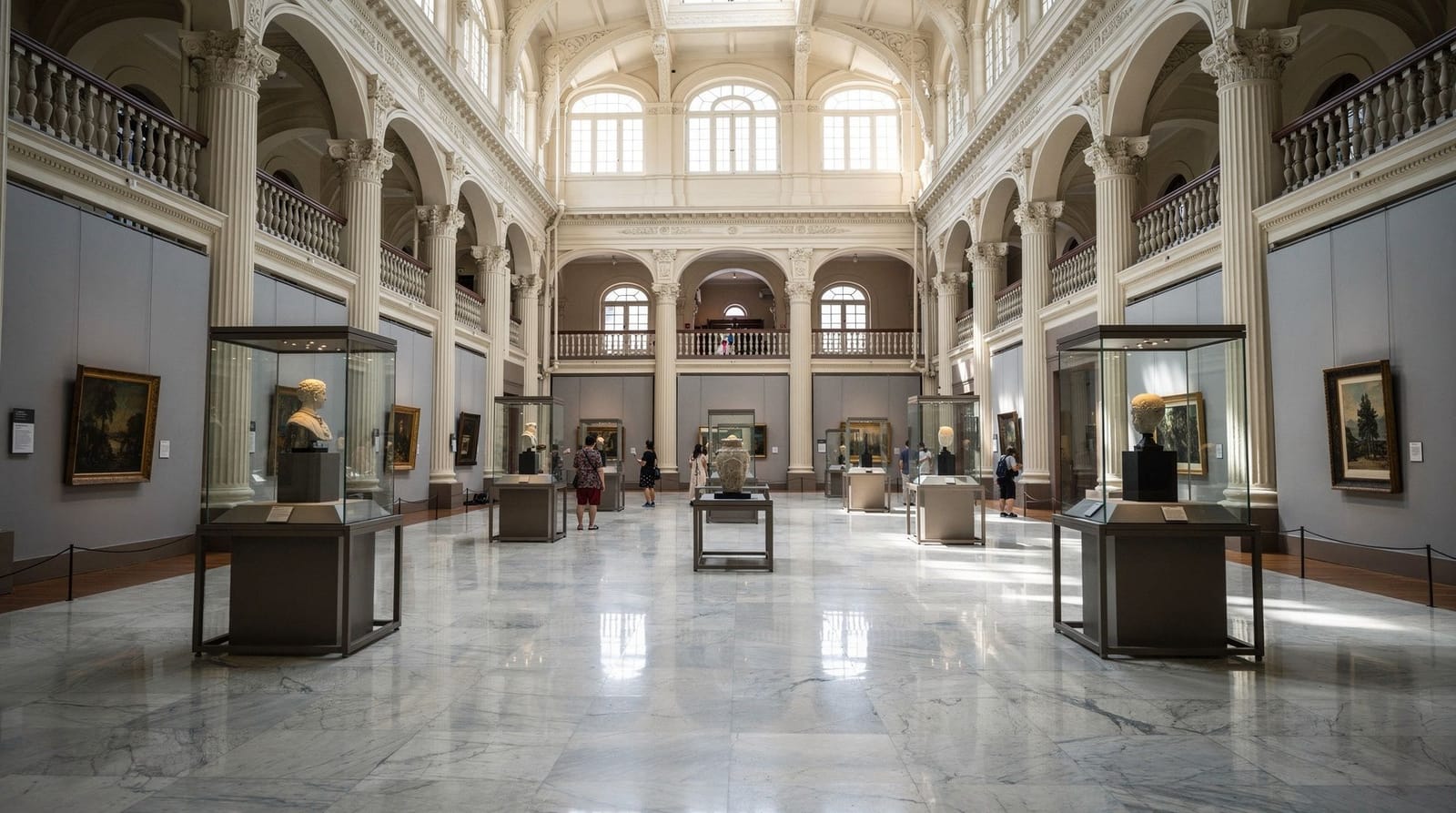
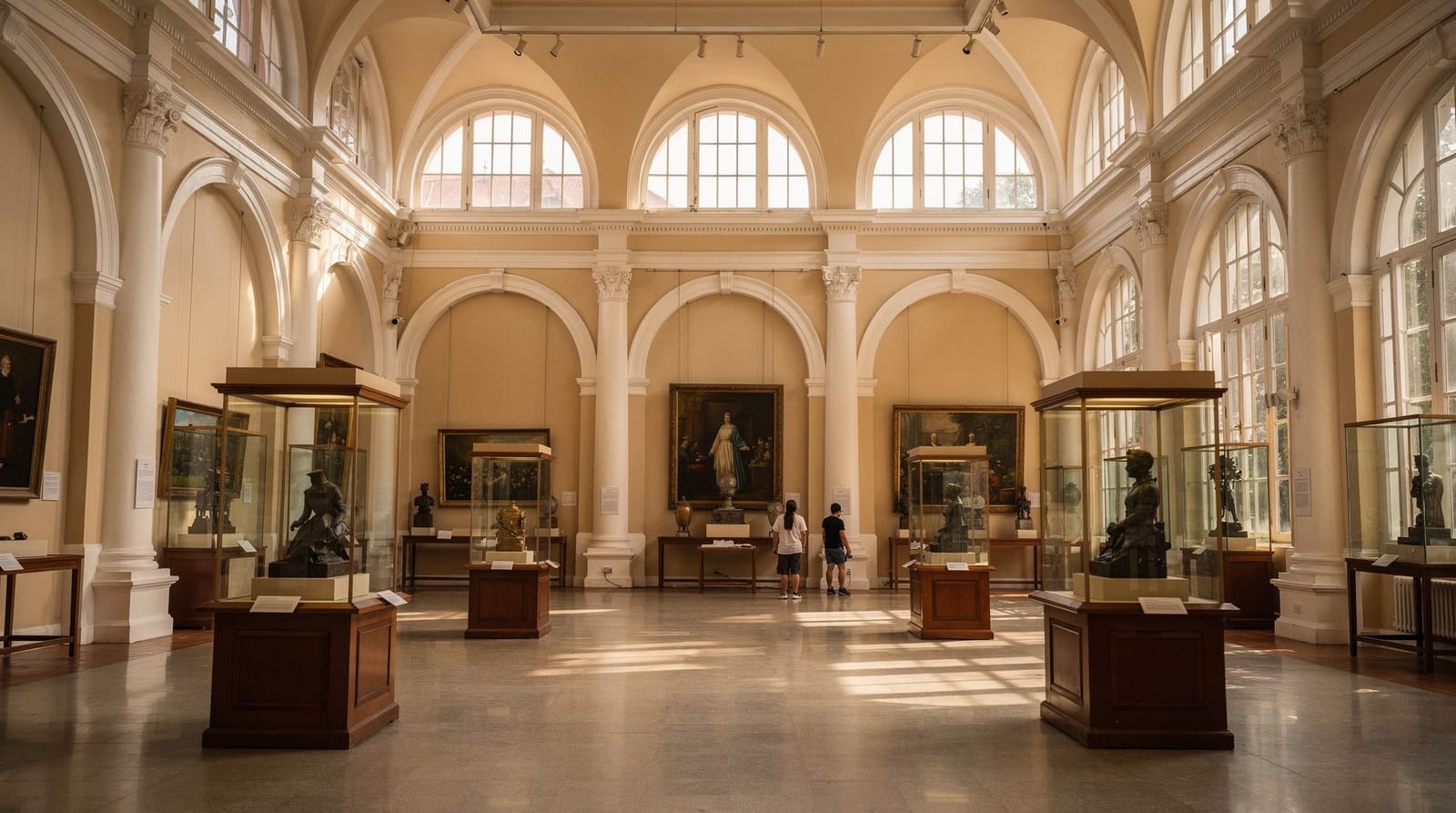
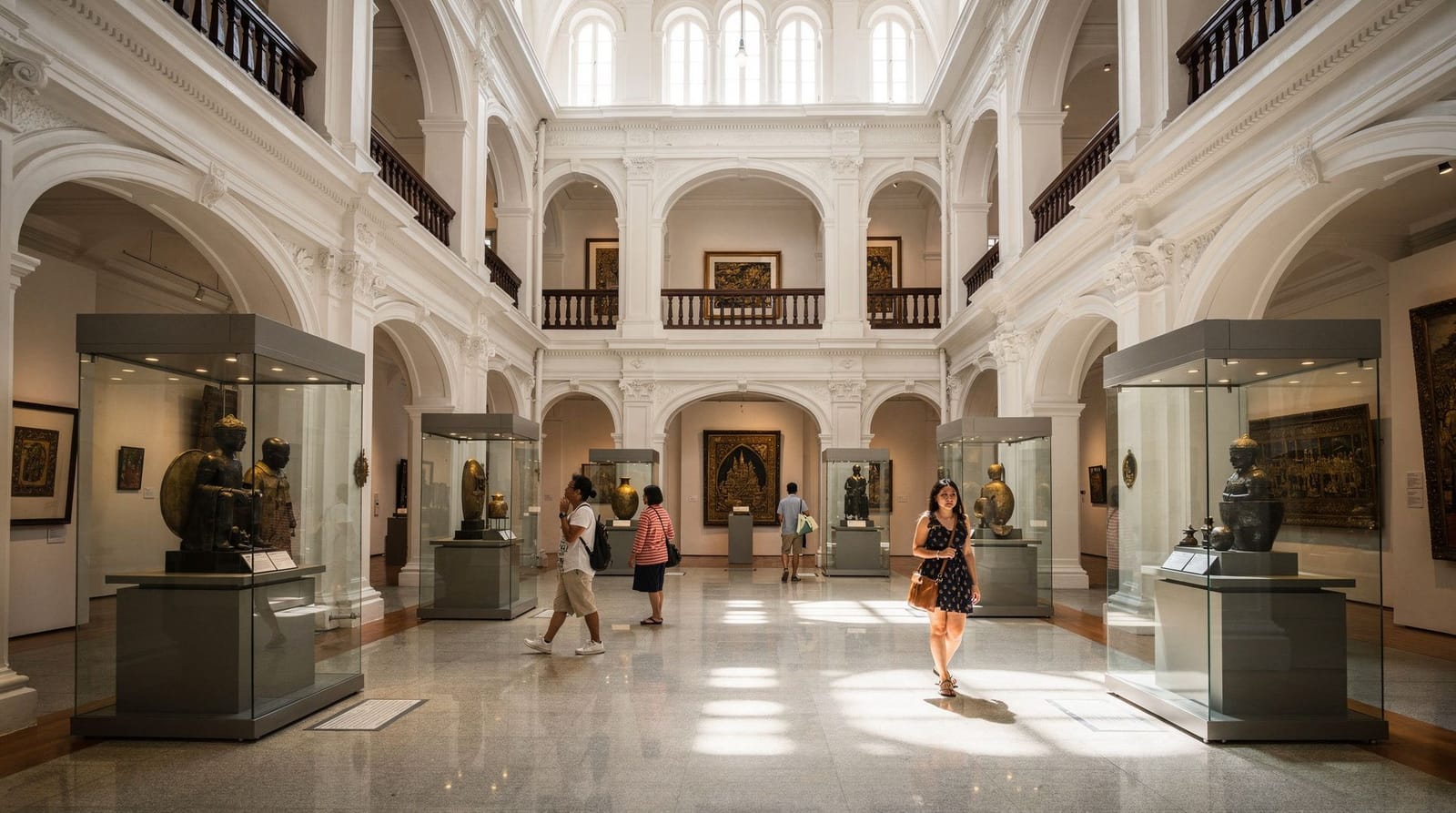
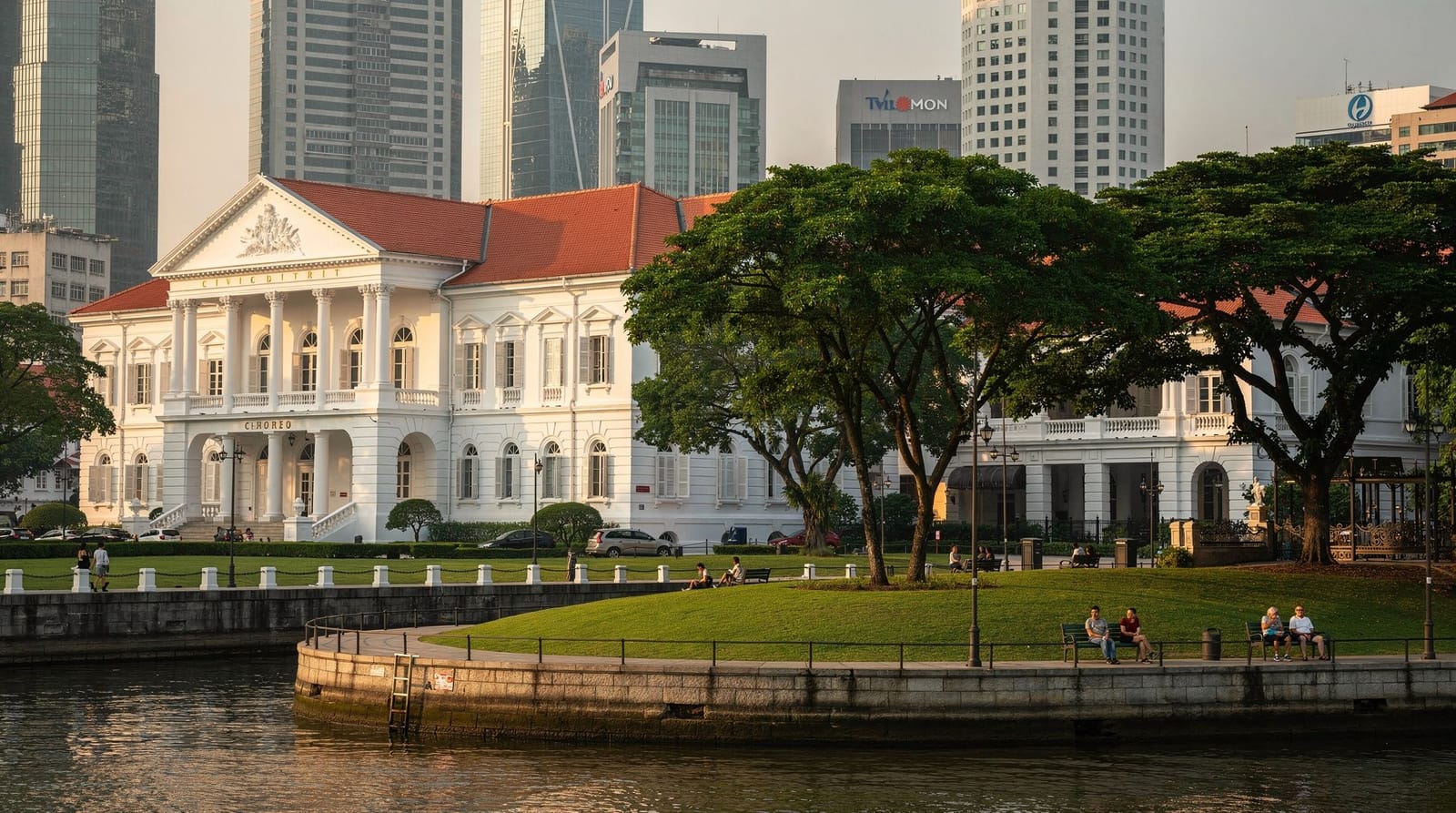
The main block of the National Museum is a late Victorian Neoclassical building (completed 1887) with a large rotunda dome and symmetrical facade. The building has been through several significant renovations, most recently a major extension opened in 2006 that added the glass-and-steel contemporary wing, now housing the Living Galleries.
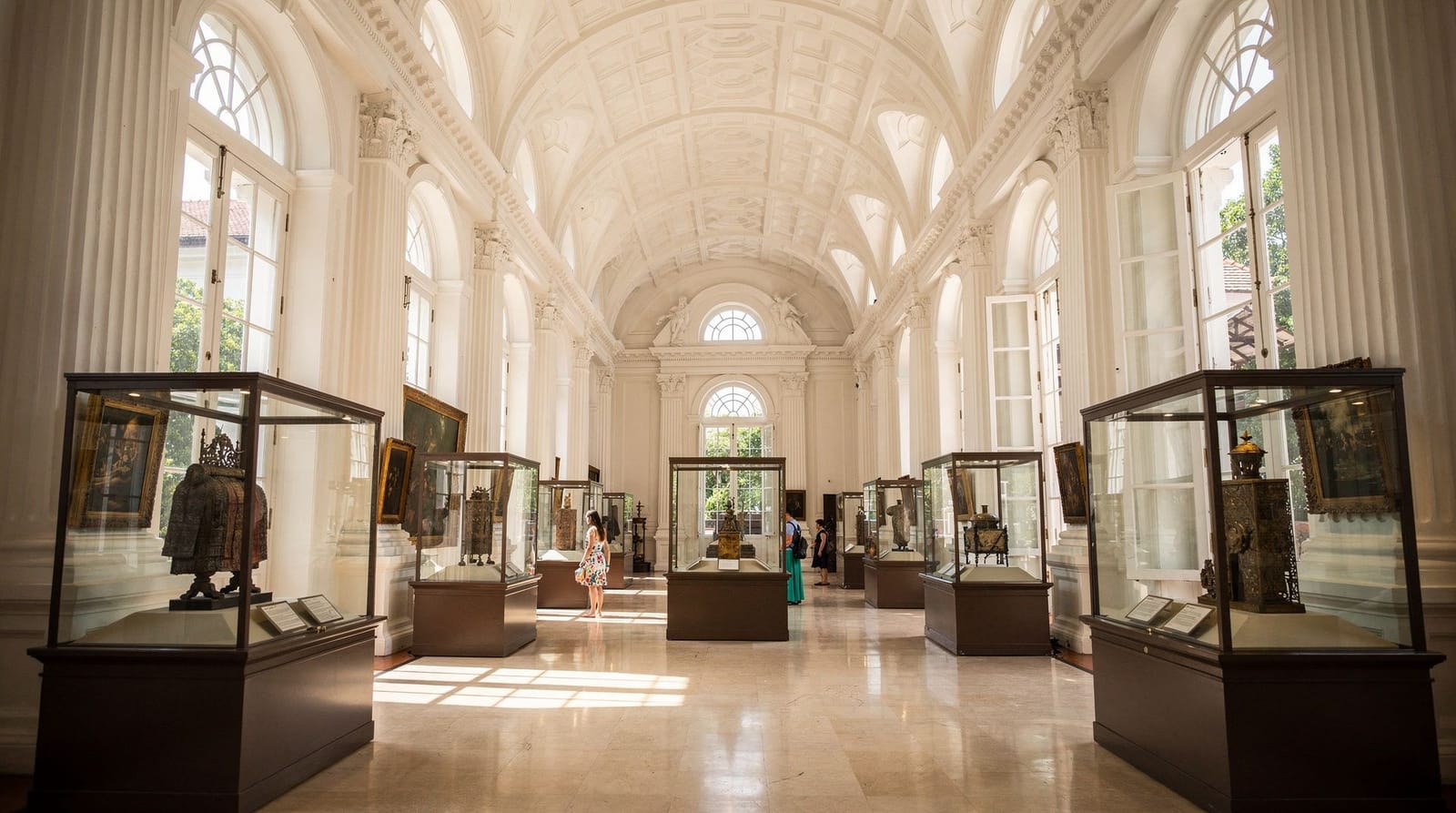
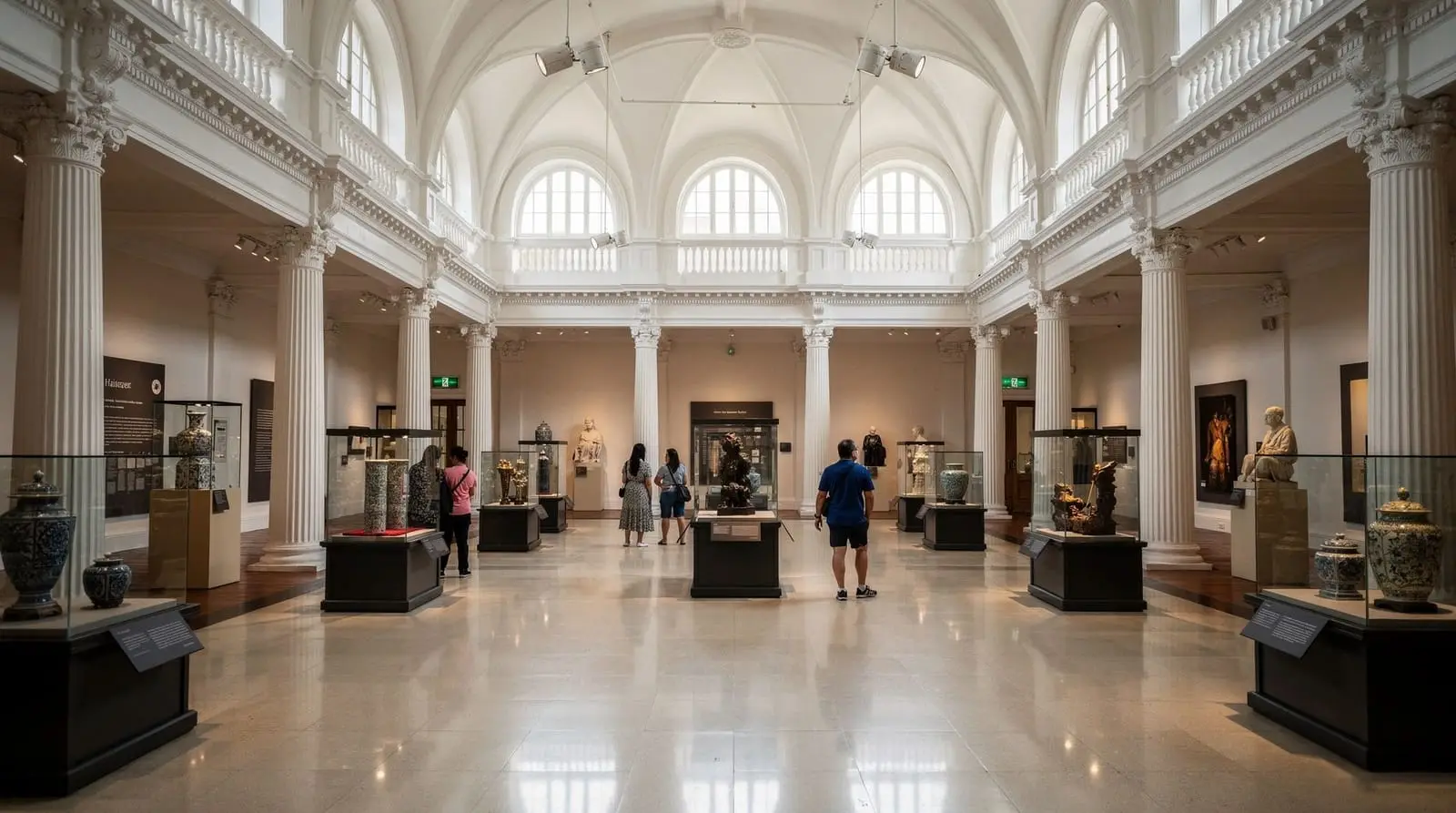
The interior rotunda — with its stained-glass panels depicting the early history of Singapore under the dome — is one of the more atmospheric spaces in the city. The original galleries have high ceilings, marble floors, and the scale of serious Victorian civic architecture.
Walking the building as well as the collection is part of the experience.
Singapore History Gallery
The Singapore History Gallery on Level 2 of the main building is the museum’s centrepiece and the best single resource in Singapore for understanding the city’s history. The gallery is divided into chronological sections:
Early Singapore (before 1819): The Malay kingdom of Temasek, the Javanese and Malay accounts of early settlement, and the Malay Annals references. The famous 14th-century Singapore Stone fragment (with an undeciphered inscription that was largely destroyed by the British in 1843) is one of the key artefacts here.
Colonial Singapore (1819–1942): The arrival of Stamford Raffles and the establishment of the trading post; the growth of the immigrant city; the shophouse districts; the colonial economy; and the social stratification of the colonial period. The gallery is honest about the exploitative dimensions of colonial rule as well as the genuine infrastructure and institutional development that accompanied it.
The Japanese Occupation (1942–1945): This section is the most historically significant and most emotionally intense. The fall of Singapore in February 1942 — Churchill called it “the worst disaster and largest capitulation in British history” — and the subsequent three and a half years of Japanese rule are covered with documentary photographs, personal testimonies, and artefacts. The civilian internment experience, the Sook Ching massacre of Chinese civilians, and the conditions of everyday life under occupation are presented with appropriate seriousness.
Self-government and independence (1945–1965): The post-war period, the British decolonisation process, the merger with Malaysia in 1963, and the separation and independence of Singapore on 9 August 1965. The political complexity of this period — including the suppression of communist-aligned trade unions and political opponents — is covered honestly.
Modern Singapore (1965–present): The rapid industrialisation, housing programme, education system, and economic development of Singapore’s first decades of independence; the transition from Lee Kuan Yew to subsequent leaders; and Singapore’s position in the contemporary world. This section is the most balanced presentation of Singapore’s development that exists in a publicly accessible format in the country.
Living Galleries
The Living Galleries on Level 1 of the glass wing cover Singapore’s cultural and social life in the 20th and 21st centuries. Four main gallery spaces:
Fashioning Singapore: the history of clothing and fashion in Singapore from immigrant community dress to contemporary fashion — Peranakan baju kebaya, Indian sari, the evolution of Western dress in Singapore, and the fashion industry today. Well-curated and accessible.
Singapore Cinematics: Singapore’s film history, from the early Malay-language films of the 1950s and 1960s through the decline and revival of Singapore cinema, including the contemporary Singapore new wave (Eric Khoo, Jack Neo, Anthony Chen).
Goh Seng Chew Photo Collection: a collection of documentary photographs from Singapore’s 20th century — faces, streets, and daily life from the 1920s through the 1980s. One of the gallery’s most humanising sections.
The Food Gallery: Singapore’s food culture as social history — the development of the hawker centre system, the specific dishes that defined immigrant communities, and food as memory and identity. The most immediately engaging gallery for most visitors and connects directly to the experience of eating at hawker centres during your trip.
Special exhibitions
The museum runs rotating special exhibitions alongside the permanent galleries, typically focusing on specific periods of Singapore history, particular communities or cultural practices, or connections with the broader region. The quality is generally high. Check the museum website for current programming.
Around the museum
The National Museum sits in the Bras Basah-Bugis arts district, with several other significant institutions within easy walking distance:
- Singapore Art Museum (SAM, 71 Bras Basah Road, across the street) — contemporary Southeast Asian art, often with strong political and social engagement. In a former 19th-century school building.
- Fort Canning Park (directly behind the museum, up the hill) — a historic park on the hill that was the seat of early Malay royalty, colonial military headquarters, and the site of Raffles’ early botanical garden. Free entry, and one of the most historically layered sites in Singapore. See Fort Canning.
- National Gallery Singapore (10 minutes walk south) — Singapore and Southeast Asian fine art. See National Gallery guide.
- Peranakan Museum (Armenian Street, 10 minutes walk) — the most focused museum of Peranakan culture, currently undergoing renovation; check current status before visiting. See Peranakan Museum.
Buying tickets
Standard admission is SGD 15 for international visitors. Pre-booking online is useful for planning but the museum rarely sells out; same-day tickets at the counter are usually available. Singapore residents with NRIC or valid ID enter free.
For a combined museum and sightseeing day:
Singapore: National Gallery entry ticketsAnd for a city overview before diving into the museum district:
Singapore: hop-on hop-off sightseeing FunVee city tourPractical information
Address: 93 Stamford Road, Singapore 178897 MRT: Bras Basah (CC2) Exit B (5 min walk); or Dhoby Ghaut (NS24/NE6/CC1) (8 min walk) Opening hours: Daily 10:00–19:00 (last entry 18:30). Café and museum shop open from 10:00. Admission: SGD 15 adults; Singapore residents free; children under 6 free Best time: Weekday mornings — quietest, best for the History Gallery. The museum has good air-conditioning throughout, making it an excellent rainy-day option.
For Singapore’s broader museum landscape: museums Singapore guide and free museums Singapore.
The Singapore Stone and other artefacts worth slowing down for
Beyond the headline galleries, a handful of individual objects reward a slower look. The 14th-century Singapore Stone fragment is easy to walk past but represents one of the few physical traces of pre-colonial Singapore that survives at all — most of the original slab was blown up by the British in 1843, and what remains is a genuine rarity. In the Japanese Occupation section, the personal testimony recordings are more affecting than the photographs alone; setting aside ten minutes to listen rather than just read the panels changes how the section lands. The museum shop near the exit also stocks a better-than-average selection of Singapore history books if you want to keep reading after the visit.
Reading the museum before you explore the city
The single biggest return on time here is sequencing: visit the National Museum early in your trip, ideally on day one or two, so the Singapore History Gallery gives context to everything you see afterwards. Sites that otherwise look like unremarkable streets or buildings — the shophouse rows of Chinatown, the colonial buildings of the Civic District, the war memorials scattered around the island — read very differently once you understand the Japanese Occupation section and the independence story. This is the rare museum visit that actively improves the rest of the trip rather than simply being one more attraction on the list, which is why it belongs early in a first-timer itinerary rather than saved for a rainy afternoon.
Combining with Fort Canning and the arts district
Because the museum sits directly below Fort Canning Park, a natural half-day combines the two: museum in the cooler morning hours, then a walk up the hill through Fort Canning’s colonial and Malay royal history sites once the History Gallery has given you the background to appreciate them. The wider Bras Basah-Bugis arts district around the museum also rewards a slow wander — see Bugis Singapore for the surrounding streets, markets, and independent galleries that fill out an arts-focused day.
Frequently asked questions about the National Museum of Singapore
How long should I spend at the National Museum?
Two to three hours covers the Singapore History Gallery and one or two Living Galleries comfortably. If you want to see both the permanent collection and a special exhibition, allow 3–4 hours. The museum has a café on Level 1 and a museum shop at the exit — factor those in if you plan to use them.
Is the National Museum air-conditioned?
Fully air-conditioned throughout — one of the better air-conditioned spaces in Singapore given how large it is. An excellent choice on particularly hot days or during rain. The outdoor areas (the grounds and the courtyard) are not air-conditioned, but the galleries and walkways between them are.
What language is the National Museum in?
All gallery labels, text panels, and audiovisual content are in English. The museum is accessible to English-speaking visitors without translation. Some exhibitions may have multilingual elements.
Is the National Museum good for understanding Singapore before arriving?
If you can read about the museum before your visit (the Singapore History section focuses heavily on colonial and post-colonial history), it provides a strong foundation for understanding what you see as you travel around the city. The Japanese Occupation section in particular gives context for many specific sites and memorials around Singapore.
What is the difference between the National Museum and the Asian Civilisations Museum?
The National Museum focuses on Singapore’s specific history — local, national, and political. The Asian Civilisations Museum (1 Empress Place, on the river) covers the material culture of Asia’s civilisations more broadly — ceramics, textiles, religious art, and everyday objects from China, India, Southeast Asia, West Asia, and the Islamic world. Both are excellent; the National Museum is the better starting point for Singapore first-timers.
Top experiences
Bookable activities with verified prices and instant confirmation on GetYourGuide.