Kampong Glam
Kampong Glam is Singapore's Malay-Arab quarter — Sultan Mosque, colourful Haji Lane, perfume shops, and some of the city's best Middle Eastern food.
Singapore: Little India and Kampong Glam hidden trails
Quick facts
- Character
- Malay-Arab heritage quarter, street art, independent boutiques
- MRT access
- Bugis (East-West/Downtown lines) — 8 min walk to Sultan Mosque
- Key streets
- Haji Lane, Arab Street, Baghdad Street, Bussorah Street
- Landmark
- Sultan Mosque (1932), Malay Heritage Centre
- Best time
- Late afternoon into evening; avoid Friday midday (mosque prayers)
Kampong Glam occupies a narrow strip of the city between Bugis MRT and the Kallang waterway — small in area, disproportionately dense with things worth seeing. It is Singapore’s Malay-Arab quarter, gazetted as a Malay settlement under Raffles’ 1822 town plan and still carrying much of that identity in the mosques, madrasahs, perfume traders, and textile merchants that line Arab Street and its tributaries.
| Where | Between Bugis MRT and the Kallang waterway |
| Cost | Free to walk; Malay Heritage Centre around SGD 6 |
| Time needed | Half a day; pairs well with Little India for a full day |
| Getting there | Bugis MRT (East-West/Downtown lines), 5–8 min walk |
| Best time | Weekday late afternoon into evening; avoid Friday 12h–14h |
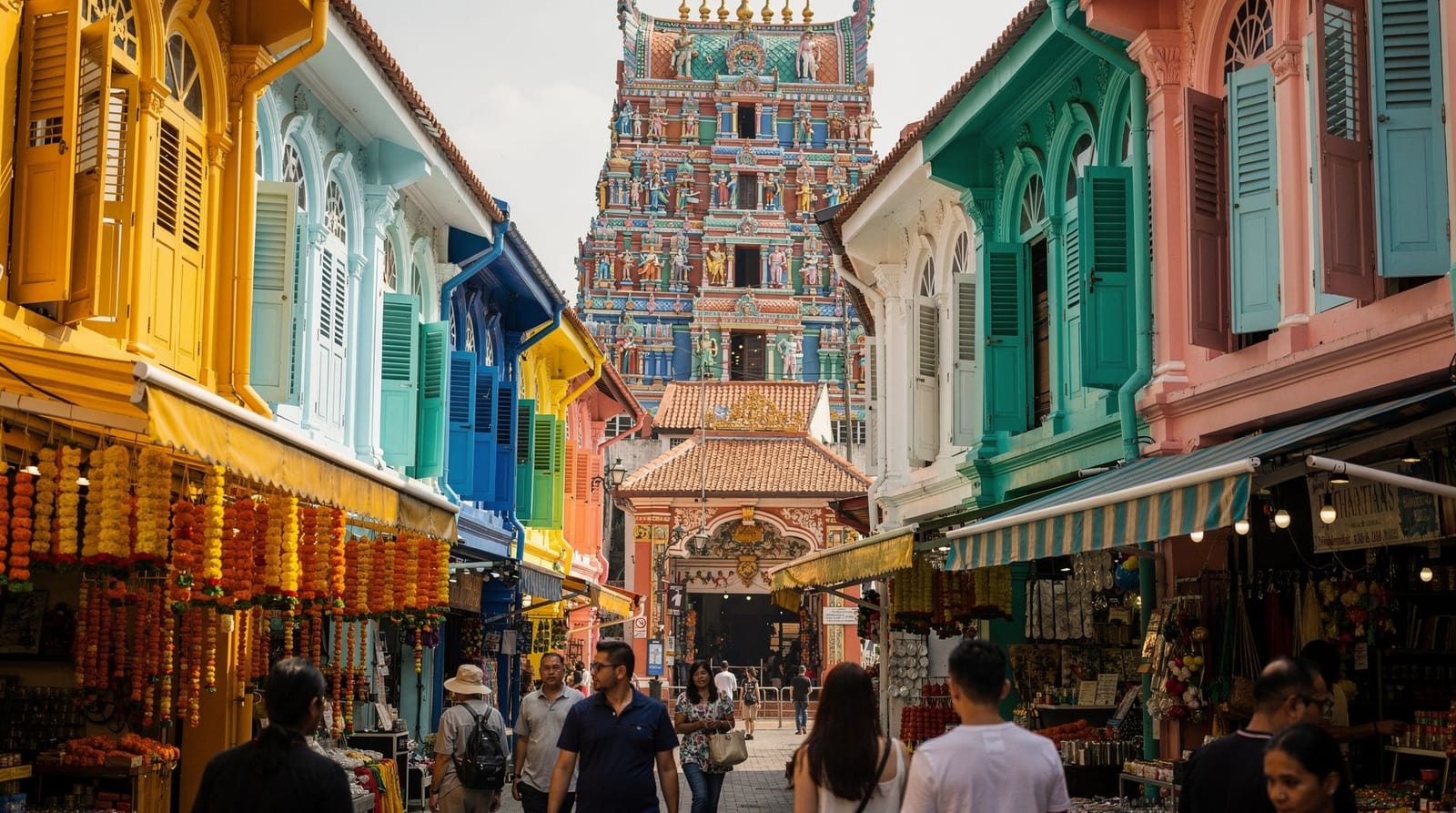
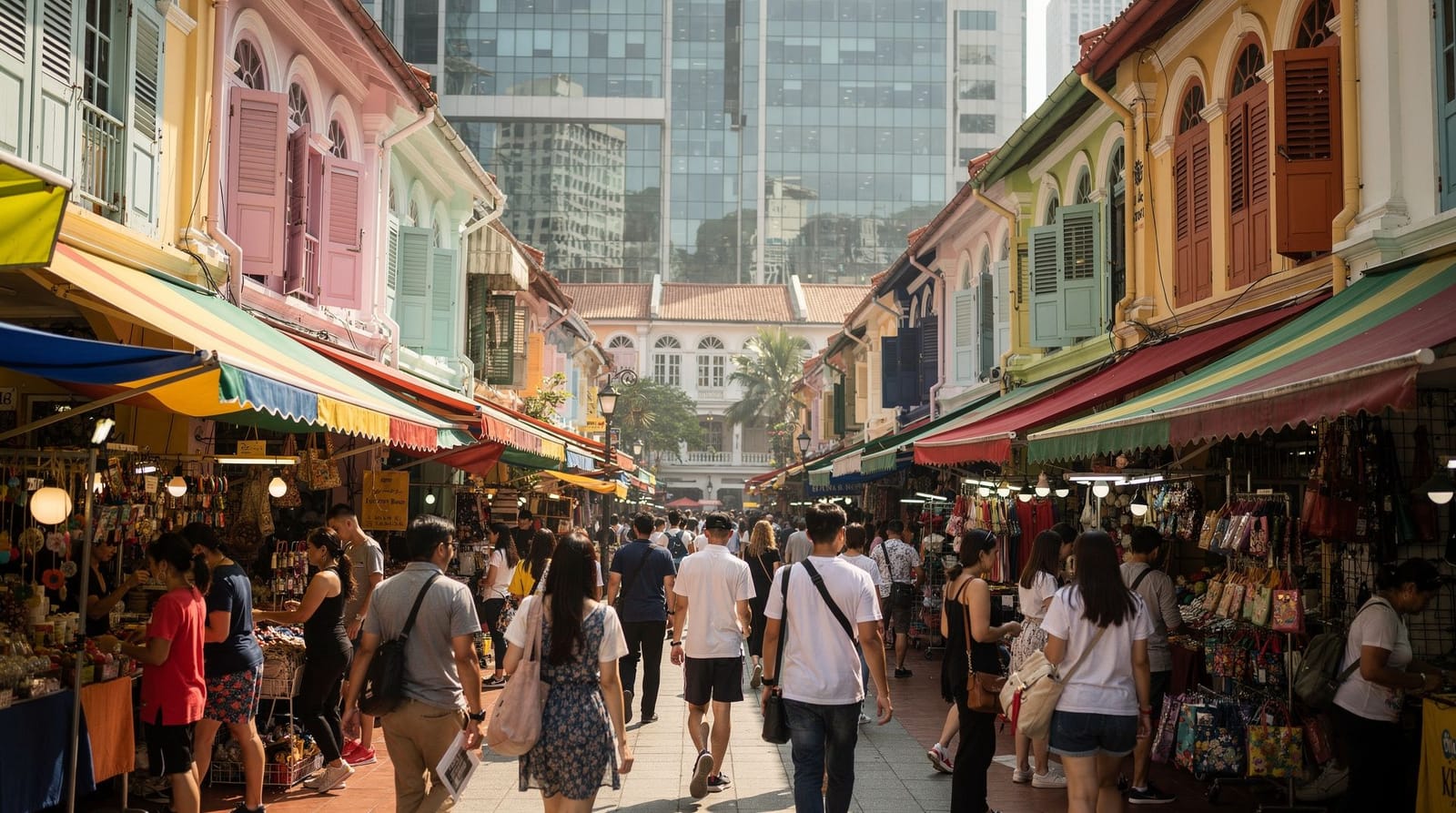
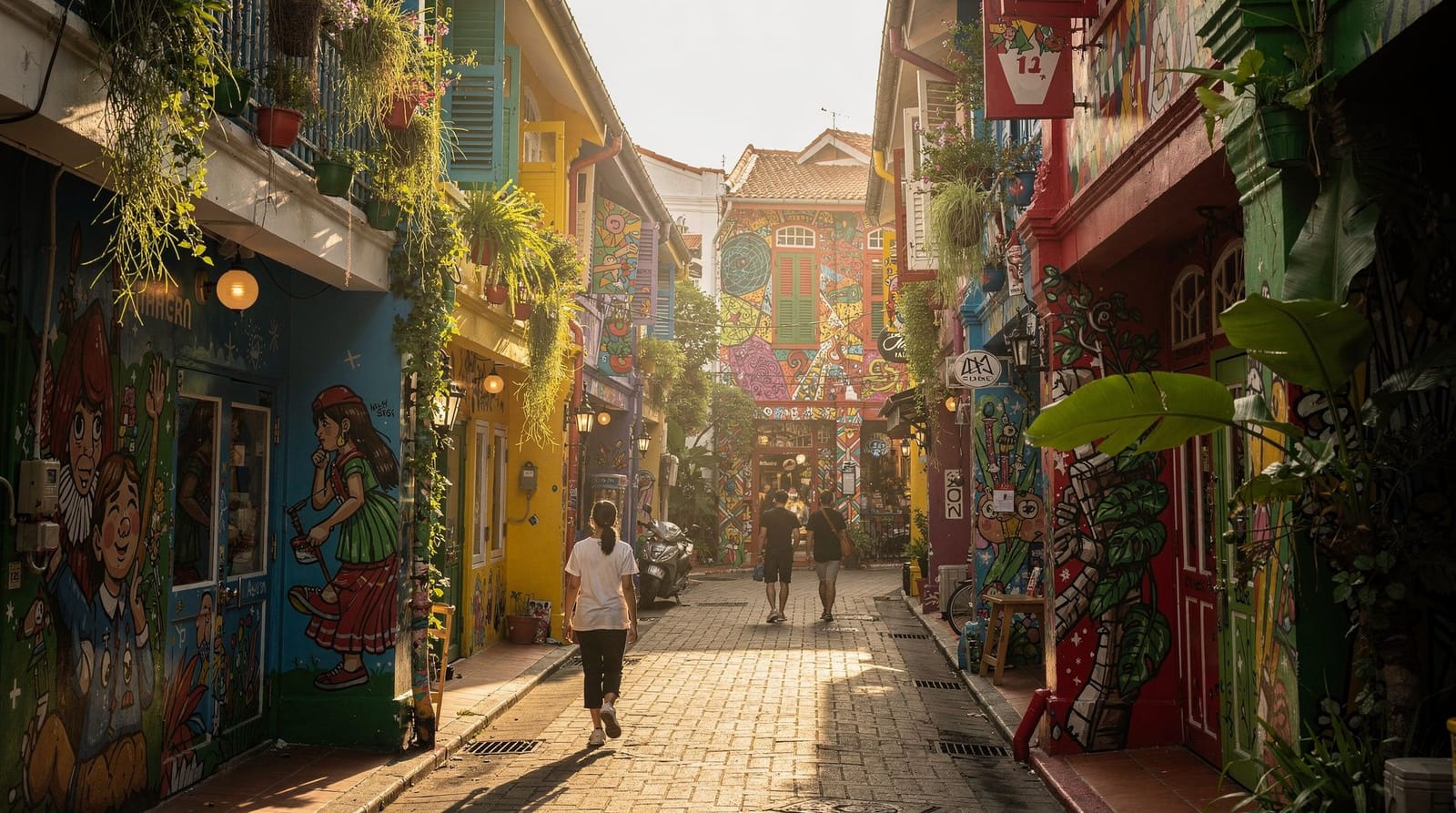
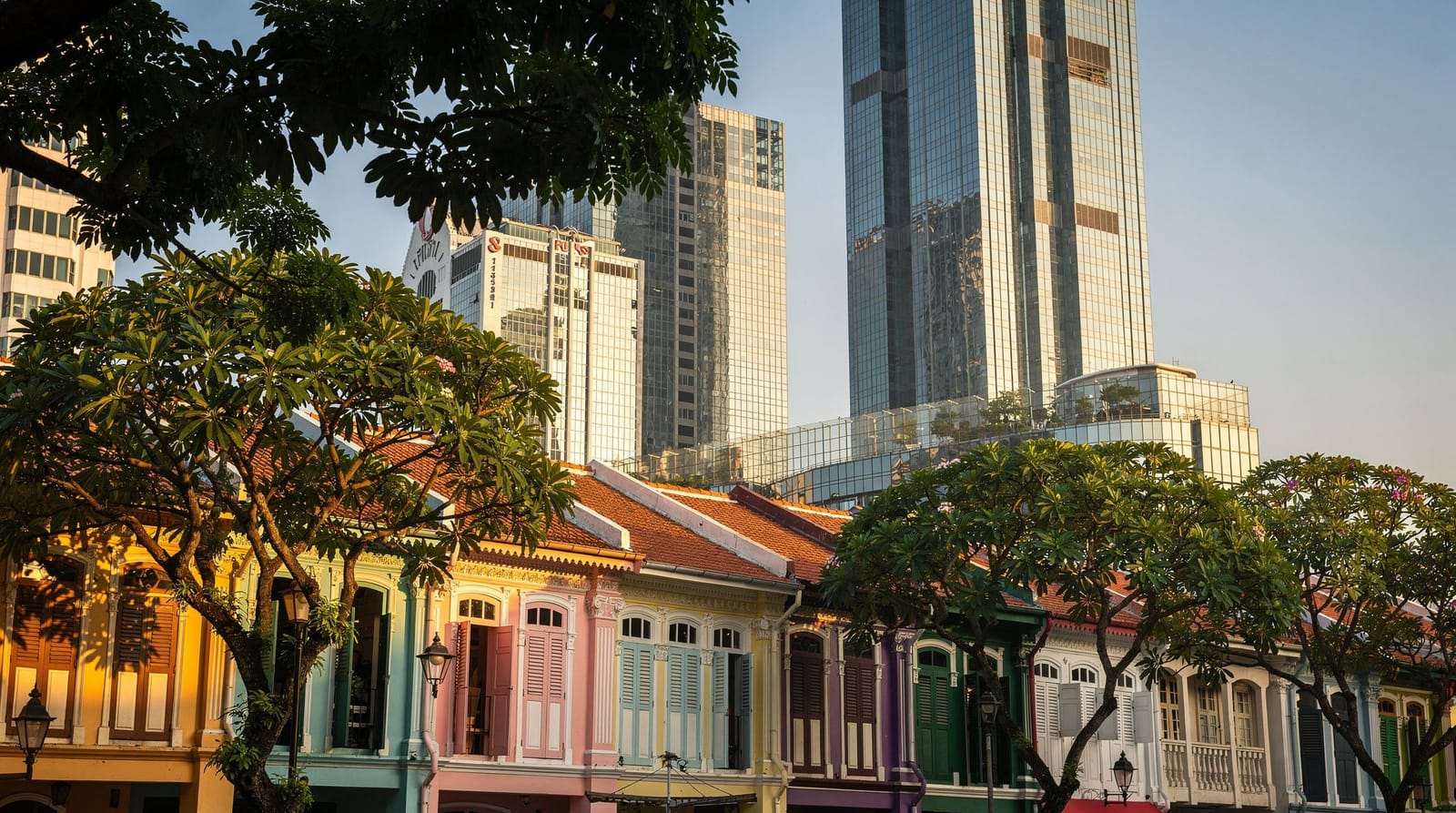
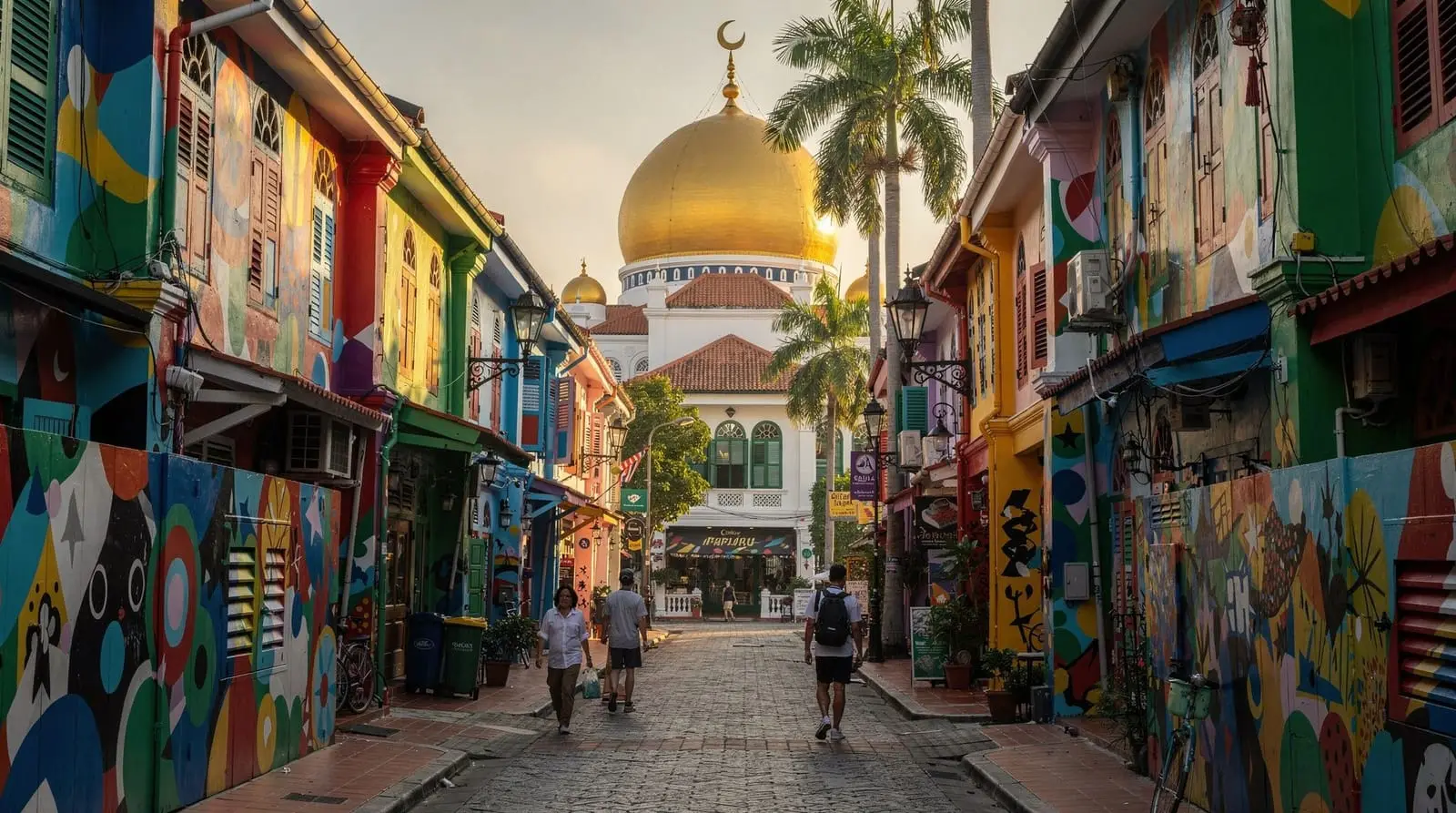
The pitch to the standard tourist is “colourful Haji Lane.” That is a reasonable starting point but only the surface. The lane is genuinely photogenic — tightly packed shophouses painted in pastels and murals, boutiques selling things that are not available at Changi Airport, small cafés with outdoor seating. But it fills up fast on weekend mornings, and the experience is better mid-week and in the late afternoon when light is warmer and crowds are thinner.
The Sultan Mosque and Bussorah Street
Sultan Mosque on North Bridge Road is the dominant landmark — a golden dome visible from several blocks away, built in 1932 and one of Singapore’s most important Islamic buildings. Entry is free for non-Muslim visitors outside prayer times; modest dress is required (sarongs available at the entrance if needed). The interior is calm and genuinely beautiful. The courtyard at the base of the dome is made from the bottom halves of glass bottles — thousands of them — donated by the congregation when funds ran short during construction. This detail is not widely advertised; look for it.
Bussorah Street runs south from the mosque, a wide, fountain-lined pedestrian street lined with Middle Eastern restaurants and shisha cafés. It is one of the more pleasant stretches of pavement in central Singapore, particularly in the evening. Al-Tazzaq and Zam Zam (on North Bridge Road, near the mosque) are the heritage institutions for murtabak and biryani — Zam Zam has been operating since 1908.
For a deeper look at the mosque and the quarter’s Islamic heritage, the Sultan Mosque guide covers visiting logistics and history in detail.
Haji Lane — honest assessment
Haji Lane is a single-lane alley about 200 metres long, running parallel to Arab Street. It has become one of Singapore’s most photographed streets. The murals change periodically; the boutiques turn over every year or two. What you find is a legitimate concentration of independent fashion, vinyl records, ceramics, craft coffee, and small bars — and a density of amateur photographers that on weekend mornings can make the lane itself feel like a set rather than a place.
The practical advice: visit before 10h or after 17h if you want photographs without people in them. The boutiques open later (11h–12h most days), so the shops are more interesting in the afternoon. Several are genuinely worth browsing — Dulcetfig, In Good Company (local label), Garçon Garçon. None of them are cheap.
The Haji Lane photography guide has specific shooting locations and timing advice.
Photography session at Haji Lane — guided, with a professional photographerArab Street and the textile traders
Arab Street is the original commercial artery of the quarter, pre-dating Haji Lane’s reinvention by a century. The shophouses here have traded in textiles, batik, rattan, and basket-weaving materials since the early 20th century. Some of these businesses are still family-run; prices are negotiable on larger purchases.
The street has become more mixed — coffee shops, furniture stores, some tourism-oriented souvenir shops — but the textile traders remain, and if you need batik fabric, brassware, or prayer rugs, this is the place in Singapore to buy them at non-souvenir prices. Hadjee Textiles and Sun Hong are the surviving old-school names.
Malay Heritage Centre
On the site of the original Istana Kampong Glam (the former Malay royal palace), the Malay Heritage Centre museum covers the history of the Malay community in Singapore from the earliest settlements to the present. Entry is SGD 6 for adults, free for Singaporeans and PRs. The building itself is worth seeing — the 1843 Istana facade surrounds a modern museum interior.
It is a modest museum by international standards, with a focus on textiles, oral history, and material culture. Worth 45–60 minutes if you have an interest in the quarter’s background; skippable if you are pressed for time.
The perfume district
The stretch of Arab Street, Baghdad Street, and Bali Lane between Haji Lane and Aliwal Street has a notable concentration of traditional perfumers selling Arabic-style attars (oil-based perfumes without alcohol). Jamal Kazura Aromatics on Baghdad Street has been here since 1933 and is the most established; the family-run shop sells both stock fragrances and custom blends mixed on request.
Atar perfumes are a niche purchase but an authentic one — this is not something you find in Singapore’s malls. Prices start around SGD 15–25 for small bottles; custom blends run higher.
Getting to Kampong Glam
Bugis MRT (East-West Line and Downtown Line) is the main access point — about 8 minutes’ walk to Sultan Mosque and 5 minutes to Haji Lane via Victoria Street. The walk from Nicoll Highway MRT (Circle Line) is about the same distance from the northeast. Taxis and Grab drop you on North Bridge Road.
The neighbourhood connects naturally with Bugis to the west and Little India to the north — a logical full-day walking itinerary covers all three. For routing ideas, see the ethnic quarters guide.
Little India and Kampong Glam hidden trails — guided walking tourWhat to eat
Beyond Zam Zam and the Bussorah Street restaurants, a few specific recommendations:
Hjh Maimunah on Jalan Pisang — Malay-Javanese cuisine, a local institution with a Bib Gourmand designation. Nasi padang (rice with a selection of cooked dishes) around SGD 8–12 per person. Queue is standard; it moves quickly.
Blu Jaz Café on Bali Lane — the neighbourhood’s main live music venue, also serves food. Local jazz acts most evenings from around 20h. Drinks are reasonably priced for the area.
Piedra Negra on Haji Lane — Mexican food, reliably good, serves until late. Useful if the Middle Eastern options are full.
The best hawker centres guide covers where to eat affordably across the city; Kampong Glam itself skews toward sit-down restaurants rather than hawker centres.
The Vespa sidecar experience
One of the more unusual ways to see the quarter is by Vespa sidecar — a 1–2 hour ride through Kampong Glam and the Civic District in a classic sidecar rig. The experience is genuinely fun and gives access to some of the smaller lanes that a standard walking tour covers quickly. It is a splurge (around SGD 155 per vehicle), but works well for couples or pairs.
Kampong Glam and Civic District Vespa sidecar tourKampong Glam versus the other cultural quarters
Singapore has three walkable ethnic heritage quarters within a short distance of each other, and visitors with limited time often need to choose. A rough comparison:
| Quarter | Character | Food strength | Best time |
|---|---|---|---|
| Kampong Glam | Boutique, street art, calmer | Middle Eastern, Malay sit-down | Late afternoon–evening |
| Little India | Dense, sensory, commercially active | Cheap South Indian hawker food | Morning market, evening temples |
| Chinatown | Heritage shophouses, temples, tourist-dense | Hawker food, Michelin street stalls | Any time, avoid peak lunch |
All three are connected by MRT or a manageable walk, and the ethnic quarters guide has suggested routes for combining two or all three in a single day.
What is changing
The tension in Kampong Glam is the same as in most of Singapore’s heritage districts: rising rents pushing out older traders, replacement by cafés and boutiques oriented toward Instagram rather than community. Haji Lane reflects this most visibly — it turned over from a working street to a tourist attraction within a decade. Arab Street’s textile district is more stable because the customer base (Muslim community, textiles traders) is less sensitive to the Instagram cycle.
The area is still genuinely worth visiting, but if your interest is in the living Malay-Arab community rather than the boutique layer, the main mosque, Hjh Maimunah, and the Malay Heritage Centre are where it is most present. See also kampong-glam-haji-lane day blog post for a recent street-level account.
For a planned itinerary that integrates Kampong Glam with other cultural quarters, the 3-day Singapore itinerary and first-timer itinerary both include logical routing.
Frequently asked questions about Kampong Glam
Is Kampong Glam worth visiting beyond Haji Lane?
Yes. Sultan Mosque and Bussorah Street are the more architecturally significant parts of the quarter; Haji Lane is the most photographed. The whole area takes about 2–3 hours at a relaxed pace. The perfume district on Baghdad Street is a specific reason to linger that most visitors miss.
Can non-Muslims visit Sultan Mosque?
Yes, outside of prayer times (5 times daily; Friday midday is the busiest). The mosque has a visitors’ entrance on the side; sarongs and head coverings are provided free at the entrance for those not appropriately dressed. No photography inside the prayer hall; the courtyard and exterior are fine.
When is the best time to visit Haji Lane?
Weekday mornings before 11h for the fewest people and the best light for photography. Weekday late afternoon (17h–19h) for a balance of activity and manageable crowds. Weekend mornings are heavily photographed; weekday evenings are when the bars and cafés are at their most lively.
How does Kampong Glam compare to Little India?
Both are ethnic heritage quarters worth visiting. Little India is denser, noisier, and more commercially active (Mustafa Centre, flower garland sellers, the main Deepavali celebrations). Kampong Glam is quieter, more boutique-oriented, with better sit-down food options and more street art. They are 20 minutes apart on foot and make a natural pair.
Is there a hawker centre in Kampong Glam?
Not within the quarter itself. The nearest hawker options are at Bugis+ food court (mid-range, not traditional), or a short walk to Albert Centre Market and Food Centre on Bugis Street. For traditional hawker food in the area, best hawker centres lists the closest.
Is Kampong Glam safe at night?
Yes — Singapore’s very low crime rate applies throughout the quarter. The area around Haji Lane and Bali Lane has bars open until late and a steady street presence. Standard urban sense applies.
What should I combine Kampong Glam with in one day?
Little India is the natural pairing — about 20 minutes on foot or a short MRT ride, and both are cultural quarters best explored at a similar unhurried pace. The ethnic quarters guide has a suggested route that covers both without feeling rushed, and the 3-day Singapore itinerary shows where it fits into a longer trip.
Do I need a guided tour to appreciate Kampong Glam?
No — the quarter is compact and easy to explore independently, and this guide covers the key sights. A guided tour adds context (history, food recommendations you wouldn’t find alone) and works well if you want the Vespa sidecar novelty or a combined Little India and Kampong Glam route without planning it yourself.
Top experiences
Bookable activities with verified prices and instant confirmation on GetYourGuide.