Sultan Mosque Singapore: visitor guide with honest dress code tips
Flagship Singapore cultural city tour
Can tourists visit Sultan Mosque in Singapore?
Yes. Sultan Mosque (Masjid Sultan) at 3 Muscat Street in Kampong Glam is open to non-Muslim visitors. Entry is free. Full-length robes are provided at the entrance for visitors not meeting the dress code (covered hair for women, covered arms and legs for all). Visitor access is restricted during the five daily prayer times — arrive between 10 am–noon or 2–4 pm on weekdays for the most comfortable visit. Remove shoes before entering. The interior and the surrounding Kampong Glam neighbourhood together make for a rewarding half-morning.
Quick answer: Sultan Mosque is Singapore’s most significant Islamic monument and a free visit. Non-Muslim visitors are welcome with covered arms, legs, and hair — robes provided at the entrance. Visit between 10 am–noon or 2–4 pm. Pair with a walk through Bussorah Street and Haji Lane for a half-morning in Kampong Glam.
| Where | 3 Muscat Street, Kampong Glam (destination guide) |
| Cost | Free (robes provided free) |
| Visitor hours | Sat–Thu around 10 am–noon and 2–4 pm; Fri 2:30–4 pm |
| Getting there | MRT Bugis (EW12/DT14), then 8–10 min walk |
| Time needed | 20–30 min inside; 1.5–2 hrs with Bussorah Street and Haji Lane |
About Sultan Mosque
Masjid Sultan — Sultan Mosque — is the spiritual heart of Singapore’s Malay-Muslim community and one of the most architecturally distinctive buildings in the city. Its golden dome and twin minarets are visible across the rooflines of Kampong Glam and appear in more photographs of Singapore than almost any other religious building.
The mosque stands at 3 Muscat Street, reached via the Bussorah Street pedestrian precinct — a tree-lined mall with restaurants, souvenir shops, and a clear sight line to the golden dome that makes it one of the more photogenic street approaches in Singapore.
History of the mosque
The original Sultan Mosque was built in 1824, two years after Singapore’s founding. Sultan Hussein Shah — who had signed the 1819 treaty with Raffles that established the British East India Company’s presence in Singapore — was granted a subsidy of SGD 3,000 by Raffles for the construction of a mosque. The funding came with the condition that the site serve not only the Malay community but also Indian Muslim traders who were essential to early Singapore’s commerce.
This original structure was a more modest building on the same site. By the early 20th century, it had fallen into disrepair and was demolished. The current building was constructed between 1924 and 1928 to designs attributed to Denis Santry of Swan & Maclaine, a British architectural firm working extensively in Southeast Asia at the time. The brief was for a mosque appropriate to Singapore’s status as a major colonial port city — the result was a Saracenic Revival design drawing on Persian and Mughal precedents but adapted for the tropical climate.
The mosque was gazetted as a National Monument of Singapore in 1975 and remains under the management of the Majlis Ugama Islam Singapura (MUIS, the Islamic Religious Council of Singapore).
Architecture: what to look for
The golden dome: The mosque’s most prominent feature is its large central dome, covered in gleaming gold-coloured material that catches the light dramatically in the late afternoon. The dome sits above the main prayer hall. A second, smaller dome flanks it.
The minarets: Two tall square minarets frame the main entrance facade, following the Ottoman and Mughal tradition of flanking towers from which the adhan (call to prayer) is made. In modern Singapore, loudspeakers mounted on the minarets carry the amplified call across the surrounding neighbourhood.
The glass bottle base: An unusual detail noted by architects and historians — the base of the mosque’s main dome is ringed by a decorative band incorporating glass bottles (various accounts suggest these came from the poor of the community, who donated bottles when they could not donate money for construction). This is partially obscured from ground level but visible in closer examination from inside or from photographs.
The main prayer hall: The interior is a large, carpeted open space with minimal furniture — the Islamic prayer tradition requires nothing more than a clean, flat surface oriented toward Mecca (the qibla, indicated by the mihrab niche in the wall). The visual richness comes from the tilework, the geometric ceiling decoration, and the calligraphic panels bearing Quranic verses in Arabic script.
The Saracenic Revival style: The architecture intentionally blended Islamic historical styles — Moorish horseshoe arches, Persian ornamental tilework, Mughal bulbous dome form — into a synthesis appropriate for a multi-origin Muslim community in colonial Singapore. This architectural eclecticism parallels the multicultural reality of Singapore’s Islamic community itself.
Visiting as a non-Muslim
Sultan Mosque genuinely welcomes non-Muslim visitors outside prayer times. The mosque has an information desk, multilingual signage, and staff who are accustomed to guiding curious visitors through the etiquette.
Dress code in practice:
- Women: Cover hair (bring a scarf or use the robe), cover arms to at least the elbow, cover legs to at least the knee
- Men: Cover arms (short sleeves are acceptable; tank tops are not), cover legs to the knee minimum
- Both: Remove shoes at the entrance shoe rack (flip-flops are fine — you slip them off and leave them, then collect on exit)
The provided robes: The mosque provides simple full-length jubah robes in green and purple at no charge. There is a self-serve rack at the main entrance. Pick up a robe, wear it over your existing clothes, enter, and return it when leaving. This system is standard at mosques throughout Southeast Asia and you should not feel self-conscious about using it.
Prayer times: The five daily prayers (Subuh, Zohor, Asar, Maghrib, Isyak) last approximately 15–20 minutes each. During prayer times, non-Muslim visitors are asked to remain in the outer areas or wait outside until prayers conclude. The visit times above (10 am–noon and 2–4 pm on most days) are structured to avoid the Zohor (midday) prayer. Friday afternoon has additional restrictions for the Jumu’ah congregational prayer.
Photography: Photography is permitted in the mosque’s exterior and in the main hall when prayer is not in progress. Photographing worshippers at prayer without permission is not appropriate. The exterior, the dome, and the Bussorah Street approach are all excellent photography subjects.
The Kampong Glam neighbourhood
Sultan Mosque sits within the larger Kampong Glam heritage district — designated by the Singapore government as a conservation area for its Malay-Muslim built heritage. The neighbourhood extends several blocks in each direction and rewards an hour of walking.
Bussorah Street: The pedestrian street directly in front of the mosque is lined with restaurants offering Middle Eastern food (hummus, shawarma, biryani), Malay food, and a row of souvenir and craft shops. It is pleasant for a pre or post-mosque meal — several of the restaurants have outdoor seating with a direct view of the golden dome. All are halal.
Arab Street: Running perpendicular to Bussorah Street, Arab Street is Singapore’s traditional textile and craft market. Rattan ware, batik fabric, lace, traditional Malay dress, and handmade baskets are available at shops that have been on this street since the 19th century. Not a tourist trap — these are working businesses with regular wholesale customers.
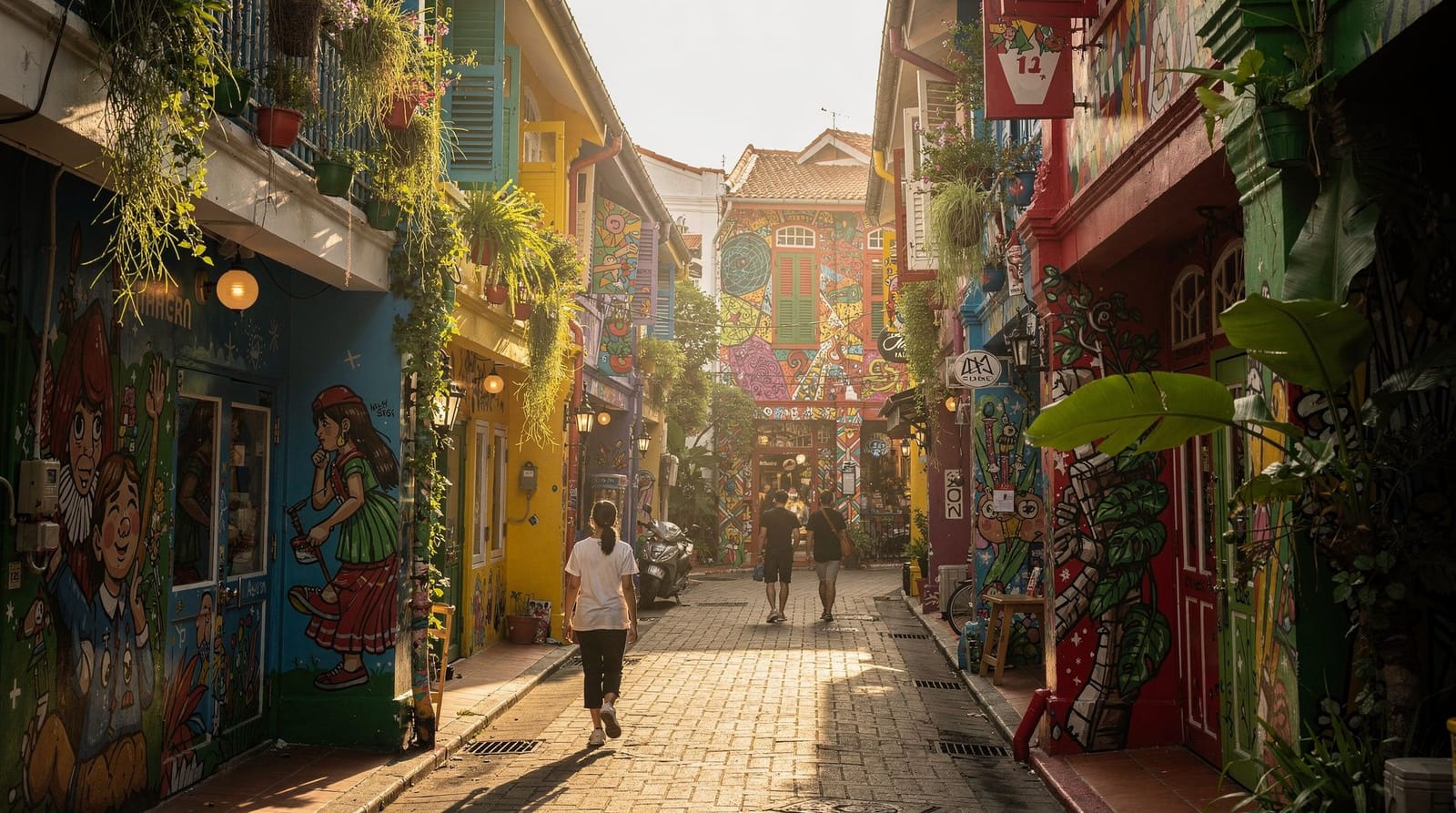
Haji Lane: The contrasting face of Kampong Glam — a narrow alley between Bussorah Street and Beach Road lined with independent clothing boutiques, vintage shops, cafes, and street art. Younger, more creative, and a useful reminder that cultural quarters evolve rather than freeze. Best photographed in the morning before the cafe crowds arrive. See Kampong Glam and Haji Lane for the full neighbourhood guide.
Malay Heritage Centre (85 Sultan Gate): The former Istana Kampong Glam (palace of the Malay sultans) has been converted into a museum covering Malay history, culture, and heritage in Singapore. Entry approximately SGD 6 adult. Good context for understanding the mosque’s place in Singapore’s Malay community history.
Flagship Singapore cultural city tourGetting to Sultan Mosque
The closest MRT station is Bugis (EW12/DT14), about an 8–10 minute walk via Victoria Street and Arab Street. This is the route most first-time visitors take, and it conveniently drops you into the Arab Street shopping strip before you reach the mosque itself — see the Bugis neighbourhood guide if you want to combine the two areas into one outing. Nicoll Highway (CC5) is a slightly longer walk (12–15 minutes) but avoids the busier Bugis crowds. Grab or taxi from Marina Bay or Orchard Road costs roughly SGD 8–14 depending on traffic. There is limited street parking; a Grab or the MRT is more practical than driving. For general navigation, the MRT guide covers fares and line colours.
Photography and quiet corners
Kampong Glam rewards visitors who slow down and look past the obvious shots. The classic frame is Bussorah Street looking straight at the golden dome — best in the late afternoon (around 5–6 pm) when the light is warm and the crowds have not yet peaked for dinner. For a different angle, the side streets off Baghdad Street give a less-photographed view of the minarets against the shophouse rooflines. The broader Instagram spots guide and best photo spots guide cover more of the neighbourhood’s photogenic corners, including Haji Lane’s murals.
What to skip if you are short on time
If you only have 45 minutes in Kampong Glam, prioritise the mosque exterior and Bussorah Street over a full loop of Arab Street and Haji Lane — the golden dome view and a few minutes inside the prayer hall (outside prayer times) capture the essence of the visit. The Malay Heritage Centre is worthwhile but skippable on a tight schedule; it rewards visitors with an hour to spare rather than those doing a quick photo stop. If you are combining Kampong Glam with several other neighbourhoods in one day, see free things to do in Singapore for how a mosque visit fits into a no-cost itinerary alongside temples and parks.
Placing the mosque in a wider Singapore day
Sultan Mosque makes more sense once you see it as one chapter in a longer story. The Singapore history 101 primer and the colonial Singapore guide explain why a Malay sultan, British administrators and Indian Muslim traders all left their mark on this corner of the city, and reading either before you go changes how the building feels once you step inside.
If the visit leaves you curious about other faiths and communities, the ethnic quarters guide shows how Kampong Glam, Little India and Chinatown sit side by side. The temples of Singapore overview is a natural next read, and two good places to continue are the Sri Mariamman Temple and the Buddha Tooth Relic Temple, both of which ask for similar respect around dress and shoes. For the Chinese and Indian neighbourhoods themselves, see the Little India guide and the Chinatown guide.
For museum context, the Asian Civilisations Museum and the National Museum of Singapore both help put the Malay-Muslim story into the broader picture, and the Peranakan culture guide covers another community whose heritage is easy to miss on a quick trip.
Singapore: temples, Chinatown and Little India private tourA few practical pairings are worth knowing about. The Bugis street markets are a short walk away if you want a cheaper, busier shopping stop after the quiet of the mosque, and the Haji Lane photography guide is useful if the alley is your main reason for the trip. If rain is forecast, the Singapore in the rain guide has ideas for keeping the day going, and the what to pack guide is a reminder to carry a light scarf and modest layers. Visitors with only a single day in the city can see how Kampong Glam might fit into the one-day Singapore itinerary, and the Bugis destination page covers the neighbouring district.
Halal food near Sultan Mosque
The Kampong Glam area has excellent halal options suitable for Muslim travellers observing dietary requirements:
Zam Zam Restaurant (699 North Bridge Road): Operating since 1908, this is Singapore’s oldest Indian Muslim restaurant and one of the most famous. Known for murtabak (stuffed pan-fried bread), biryani, and fish head curry. Affordable and reliable.
Bussorah Street restaurants: Multiple Middle Eastern and Malay restaurants along Bussorah Street, including Alaturka (Turkish), The Olive Tree (Mediterranean), and several Malay-Singaporean establishments. All halal.
Tekka Centre (48 Serangoon Road, Little India): A 15-minute walk or short MRT from Kampong Glam — an indoor market with an excellent food centre for Indian Muslim hawker food including fish head curry, nasi lemak, and roti prata. See Halal food in Singapore for a comprehensive guide.
Frequently asked questions about Sultan Mosque Singapore
What should I do if I arrive during prayer time?
Wait in the outer courtyard or on Bussorah Street until prayers are complete (15–20 minutes). Many visitors use this time to photograph the exterior or explore Bussorah Street. Staff at the mosque entrance will indicate when visitor access resumes.
Is there a guided tour of Sultan Mosque available?
Some general Singapore cultural tours include the mosque as a stop. The mosque itself does not operate organised public guided tours in the same way that some heritage museums do — it relies on its signage and information materials. Tour operators offering cultural district tours of Kampong Glam typically include the mosque exterior and Bussorah Street. Check Best walking tours in Singapore for tour options.
Can women wear their own scarf instead of the mosque’s robe?
Yes. Women who bring their own headscarf and wear appropriate clothing (covered arms, covered legs) do not need to use the mosque’s robe. The robe is provided for those who are not already meeting the dress code. Bringing your own lightweight scarf is more comfortable than the standard robe in Singapore’s heat.
Is Sultan Mosque accessible for wheelchair users?
The mosque has accessible entrance points and facilities. Contact the mosque directly for specific accessibility arrangements if required, particularly regarding prayer times and route.
How long should I spend at Sultan Mosque?
The mosque interior itself merits 20–30 minutes of attentive visiting. Combined with the Bussorah Street approach and a brief walk through Arab Street and Haji Lane, budget 1.5–2 hours for the Kampong Glam area as a whole. A longer visit (2–3 hours) incorporating the Malay Heritage Centre and a meal on Bussorah Street makes a satisfying half-morning.
Can I visit Sultan Mosque during Ramadan?
Yes, with additional sensitivity. During Ramadan, the mosque sees higher devotional activity and evening iftar gatherings. The street bazaars of Geylang Serai are the main Ramadan draw for visitors (see seasonal context). Visiting the mosque during Ramadan is respectful if visitors are mindful of the heightened religious significance of the month — quieter behaviour, no food consumption near the entrance, and awareness of fasting observance.
Top experiences
Bookable activities with verified prices and instant confirmation on GetYourGuide.