Best photo spots in Singapore: where to go and when to shoot
Singapore photography: Marina Bay Sands & Gardens by the Bay
Where are the best photo spots in Singapore?
The best photography locations in Singapore are Marina Bay Sands and Gardens by the Bay at blue hour (7–8 pm), Haji Lane murals in Kampong Glam, Henderson Waves bridge at golden hour, the Supertree Grove during the Garden Rhapsody light show (7:45 pm and 8:45 pm), Thian Hock Keng Temple in Chinatown, and Little India during Deepavali light-up. Timing is critical — most Singapore landmark shots are significantly better at dawn, golden hour, or dusk than in harsh midday light.
Photography in Singapore: the fundamentals
Singapore is one of the world’s most photographically rewarding cities — but the quality of your shots depends heavily on timing. Singapore’s equatorial light is harsh and flat from 10 am to 4 pm, washing out colours and creating unflattering shadows. The same locations look completely different at golden hour (6:30–7:00 pm) and blue hour (7:00–7:30 pm).
This guide covers the best locations with honest timing advice — not just where to stand, but when to show up.
| Best window | Blue hour, 7:00–7:30 pm (also dawn, 6:00–6:45 am) |
| Cost | Most spots free; paid extras around SGD 20–35 |
| Gear needed | Any camera with decent low light; tripod useful after dark |
| Getting around | MRT to each district, then walk |
| Avoid | 11 am–3 pm harsh flat light almost everywhere |
Golden hour in Singapore: Approximately 6:30–7:00 pm (sunset varies ~6:50–7:10 pm throughout the year). The variation is small due to Singapore’s equatorial position.
Blue hour: Approximately 7:00–7:30 pm. This 15–20 minute window after sunset when the sky shifts from orange to deep blue — while city lights are fully active — is the single best photography window for urban Singapore shots.
Dawn: 6:00–6:45 am. Far less crowded than evening, soft warm light. Equally beautiful and dramatically fewer people at iconic spots.
Marina Bay: Singapore’s signature photography location
Marina Bay is Singapore’s most photographed area. The combination of Marina Bay Sands, the Helix Bridge, the Esplanade domes, the Singapore skyline, and the reflective bay surface creates compositions that are immediately recognisable as Singapore.
Best positions:
The Helix Bridge (south end, facing MBS): Stand at the mid-point of the Helix Bridge and face Marina Bay Sands across the bay. This is the classic MBS-from-the-water composition. Blue hour is the definitive time — sky colour above MBS, bay reflection, and the Helix Bridge’s own helix-shaped LED lighting all activate simultaneously.
The Jubilee Bridge / Esplanade Bridge area: Shoot across the bay from near the Esplanade. You get MBS on the right, the CBD skyline on the left, and the bay in between. Wide-angle composition.
The Float@Marina Bay area (near Bayfront MRT): Low-down waterfront shots of MBS reflection in the bay. Best at blue hour when there is enough sky light for the reflection to be distinct.
Rooftops: Marina Bay Sands SkyPark and 1-Altitude both offer elevated cityscape views. SkyPark’s view south (towards Sentosa and the harbour) and north (towards the CBD) are both excellent. Blue hour here is extraordinary but book your SkyPark visit in advance.
Dawn advantage: Marina Bay at 6:00–6:30 am is almost empty. The same shots available at blue hour are available at dawn with similar light quality but without the evening crowds. Serious landscape photographers often prefer dawn for this reason.
Singapore photography: Marina Bay Sands & Gardens by the BayGardens by the Bay: Supertrees and beyond
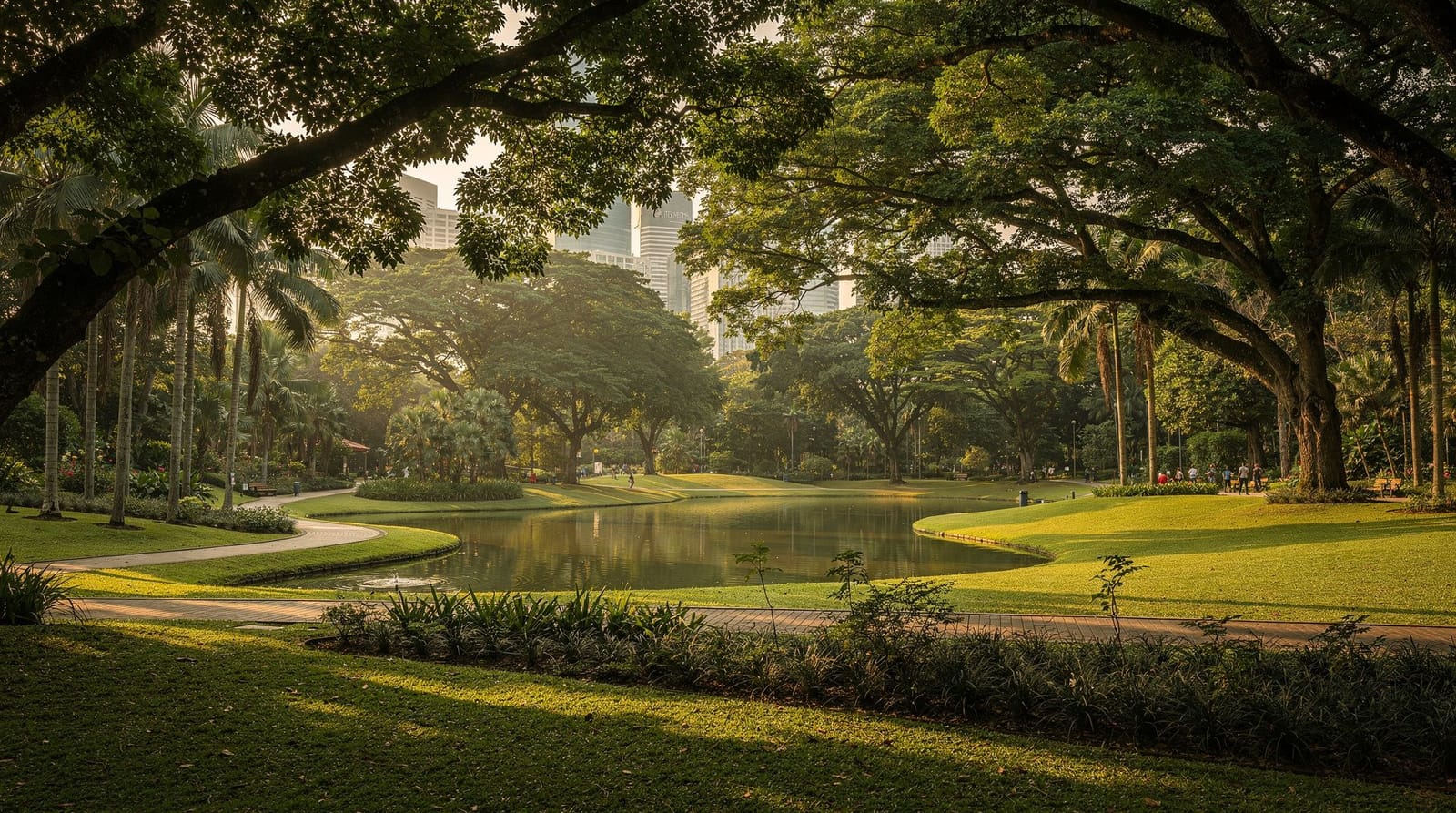
Gardens by the Bay offers multiple photography zones.
Supertree Grove at night — Garden Rhapsody light show: The 18 Supertrees are illuminated nightly and the Garden Rhapsody show (7:45 pm and 8:45 pm) adds sound and synchronised lighting. Shoot from the OCBC Skyway walkway (aerial level, paid access) or from the ground-level plaza below the trees. For ground-level shots, position yourself looking up the central cluster of three tallest Supertrees — the perspective is dramatic.
OCBC Skyway: The elevated walkway between two Supertrees gives an aerial-level view of the grove and the Marina Bay skyline. During the light show, you are inside the light display — an extraordinary experience and photography opportunity. Tickets are separate from garden entry.
Cloud Forest exterior: The Cloud Forest building (geodesic dome with mountain and interior waterfall) is itself a striking architectural subject. Best photographed from the Dragonfly Lake area to the south at golden hour — the dome glows warmly.
Flower Dome: Less photographically dramatic exterior. Interior has seasonal floral displays — check the Gardens calendar for current installation.
Dawn at Gardens: The outdoor Supertree Grove at 6:00–6:30 am with the MBS building visible beyond and no crowds is one of Singapore’s best dawn shots. The light turns the Supertrees golden before the harsh midday flat light arrives.
Haji Lane: Singapore’s most colourful street
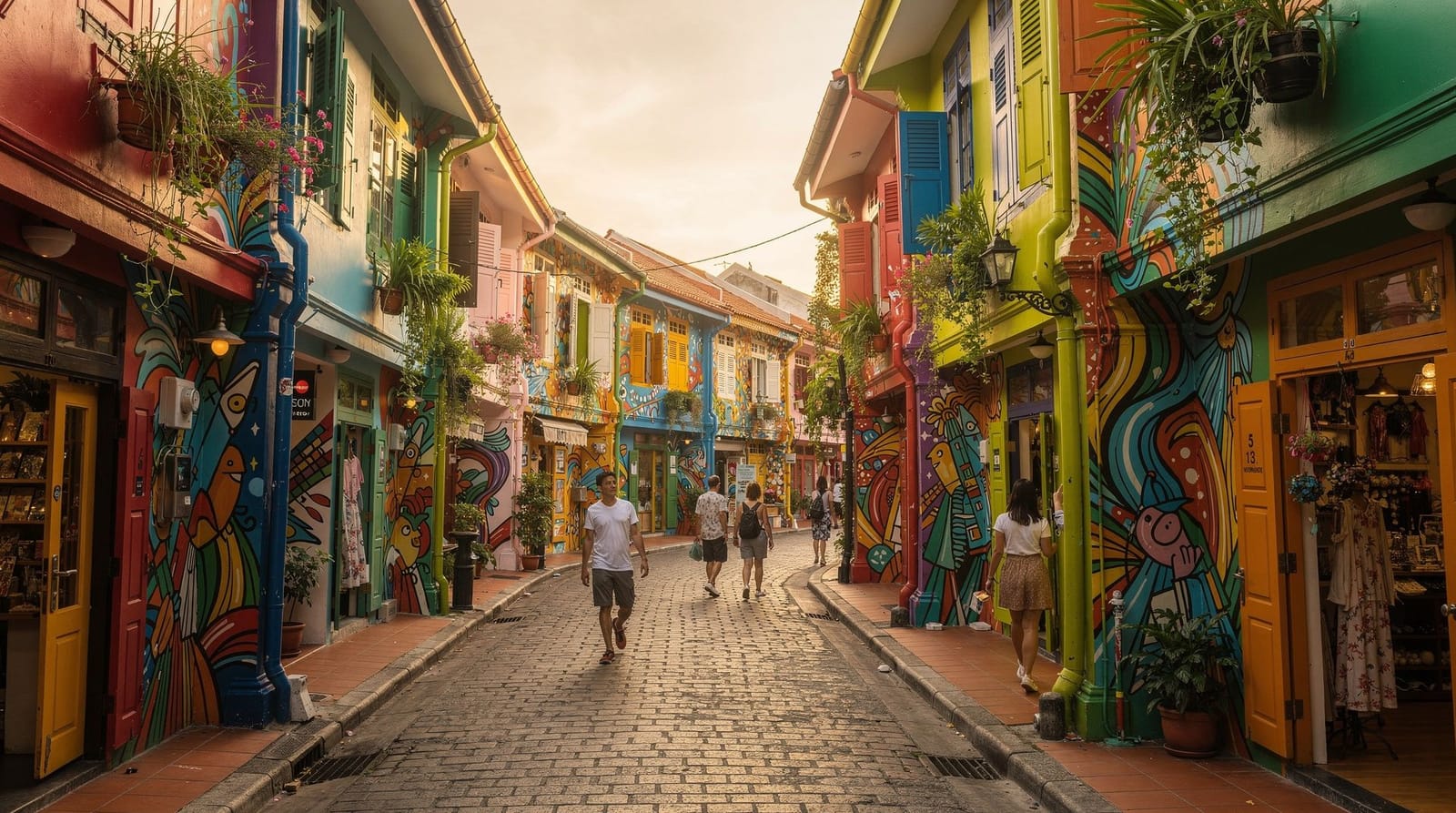
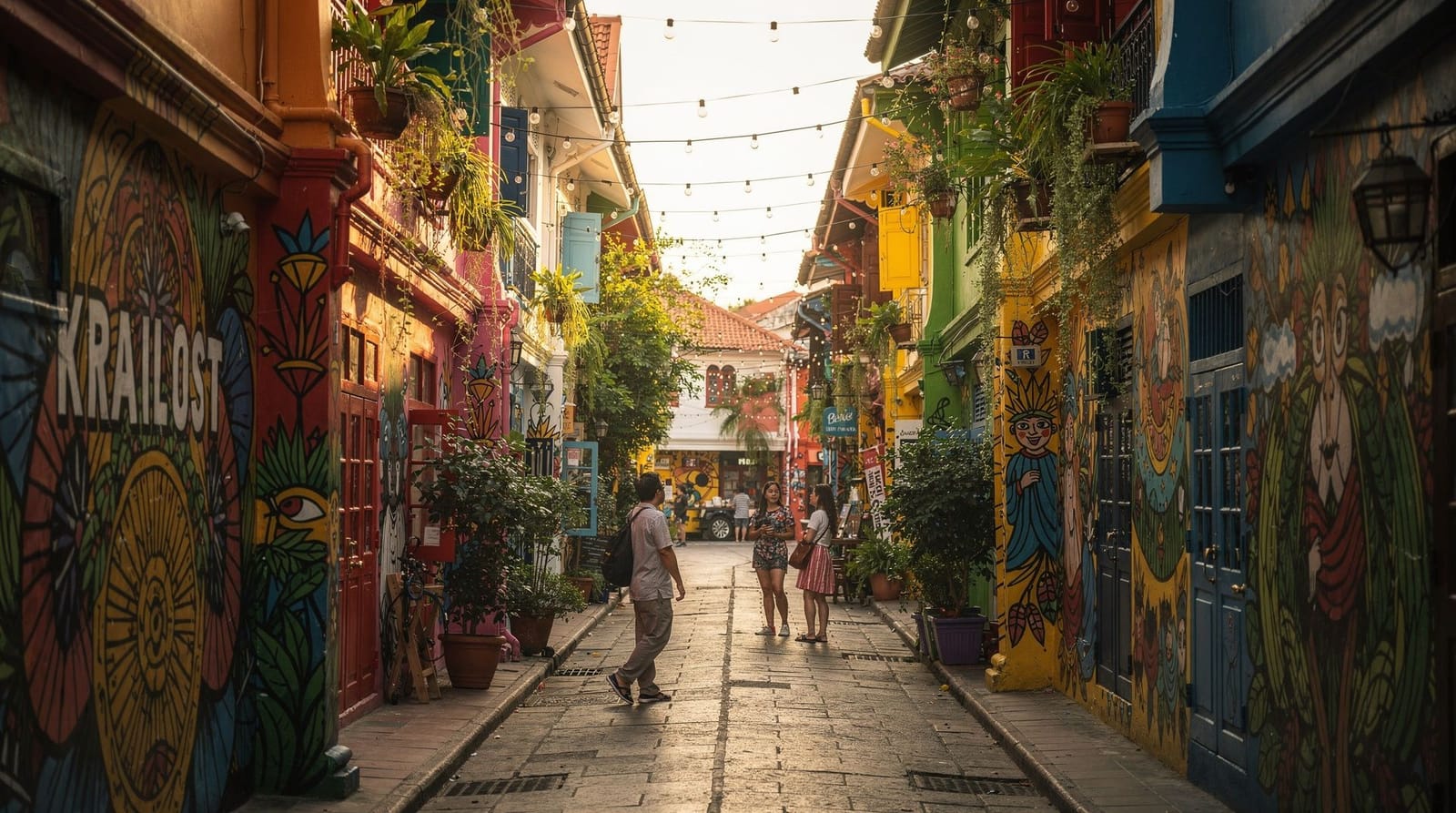
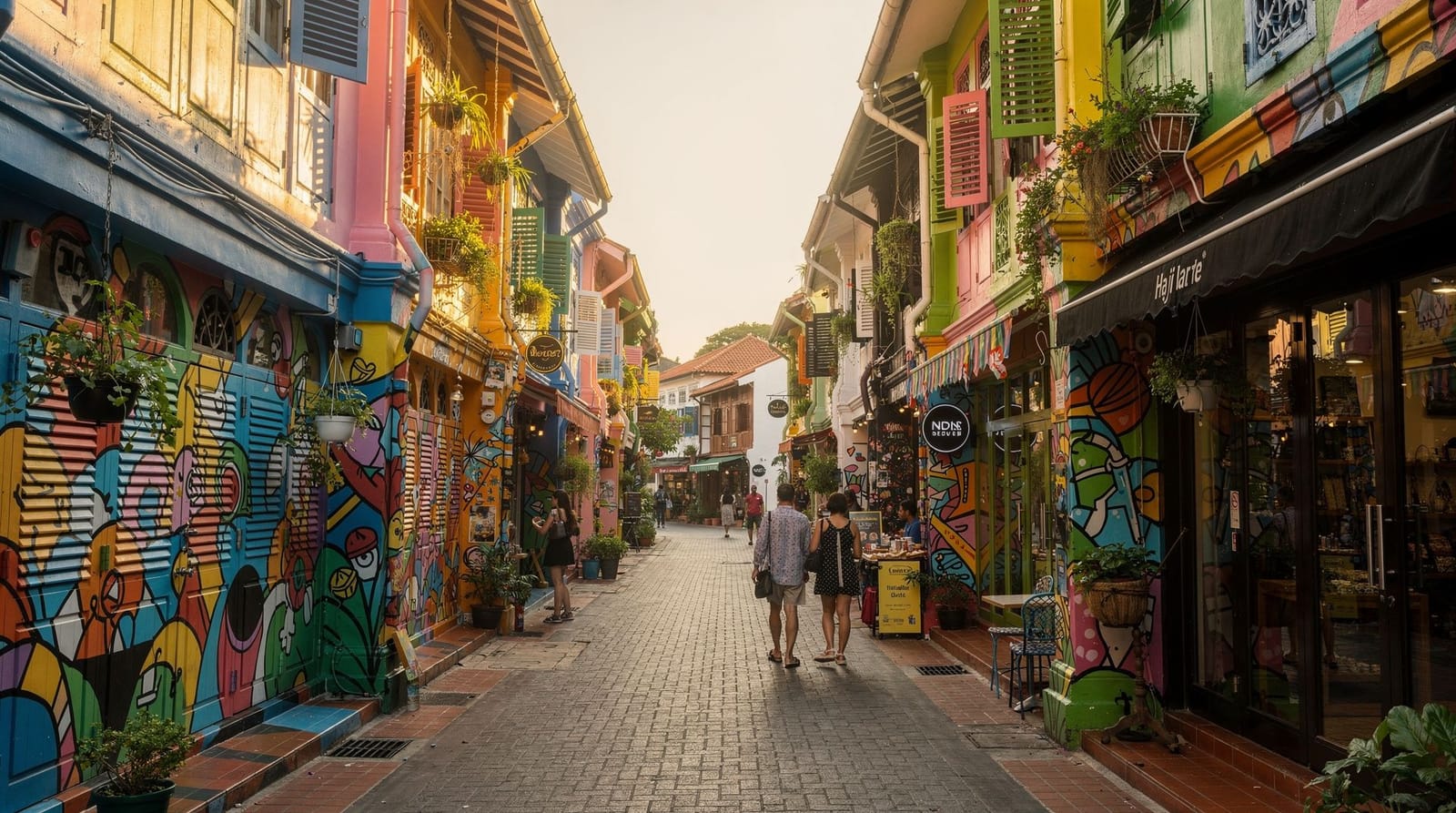
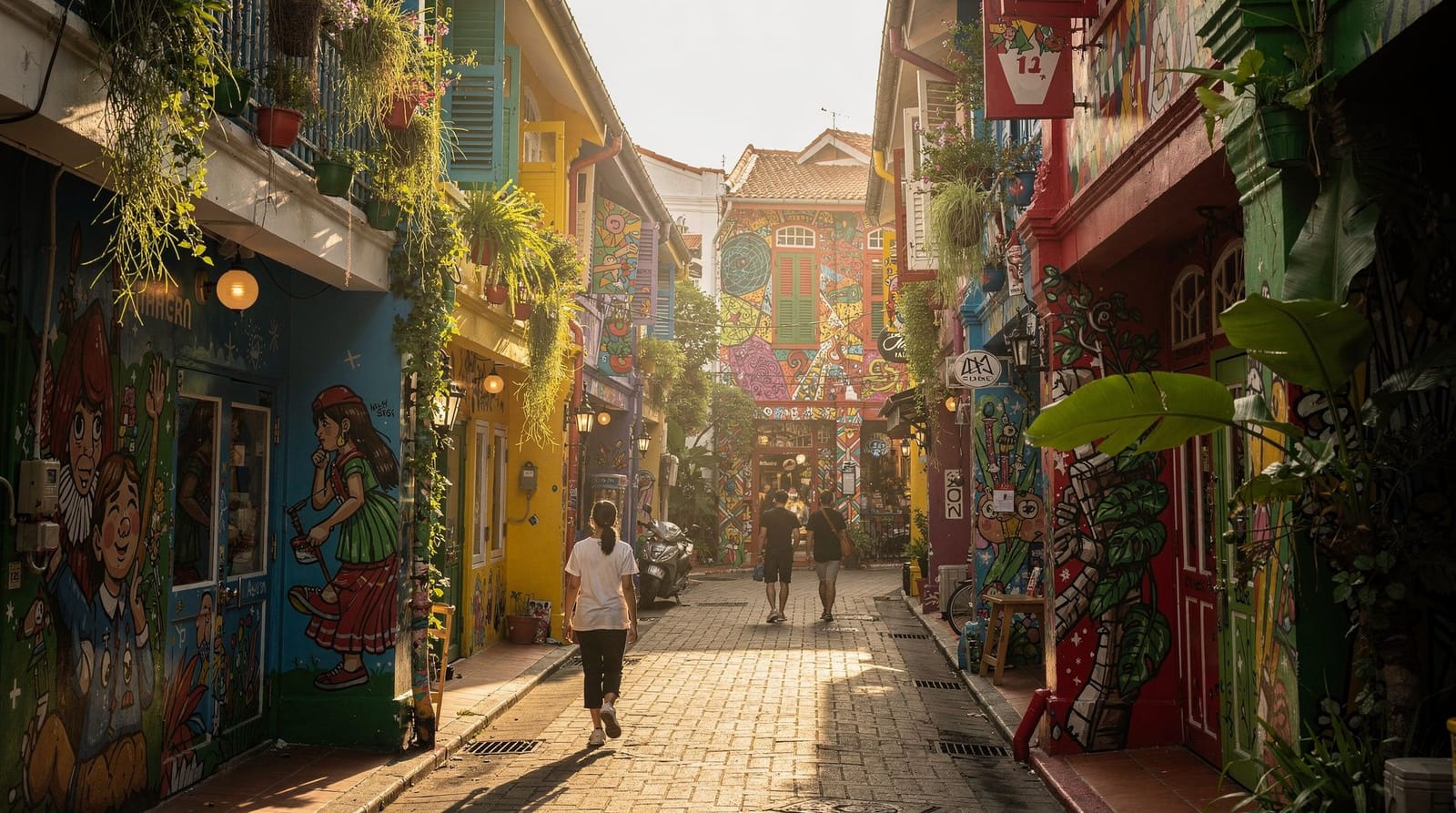
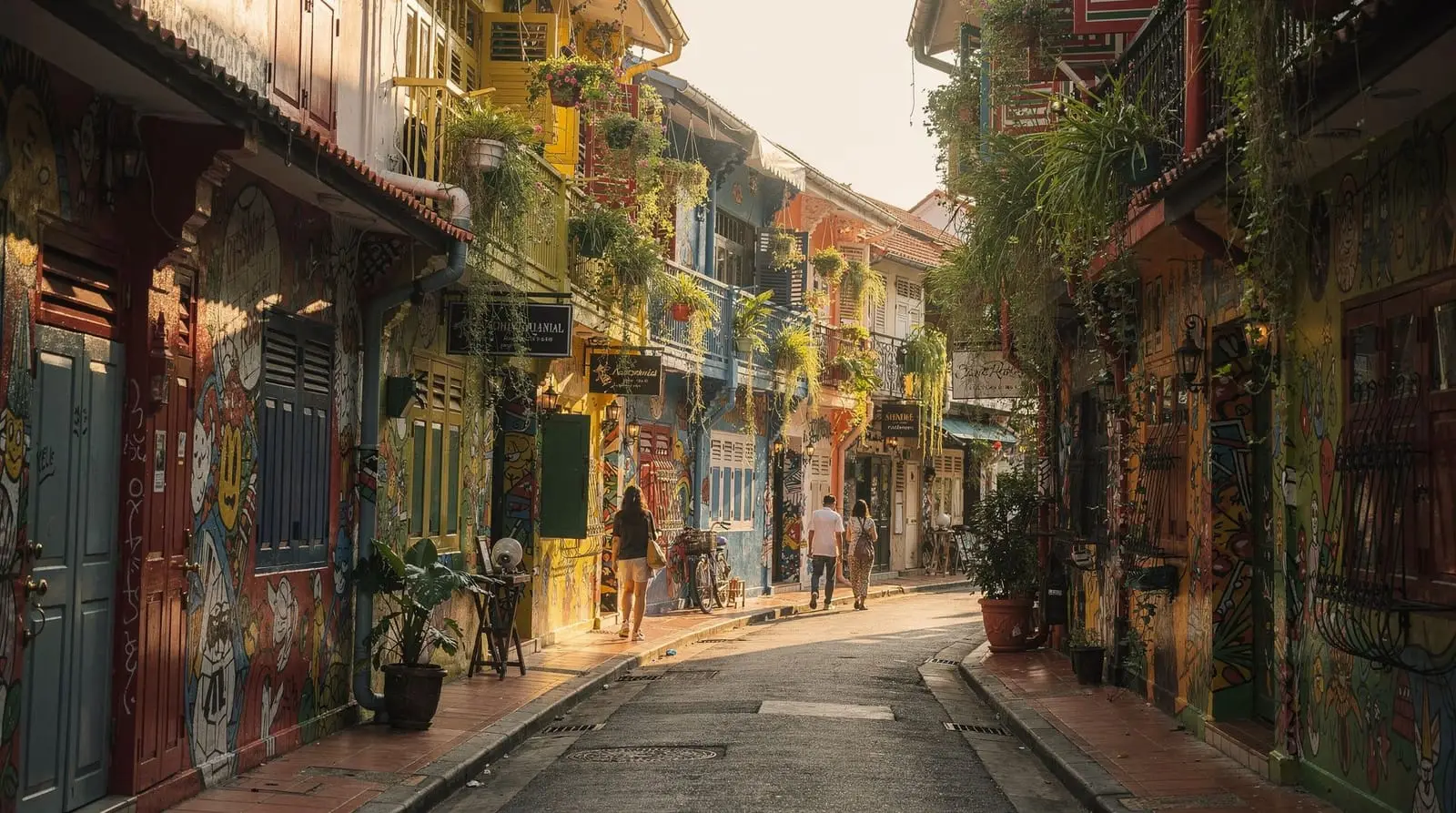
Haji Lane in Kampong Glam is a narrow alley (approximately 200 metres long) lined with cafes, boutiques, and constantly evolving street art murals. The murals range from geometric abstract to character-based illustration — all in strong, vivid colour.
Best photography timing:
- 7:00–9:00 am: Empty lane, soft early light coming from the east. The light falls directly into the lane at this hour, illuminating murals without harsh shadow.
- 4:30–6:00 pm: Afternoon light from the west angles along the lane. Less crowded than midday, decent light.
- Avoid: 11 am–3 pm (harsh overhead light, deep shadow, weekend lunch crowds)
Composition tips:
- Stand at one end of the lane and shoot toward the other — the converging perspective and building colours make a strong composition
- Use the narrow lane as a leading line with murals as subject
- Shoot murals straight-on (phone or camera perpendicular to the wall) in the morning for flat, even light
Getting there: Bugis MRT (East-West Line / Downtown Line), then 5-minute walk south through Arab Street toward the Malay Heritage Centre. See Kampong Glam and Haji Lane for the full neighbourhood guide.
Photography: moments at Haji LaneHenderson Waves: the most beautiful bridge in Singapore
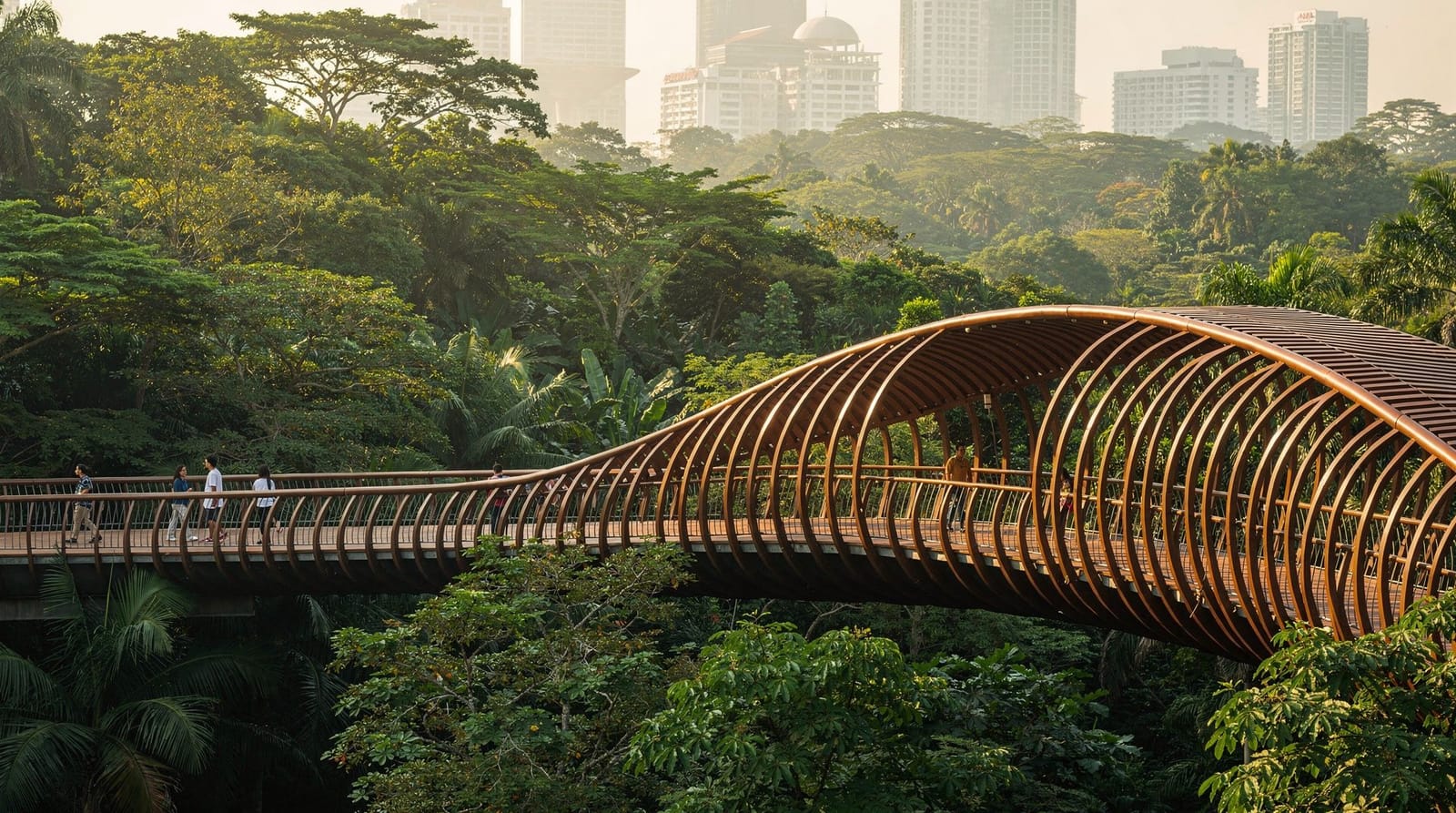
Henderson Waves is a 274-metre pedestrian bridge along the Southern Ridges walking trail, connecting Mount Faber Park and Telok Blangah Hill Park. The bridge undulates in a wave form and is clad in curved timber slats — one of Singapore’s most architecturally distinctive structures.
Best timing:
- Golden hour (6:30–7:00 pm): The warm light illuminates the timber cladding and creates long shadows through the wave forms. The hill forest backdrop and the distant Singapore skyline visible from the bridge make for compelling compositions.
- At night: The bridge has built-in LED lighting that activates after dark — a distinctive blue-white illumination of the wave forms. The night photography is strong but requires a tripod for longer exposures.
Composition approach:
- Shoot from below the bridge at golden hour — the underside of the wave forms against the warm sky
- Shoot from the bridge deck toward the city skyline
- Include people walking the bridge for scale — the wave forms are dramatic at human scale
Getting there: Harbourfront MRT (Circle Line / North-East Line) or Telok Blangah MRT (Circle Line), then a 15–20 minute uphill walk. Alternatively, start the full Southern Ridges trail from Harbourfront. See Southern Ridges and Henderson Waves for the full trail guide.
Chinatown’s temples and street colour
Thian Hock Keng Temple: Singapore’s oldest Hokkien temple (built 1839–1842), on Telok Ayer Street. The ornate facade, symmetrical roofline, and colourful details are excellent subjects. Best in morning light (9:00–10:30 am) when the facade is front-lit. Incense smoke in morning puja adds atmosphere.
Sri Mariamman Temple: The gopuram (entrance tower) of Singapore’s oldest Hindu temple (South Bridge Road) is Singapore’s most photogenic religious facade — covered in brightly coloured sculpted figures. Best with morning light from the east (10–11 am for Sri Mariamman, which faces west). Early evening side light is also strong.
Chinatown Street: The covered shophouse corridors along Pagoda Street, Temple Street, and Smith Street are classic Singapore street photography subjects. Best in overcast light (which reduces harsh shadows in the covered five-footway corridors) or early morning.
Chinatown at CNY: See Chinese New Year in Singapore — the Chinatown light-up at dusk and the red lantern corridors photographed at blue hour are among Singapore’s most spectacular seasonal photography subjects.
Little India during Deepavali
Little India’s Deepavali light-up (October/November) is Singapore’s most photographically rich seasonal event. The illuminated arches above Serangoon Road, photographed from street level looking up the corridor of lights, create images that are unmistakably Singapore.
Timing: Dusk to 9 pm. The sweet spot is when the sky retains a deep blue colour while the festival lights are fully active (approximately 7:15–7:45 pm). After full dark, the sky becomes black and the colour contrast is less interesting.
Composition: Standing in the middle of Serangoon Road (traffic is managed during peak Deepavali evenings), looking north with the arches receding toward the vanishing point. Include people walking through the lights for scale and life.
See Deepavali in Singapore for festival timing and logistics.
Marina Barrage and East Coast Park: the sunrise alternative
Most visitors chase Singapore’s blue hour and miss the dawn window entirely, which is a shame — sunrise photography here is genuinely underrated. Marina Barrage rooftop is a free, publicly accessible grass hill with a clear eastern horizon over the bay; arrive by 6:30 am and you get soft light on the Marina Bay skyline with almost no one else around. East Coast Park, covered in the East Coast Park guide, gives a flat sea-horizon sunrise with silhouetted fishing platforms and, further along, a straight-on view of arriving container ships — a very different mood from the city shots everyone else is taking. Both spots pair well with an early hawker breakfast once the light flattens out around 8 am.
Clarke Quay and the river at night
Clarke Quay’s riverside is Singapore’s best spot for reflection photography after dark. The coloured lighting along the river, the historic godown facades, and the passing bumboats create long, colourful reflections in the water — a tripod and a 1–2 second exposure turns ordinary river shots into something with real motion and colour. See the Clarke Quay nightlife guide for the best vantage points along the boardwalk, and consider timing your visit around a river cruise departure, since the boats themselves make good foreground subjects gliding past the Fullerton and Boat Quay shophouses.
Camera settings for Singapore’s tropical light
Singapore’s light swings from brutally harsh midday sun to near-total darkness within a couple of hours, so a few settings adjustments make a real difference. In the midday flat light, underexpose slightly (−0.3 to −0.7 EV) and shoot in shade or under five-footway corridors to avoid blown highlights. At blue hour, a base ISO (100–400) with a tripod gives the cleanest results; without a tripod, raise ISO to 800–1600 and use image stabilisation.
For the Garden Rhapsody light show or Spectra at Marina Bay after dark, a small travel tripod is worth the extra bag space — handheld night shots of moving light shows are rarely sharp. Humidity is the other factor tourists forget: wipe your lens before shooting after moving from an air-conditioned mall or MRT into Singapore’s outdoor heat, or you will get condensation fog on the glass for the first few minutes.
Free vs paid photography spots
| Spot | Cost | Best for |
|---|---|---|
| Marina Bay waterfront / Helix Bridge | Free | Skyline, blue hour reflections |
| Henderson Waves | Free | Architecture, golden hour |
| Haji Lane | Free | Street murals, colour |
| Marina Barrage rooftop | Free | Sunrise, wide skyline |
| Gardens by the Bay outdoor Supertree Grove | Free | Dawn, night light show from ground |
| OCBC Skyway | Around SGD 14 | Aerial Supertree + light show views |
| SkyPark Observation Deck | Around SGD 32 | Elevated 360° city views |
| Cloud Forest interior | Around SGD 26 | Waterfall, architecture |
Photography tours: are they worth it?
For visitors wanting expert guidance on timing, locations, and composition, a professional photography tour is worth considering.
Singapore has a number of professional photography guides who specialise in specific locations (Marina Bay at blue hour, Chinatown at dawn, Kampong Glam street murals). Tours typically run 2–4 hours and are timed specifically for optimal light.
Photography tour in Singapore (professional)Instagram walking tours are a lighter option — guided walks to the most photogenic spots with a guide who knows the best angles and shots. These are less about photography skill and more about location curation.
Singapore: highlight of Singapore Instagram walking tourWhen tours are worth it:
- You have limited time and want to hit multiple optimal locations in one session
- You are a serious photographer wanting technical guidance on Singapore-specific shooting conditions
- You want to access the best sunrise/blue hour timing with a guide who has pre-planned the logistics
When individual shooting is better:
- You are an experienced photographer who prefers to work alone and at your own pace
- Your itinerary already covers the key locations
- Your camera equipment is suited to independent use
Quick-reference: best spots by time of day
Dawn (6:00–7:00 am):
- Marina Bay waterfront (empty, beautiful light)
- Supertree Grove outdoor area
- Henderson Waves bridge
Morning (7:00–10:00 am):
- Haji Lane murals (7–9 am empty window)
- Thian Hock Keng Temple
- Sri Mariamman Temple gopuram
Evening golden hour (6:30–7:15 pm):
- Henderson Waves from below
- Supertree Grove from ground level
- East Coast Park beach (towards sunset)
Blue hour (7:00–7:30 pm):
- Marina Bay Sands from the Helix Bridge
- Gardens by the Bay domes exterior
- Skyline from Marina Barrage rooftop
Night (8:00 pm onward):
- Supertree Grove Garden Rhapsody light show (7:45 pm and 8:45 pm)
- Clarke Quay neon reflections in the river
- Chinatown street with lanterns
Frequently asked questions about best photo spots Singapore
What is the best camera for Singapore photography?
Any camera with good low-light performance matters most for blue hour and night shots. Full-frame mirrorless cameras (Sony A7 series, Canon R series, Nikon Z series) are excellent. For travel, an APS-C mirrorless (Sony A6000 series, Fujifilm X series) provides good quality in a smaller package. Phone cameras (iPhone 15 Pro, Samsung S24 Ultra) handle blue hour and garden shots competently if you use Night Mode and a stable surface.
Is photography allowed inside Singapore temples?
Generally yes in public areas of temples. Signs indicating no photography are placed at inner sanctum areas and during active religious ceremonies. Ask temple staff if uncertain. Never photograph worshippers during prayer without permission. Flash is almost always inappropriate inside temples — use available light.
Can I photograph from the top of Marina Bay Sands without staying there?
Yes. The SkyPark Observation Deck is open to non-hotel guests for a separate ticket (approximately SGD 32 adult). This gives access to the rooftop with its city views, though not the Infinity Pool (hotel guests only). See Marina Bay Sands SkyPark for whether the observation deck ticket is worth buying.
What are the best Singapore photography spots that are free?
Many of the best spots are free: Marina Bay waterfront (public walkway), Helix Bridge (public walkway), Henderson Waves (public bridge), Haji Lane (public alley), Chinatown streets, Little India, Gardens by the Bay outdoor Supertree Grove, and East Coast Park beach. Paid photography subjects include the SkyPark observation deck, the Gardens by the Bay OCBC Skyway, and the Cloud Forest interior.
Where is the best spot to photograph the Singapore skyline from across the water?
The Esplanade Bridge area (near the Esplanade Theatres, free public walkway) and the Benjamin Sheares Bridge pedestrian connector give wide-angle skyline views across the bay to MBS and the CBD. For elevated skyline views, Marina Barrage rooftop (free public access) gives an unobstructed 360-degree panorama including both the city skyline and the southern harbour.
Top experiences
Bookable activities with verified prices and instant confirmation on GetYourGuide.