Lau Pa Sat guide: the Victorian market in the CBD
Singapore: Lau Pa Sat night street food with Marina Bay walk
Is Lau Pa Sat worth visiting?
Yes — primarily for the evening Satay Street experience and the extraordinary 1894 cast-iron Victorian market building. The food stalls inside are competent but not at Old Airport Road or Maxwell level. Come at 19h00 on a weekday evening for satay under the CBD towers — it is one of the more atmospheric hawker experiences in Singapore.
| Where | 18 Raffles Quay, CBD, above Raffles Place MRT |
| Cost | Free entry; dishes SGD 5–10; satay SGD 0.60–1.20/stick |
| Time needed | 45min–1.5hrs; longer for a full Satay Street evening |
| Getting there | Raffles Place MRT (EW14/NS26), Exit B |
| Best time | 19:30 weekdays for Satay Street; 11:30–13:00 for lunch |
Lau Pa Sat is two things at once: a Victorian engineering achievement and one of Singapore’s most atmospheric places to eat in the evening. The cast-iron market building from 1894 — octagonal, high-arched, with ornate iron columns and a dramatic central space — was prefabricated in Glasgow, shipped to Singapore, and assembled on reclaimed land. It has been serving food in its current form since the 1970s. Nothing else quite like it exists in Southeast Asia.
The food inside has never been the primary reason to visit — that distinction belongs to Maxwell Food Centre, Old Airport Road, and Chinatown Complex. What Lau Pa Sat offers is context: eating satay on Boon Tat Street with the glass towers of the CBD forming the skyline is an experience that only exists at this specific location in Singapore.
The building: what makes it significant
The market was originally designed by George D. Coleman (Singapore’s colonial town planner) in 1838; the current building dates from an 1894 reconstruction by Municipal Engineer James MacRitchie, using cast-iron components made by MacFarlane & Co of Glasgow. The Victorian cast-iron market format — large roof trusses, prefabricated columns, open-sided — was a standard British colonial typology deployed across the Empire.
What makes Lau Pa Sat exceptional is its survival. Most comparable structures were demolished during Singapore’s rapid development in the 1960s–1980s. Lau Pa Sat was saved and relocated — disassembled piece by piece when the MRT tunnel was excavated beneath it in 1985–1987, stored, and reassembled in its current position. It was gazetted as a conservation building in 1973 and underwent a major restoration in 2014.
For visitors with any interest in architecture or colonial history, walking through the building attentively — looking at the iron column details, the truss work above, the original market layout preserved in the octagonal plan — is worth 20 minutes before or after eating.
Satay Street (Boon Tat Street)
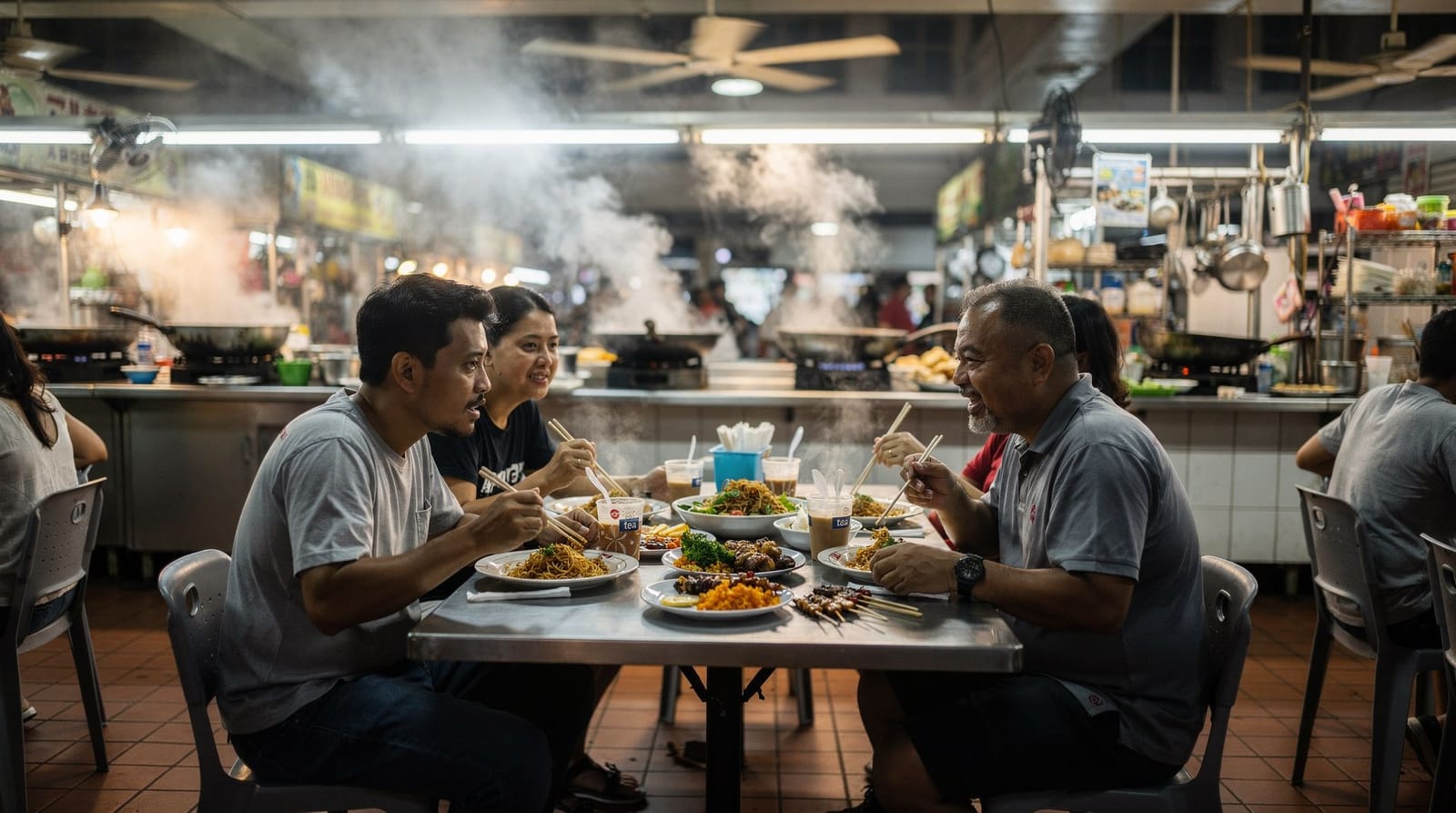
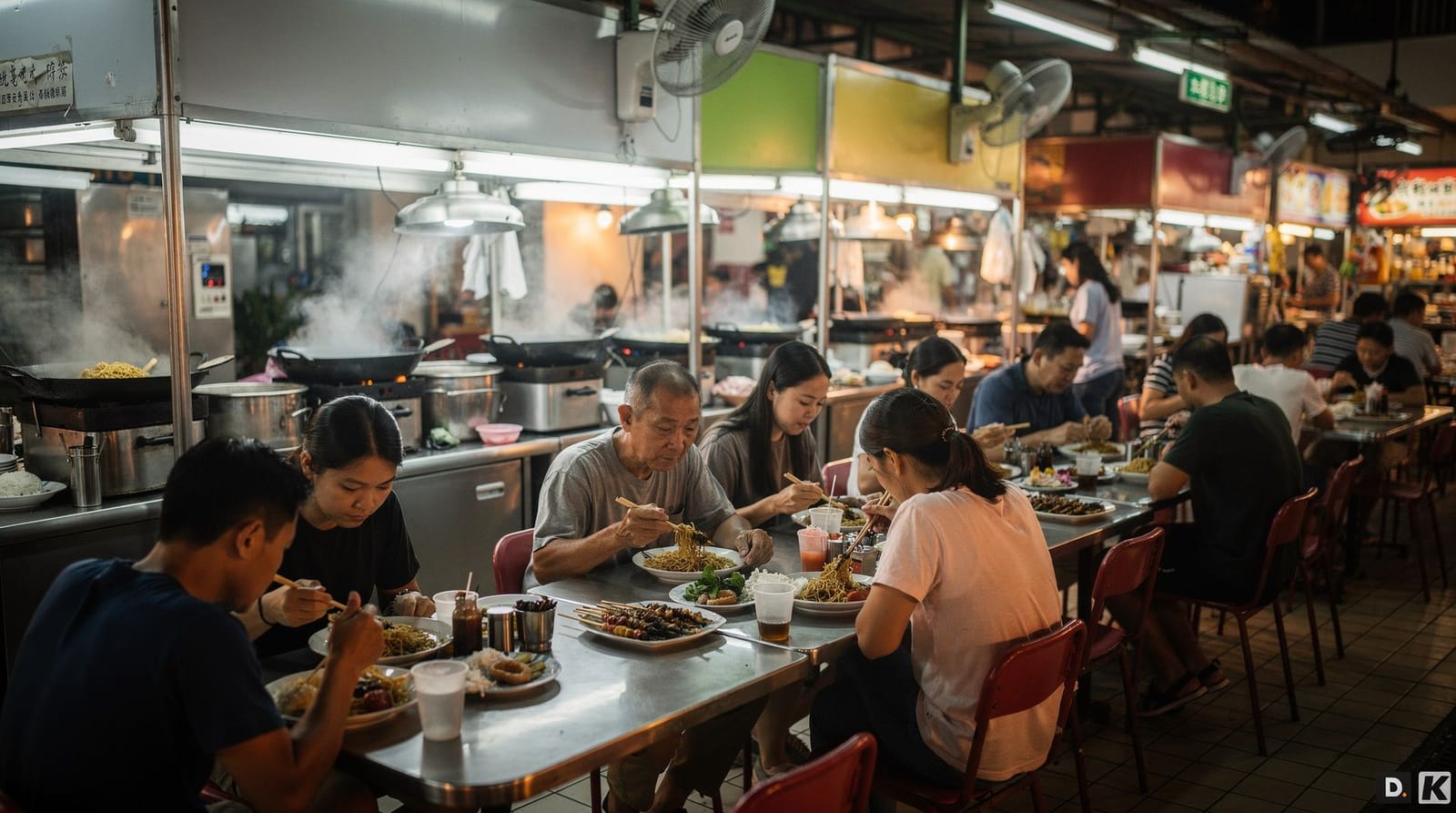
The main reason to visit Lau Pa Sat in the evening. Every night from approximately 19h00 (sometimes 18h30 on busy nights), Boon Tat Street alongside the market closes to traffic. Charcoal grills appear; smoke rises; the sound of fans and hissing meat fills the street.
What to order: Chicken satay is the most consistently good option — tender thigh meat on bamboo skewers, marinated in turmeric and lemongrass. Mutton satay is stronger-flavoured and less reliably good depending on the stall. Beef satay varies. Prawn satay is a less traditional option available here.
The peanut sauce: Served communally with your satay order, alongside compressed rice cakes (ketupat) and raw cucumber and onion. The peanut sauce at the better Satay Street stalls is made from ground roasted peanuts with lemongrass, galangal, and a small amount of chilli — not the thin, sweet, commercially diluted version you find at tourist restaurants.
How to order: Walk the street until you find a stall with space and active grilling. State how many sticks of each type you want — minimum is usually 10 sticks total. You will be directed to a table while the satay is grilled (8–10 minutes for fresh sticks). Pay at the end.
Price: SGD 0.60–1.20 per stick depending on type; approximately SGD 15–20 for two people with a full satay set plus drinks.
What time to arrive: 19h30 on weekdays is the sweet spot — the stalls are in full operation but the worst of the office-worker dinner rush has peaked. Weekend evenings see heavier tourist traffic; the atmosphere is the same but slightly less authentic.
Inside the hawker centre
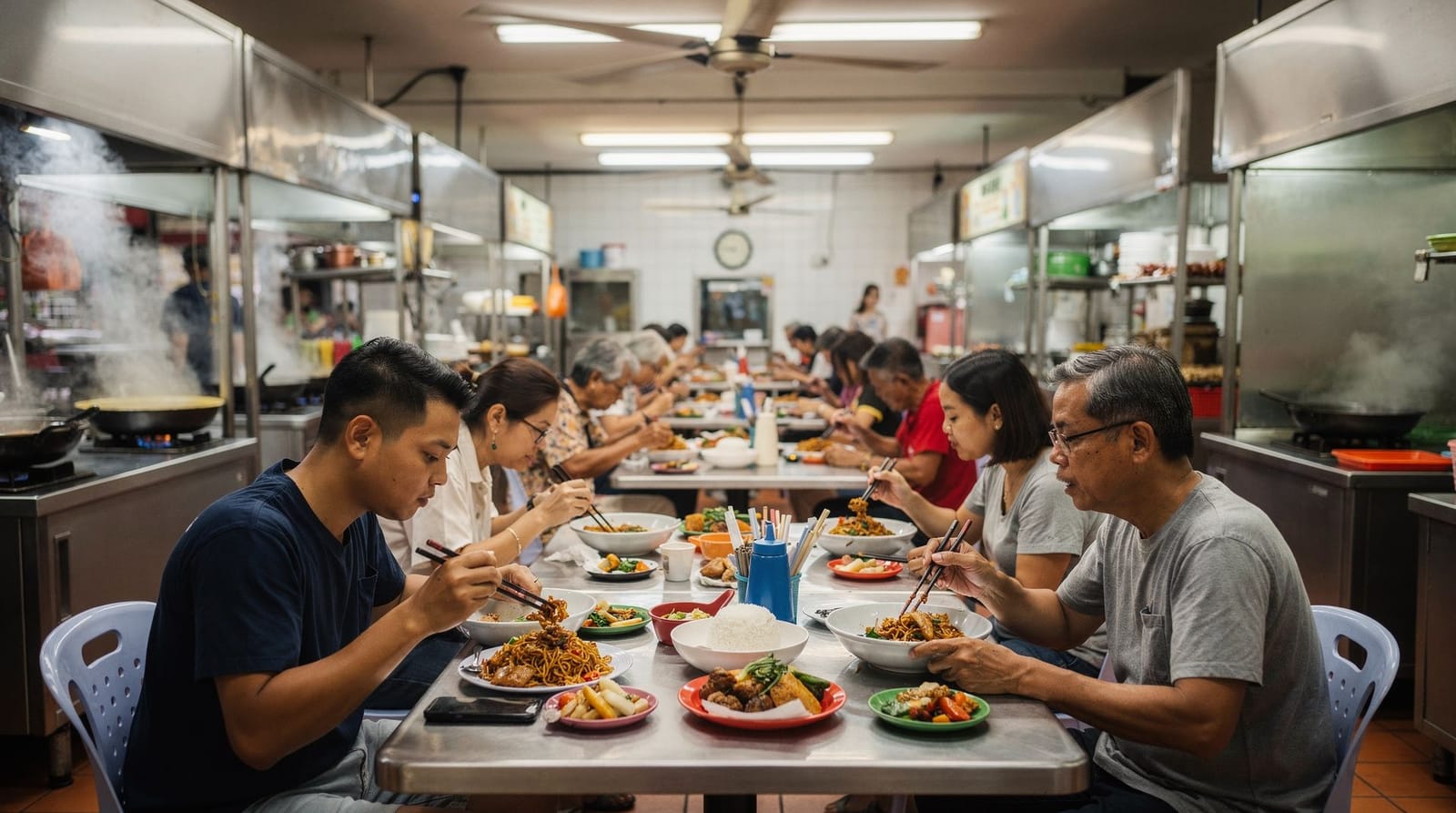
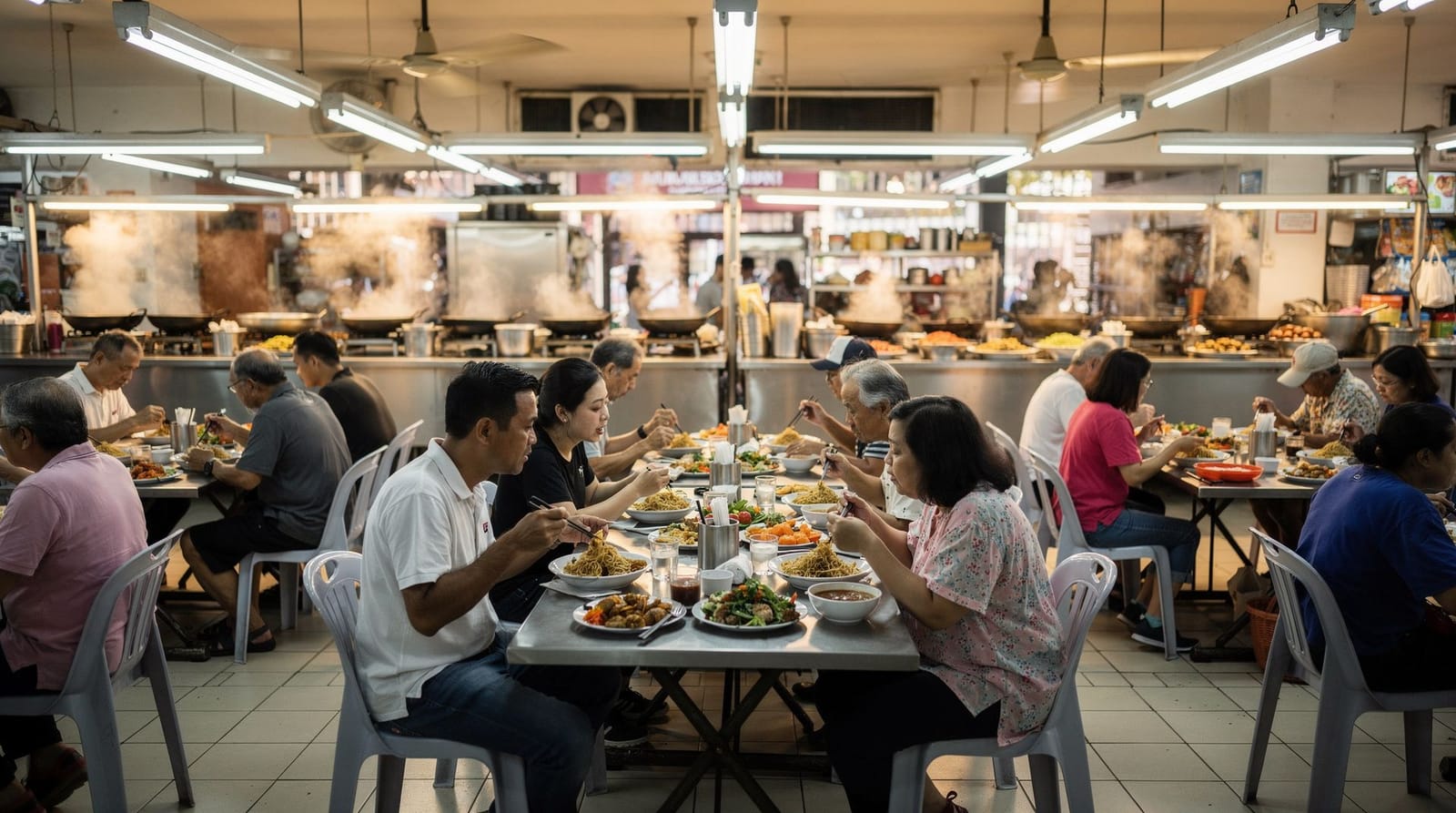
The interior stalls cover the standard Singapore hawker canon. Quality is competent; the stalls that perform best are those catering to the lunch crowd of CBD office workers, where local competitive pressure keeps standards up.
Better stalls for the interior:
Nasi Padang stalls: Malay rice with a selection of curries and side dishes. The lunch Nasi Padang operations at Lau Pa Sat serve the office population and maintain reasonable quality as a result. Chicken rendang, beef rendang, sambal aubergine, fried fish in sambal — typically SGD 5–8 for rice and two or three sides.
The Indian stalls: Briyani, roti prata, and curry rice. Standard quality with the same CBD office worker benchmark.
Wonton noodles: Several stalls; the one with the highest local repeat traffic is the most reliable indicator.
Honest advice on the interior stalls: For the iconic Singapore dishes — chicken rice, laksa, char kway teow — Maxwell Food Centre (20 minutes by MRT from Raffles Place) is significantly better. If you are in the CBD for lunch and Lau Pa Sat is convenient, eat here; if you are making a special food trip, redirect to Maxwell or Old Airport Road.
The evening atmosphere: why it works
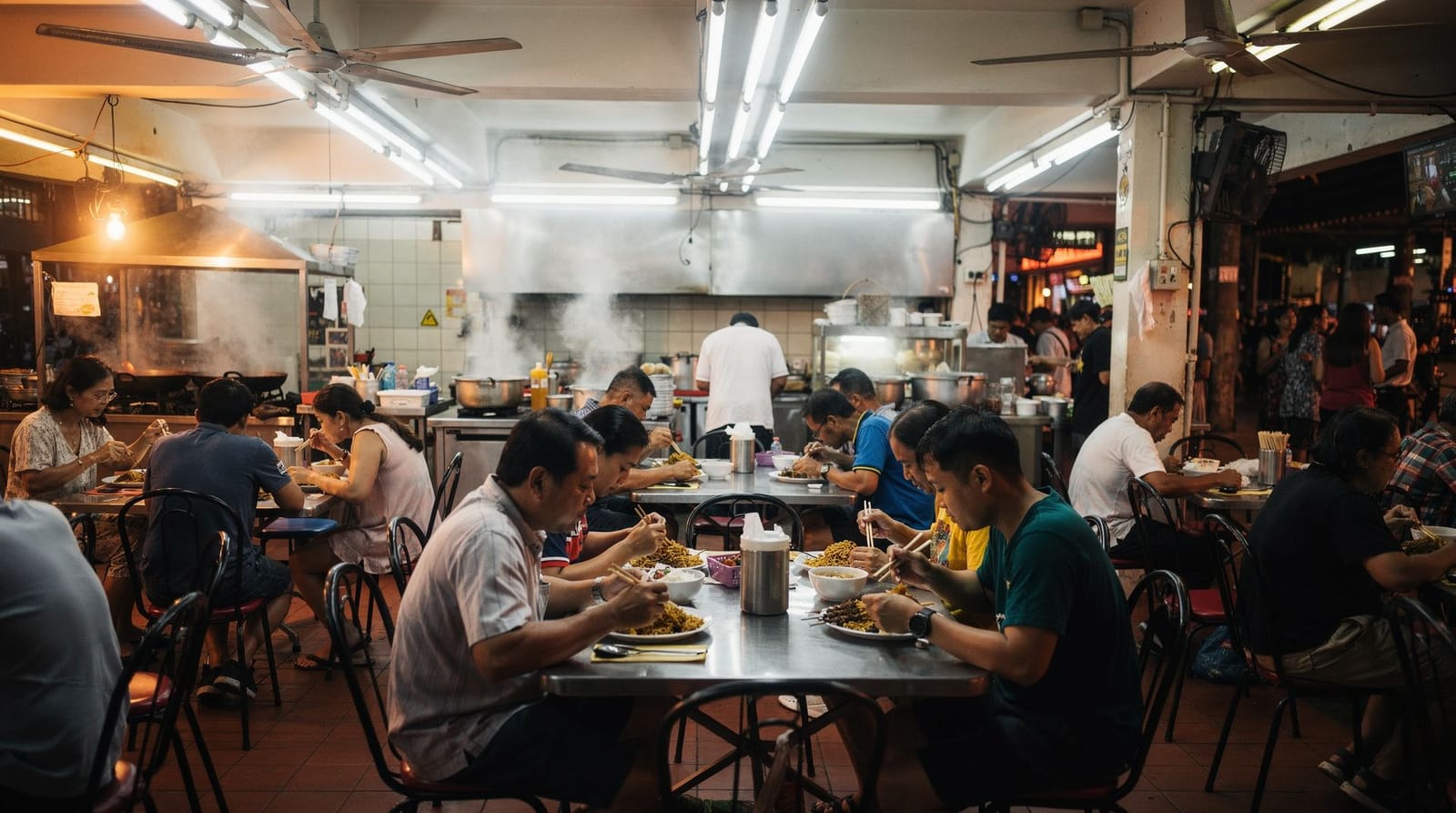
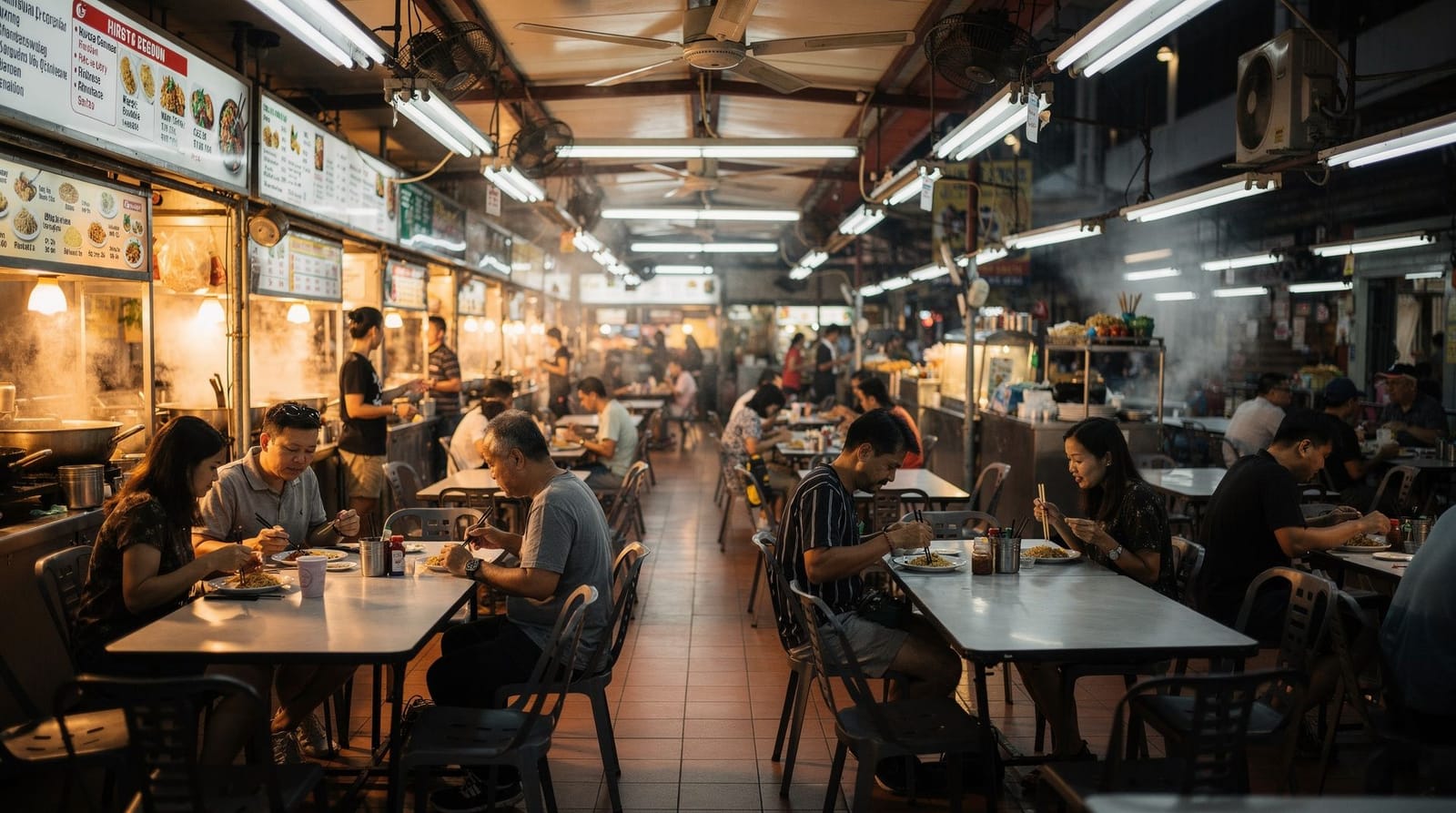
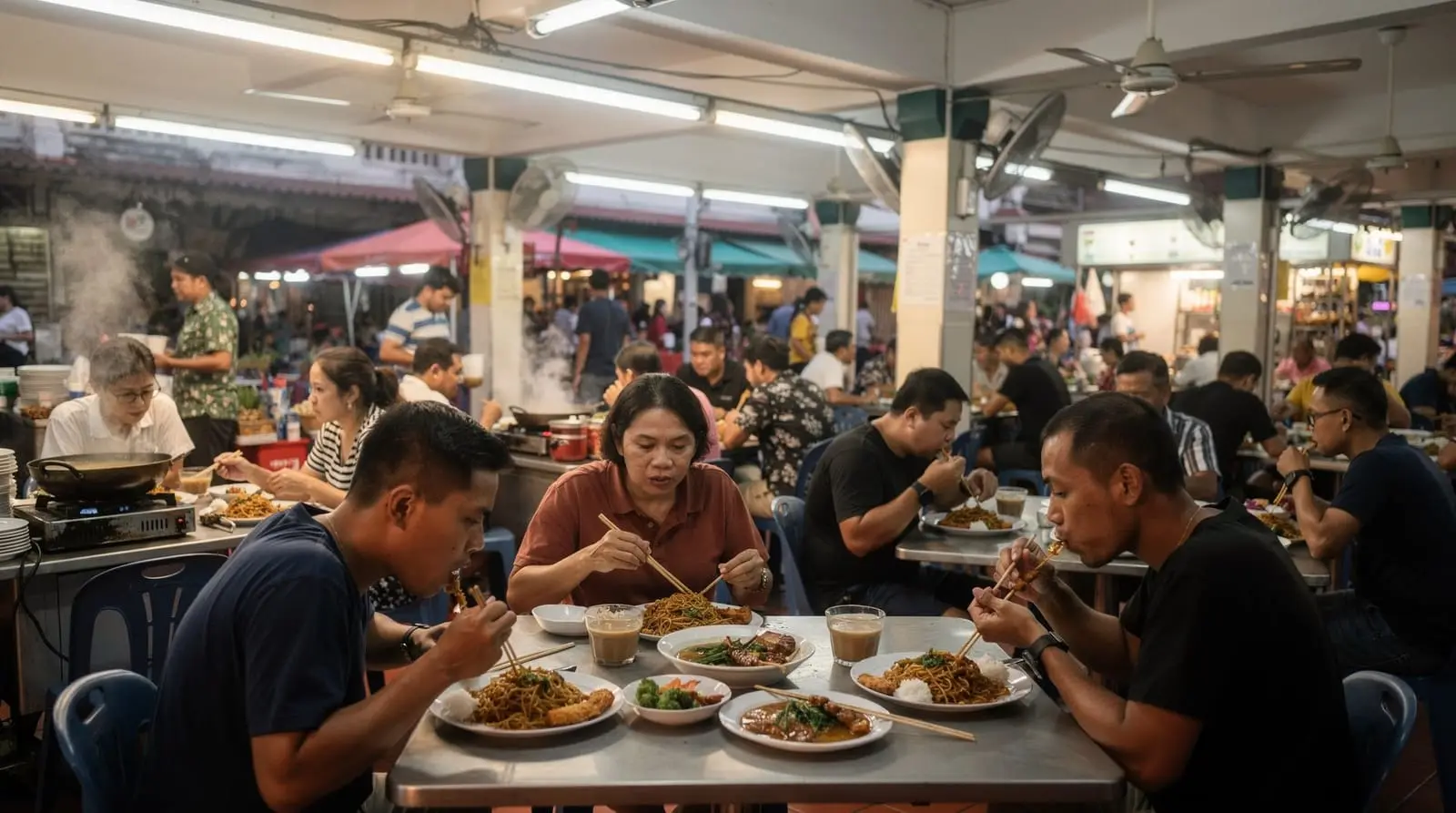
What makes the Lau Pa Sat evening unusual in the context of Singapore is the collision of building stock and activity. The Victorian market, the satay smoke, the Raffles Quay towers lit up at night, the mix of office workers in suits and tourists in shorts — it is a particularly Singapore combination of old and new, formal and informal.
The location is also a natural end point for an evening that might begin at the Merlion Park or Marina Bay waterfront. Walking from Marina Bay Sands along the waterfront to Raffles Quay (approximately 20 minutes), then dinner at Lau Pa Sat Satay Street, is one of the more satisfying evening sequences in Singapore.
Lau Pa Sat night street food with Marina Bay walk — the best evening food tour combinationFor a broader evening hawker experience covering multiple centres, the guided evening food tour covers more ground:
Evening hawker centre food tour — multi-centre sampling after darkBeer and drinks at Lau Pa Sat
Beer is available from multiple stalls throughout the centre. Tiger Beer (Singapore’s own), Heineken, and Carlsberg are standard. Prices are slightly above neighbourhood hawker centre rates (~SGD 10–14 for a pint) but comparable to CBD bar prices. Fresh fruit juices and sugar cane juice are available from dedicated stalls.
The satay and beer combination on a warm evening in the open air of Boon Tat Street is one of the better SGD 20 experiences in Singapore.
How to plan a full evening around Lau Pa Sat
The easiest way to use this place well is to treat it as the last stop of an evening rather than a destination on its own. Start with a slow walk around the bay, perhaps taking in the Marina Bay waterfront as the light fades, then let the walk end at the market when your appetite has built up. If you would rather see the lights first, the Marina Bay after dark guide suggests what to see on the way, and the Merlion Park guide covers the classic photo stop that sits naturally on this route.
Eating here also works as a relaxed finish to a day of sightseeing in the older parts of town. If you have spent the afternoon among the temples and shophouses of Chinatown, a short walk brings you to the satay smoke without needing any transport at all. Travellers who like to pace themselves can share a first round of satay, wander the interior stalls to see what else catches the eye, and then order a second round of whatever turned out best.
Tips for a smoother visit
- Share rather than order alone. Satay is meant to be passed around the table, and a group can try chicken, mutton and a few side dishes without anyone being overwhelmed.
- Look at where the locals sit. A stall with office workers queuing is usually a better bet than one whose staff are calling out to passers-by.
- Bring small notes and some patience. Most stalls prefer cash, and the grills take a little time, so treat the wait as part of the evening.
- Dress for the heat. The interior is fan-cooled rather than air-conditioned, and standing near charcoal grills adds to the warmth, so light clothing is the sensible choice.
- Keep a few napkins to hand. Peanut sauce and satay are a messy pairing, and nobody at the table minds.
If you are travelling with family or a larger group
The open layout makes Lau Pa Sat forgiving for groups. Everyone can choose their own dish from a different stall and still sit together, which is useful when tastes differ. Families with children may find the variety helpful, and the kid-friendly hawker guide explains how to pick milder dishes and manage busy dining halls. For a broader view of what suits children across the city, the Singapore with kids guide is a good companion read.
If you are travelling on a tight budget, the market is one of the more flexible places to eat in the financial district, and the Singapore on a budget guide shows how a meal here can sit alongside other low-cost choices across the city.
Where Lau Pa Sat fits in your wider food plan
Because the interior is the weaker part of the offer, it helps to think of Lau Pa Sat as one chapter in a longer food story rather than the whole book. Satay here, chicken rice elsewhere, and a laksa on another day will give a much fuller picture than any single meal. The Singapore foodie itinerary shows one way of stringing those meals together over several days, and the hainanese chicken rice guide points you to the dish you will want to try at a stronger stall than the ones inside this market.
Getting to Lau Pa Sat
MRT: Raffles Place station (EW14/NS26 interchange). Exit B leads directly toward Raffles Quay. Walk 3 minutes southeast. The market is visible from street level.
MRT alternative: Telok Ayer (DT18). 5-minute walk north on Telok Ayer Street to Raffles Quay.
Walking: 20 minutes from Merlion Park along the waterfront; 15 minutes from Chinatown; 10 minutes from Marina Bay Sands via the pedestrian underpass.
The getting around Singapore guide covers MRT lines and walking routes in the CBD.
Lau Pa Sat versus the CBD’s other options
If you’re deciding whether to eat here or elsewhere in the Civic District/CBD, it helps to know how Lau Pa Sat compares:
| Lau Pa Sat | Maxwell Food Centre | Chinatown Complex | |
|---|---|---|---|
| Signature draw | Satay Street atmosphere | Tian Tian chicken rice | Sheer stall density, Michelin picks |
| Food quality | Competent | Excellent | Excellent |
| Setting | Victorian iron market, CBD towers | Chinatown street-level | Multi-storey market |
| Best time | Evening | Lunch | Any time, avoid peak lunch |
For the fuller citywide picture, Best hawker centres in Singapore ranks all of Singapore’s major centres, and Raffles Place and the CBD covers what else to do in the neighbourhood before or after dinner. If you’re building an evening around Marina Bay and want to know what else is nearby after dark, Singapore at night rounds out the rest of the CBD’s after-dark options.
Practical details
Opening hours: 07h00–01h00 daily (individual stalls vary; some 24 hours) Satay Street hours: Approximately 19h00–midnight (weather dependent) Entry fee: Free Payment: Mostly cash; PayNow QR increasingly accepted at some stalls Seating: Indoor (air-cooled by fans, not air-conditioned) and outdoor along Raffles Quay
Frequently asked questions about Lau Pa Sat
Is the food at Lau Pa Sat tourist-priced?
Slightly above neighbourhood hawker prices, but not dramatically. Expect to pay SGD 6–10 for most dishes inside; satay on Boon Tat Street is fairly priced. It is not the aggressive tourist markup you find at airport food halls or Clarke Quay restaurants.
What is the best time to visit Lau Pa Sat?
19h00–20h30 on a weekday evening for the Satay Street experience. Lunchtime (11h30–13h) for the office worker crowd and the most active stall operations inside. Avoid 13h30–18h30 — many stalls close after the lunch service and before dinner.
Does Lau Pa Sat have vegetarian options?
Yes. The Indian vegetarian stalls inside serve thosai, roti, and rice with vegetable curries. The Chinese vegetarian stall (look for the sign indicating Buddhist vegetarian food) offers mock-meat versions of common dishes. Satay on Boon Tat Street is not vegetarian.
Is Lau Pa Sat mentioned in the Michelin Guide?
No — the building is historically significant but no stall currently holds a Bib Gourmand or star designation in the Michelin Guide Singapore. The main Michelin-recognised stalls are at Maxwell Food Centre, Old Airport Road Food Centre, and Chinatown Complex. The Michelin hawker stalls guide covers these.
Can I book a table at Satay Street?
No reservations. Satay Street operates on a walk-in basis. Find a free table or wait for one; hawker culture does not involve reservations. The chope system (tissue packet on a table) applies here as at all Singapore hawker venues — see the hawker etiquette guide.
Top experiences
Bookable activities with verified prices and instant confirmation on GetYourGuide.