Chilli crab in Singapore: where to eat it, what it costs, and what to order with it
Singapore: local hawker food tour with tastings
Where should I eat chilli crab in Singapore and how much will it cost?
The most famous chilli crab spots are Jumbo Seafood (multiple locations) and No Signboard Seafood. Budget SGD 70–100 per person for a full meal with crab, sides, and mantou (fried buns). The crab is priced by weight (market rate, typically SGD 70–120 per kg in 2026). East Coast Seafood Centre is the classic setting. Hawker chilli crab exists but full-sized crab is a sit-down restaurant experience.
Singapore’s national dish: an honest introduction
Chilli crab is officially recognised as one of Singapore’s national dishes — featured on national day commemorations, cited in international food rankings, and eaten at special occasions by Singaporeans across all communities. If you eat one dish in Singapore that requires a restaurant table and a budget, chilli crab (or its companion dish, black pepper crab) is the serious contender.
This guide is honest about cost — chilli crab is not cheap — and practical about where, how, and when to go.
| Where | East Coast Seafood Centre, Robertson Quay, Dempsey Hill, Marine Parade |
| Cost | Around SGD 68–90 per person for a full meal |
| Time needed | 1.5–2 hours for a proper sit-down meal |
| Getting there | Grab or taxi to East Coast; MRT + short walk for city branches |
| Best time | Weekday lunch for shorter waits; book ahead for weekend dinner |
The dish itself
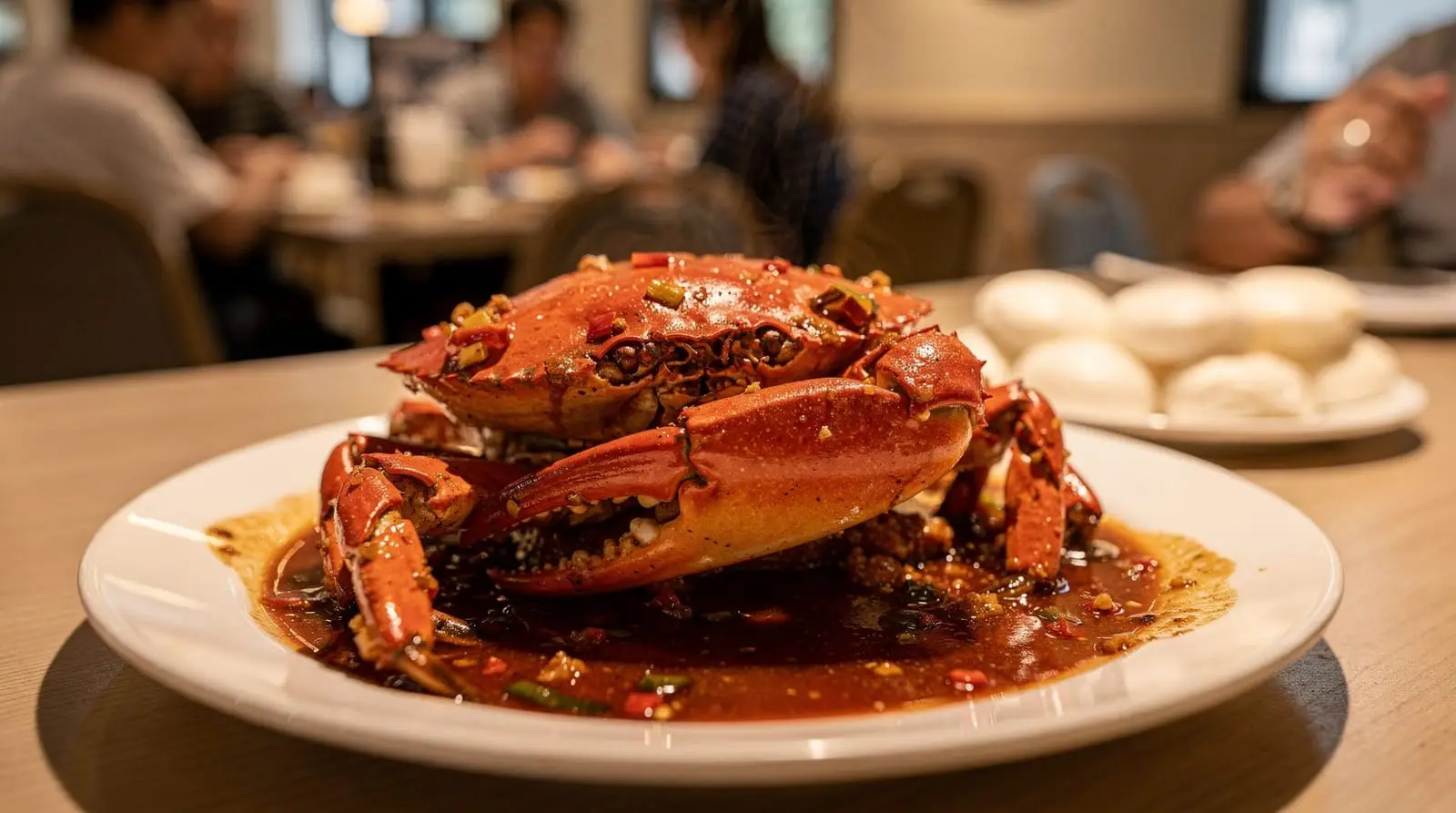
The crab: Singapore chilli crab uses Sri Lankan mud crab (Scylla serrata), a large species with thick claws and substantial meat. The crabs are live when purchased and cooked to order. A “one-kilo crab” is a typical single-serving size; a one-and-a-half or two-kilo crab is a good option for two people who want a substantial amount of meat.
The sauce: The defining sauce is not what the name implies — it is not throat-burningly spicy. The base is tomato-ketchup-derived (a Singaporean-Chinese adaptation that emerged in the 1950s), with chilli, garlic, ginger, fresh eggs stirred in at the end (creating silky egg strands), and sugar to balance. The result is semi-sweet, tangy, moderately spicy, and deeply savoury. It is one of the great sauces of Southeast Asian cooking.
The technique: The crab is chopped into sections, stir-fried in a wok at high heat with aromatics, then coated in the sauce and finished with egg. Presentation arrives as a pile of sauce-coated crab sections — shell and all — in a large wok or deep plate.
How to eat it: There is no dignified way to eat chilli crab, and locals do not pretend otherwise. Use your hands, a crab cracker, and the mallet provided. Break joints, pull meat from claws, scrape sweet meat from the shell. Mop the sauce with mantou. Have napkins ready. This is the full experience and you should embrace it.
Black pepper crab: the alternative
Black pepper crab deserves equal attention. It is a different preparation — the crab is wok-fried at very high heat with a thick coating of cracked black pepper, butter, oyster sauce, and sometimes Worcestershire sauce. The result is drier, more intensely fragrant, and less messy than chilli crab. Some food writers consider it more technically demanding.
At most seafood restaurants you can order one chilli crab and one black pepper crab for a table of three to four people — an excellent strategy that covers both dishes without redundancy.
The main restaurants
Jumbo Seafood
The most tourist-accessible and consistently recommended option. Multiple branches including East Coast Seafood Centre, Robertson Quay, and Dempsey Hill. The sauce is reliably executed; the service is experienced in guiding first-timers through ordering. Reservation strongly recommended for dinner (especially weekends).
Price: Market price per kg — typically SGD 80–120 per kg for mud crab, depending on season and size. A full meal for two including crab, mantou, one vegetable dish, and drinks: approximately SGD 160–220.
Tip: Order the chilli crab and ask for it to be packed with extra sauce. Request mantou at ordering, not after — they need to be fried fresh.
No Signboard Seafood
Famous for its white pepper crab — a lighter, more aromatic preparation using white pepper instead of black. Also serves chilli crab and black pepper crab. The Esplanade branch has good views of Marina Bay. Long queues are common; book ahead.
Long Beach Seafood Restaurant
The East Coast Road branch claims to have invented black pepper crab in the 1940s. If that claim is contested, the dish is at least very good here. More local than tourist-facing; the East Coast original is the most atmospheric branch.
Roland Restaurant
Recommended by food writers and locals as a less tourist-heavy alternative. Located on Marine Parade Road (accessible from Bedok or bus from the MRT). The sauce is said to be closer to the original 1950s recipe. Shorter queues than Jumbo; booking still advisable for weekend dinner.
East Coast Seafood Centre
Not a single restaurant but a strip of seafood restaurants along East Coast Park (near East Coast Parkway). This remains the most atmospheric setting for chilli crab — eating by the sea with a breeze, surrounded by families celebrating birthdays and anniversaries. Most of the established restaurants in the cluster — Jumbo East Coast, Red House Seafood, and others — serve competitive versions.
For the full picture of what else is in the area, see the east coast park guide.
What to order alongside the crab
A crab-centred meal typically also includes:
Mantou (fried buns): Essential. Order two to three baskets (SGD 3–5 per basket) at minimum. The sauce is too good to waste.
Cereal butter prawns: Very popular at Singapore seafood restaurants — prawns wok-fried with butter, oats, and curry leaves until coated in a golden-savoury crumble. Often better value than crab per kilogram.
Zi char vegetables: Kai lan (Chinese broccoli) with oyster sauce or garlic; morning glory; tofu with fermented bean paste. Order one vegetable dish minimum. These are affordable (SGD 10–15) and balance the richness of the crab.
White rice: Standard accompaniment. SGD 1–2 per bowl.
Tiger beer or calamansi lime juice: Tiger Beer (brewed in Singapore) is the canonical pairing. Calamansi lime is the non-alcoholic option that cuts through the sweetness of the sauce.
Honest price breakdown
The cost of chilli crab in Singapore is a common source of sticker shock for visitors who have been eating SGD 5 hawker meals all week. Here is an honest per-person breakdown:
| Item | Approximate cost |
|---|---|
| Crab (1 kg, split between 2 people) | SGD 85–110 |
| Mantou (2 baskets, 8 pieces) | SGD 6–10 |
| Vegetable dish | SGD 10–15 |
| Rice (2 bowls) | SGD 2–4 |
| 2 x Tiger Beer | SGD 16–20 |
| Service charge + GST (13.9%) | SGD 15–25 |
| Total for two | SGD 135–180 |
| Per person | SGD 68–90 |
This is a meal on the level of a mid-range restaurant in a Western capital. Within Singapore’s food landscape it is very different from the SGD 8 hawker lunch — deliberately so. Chilli crab is positioned as a celebratory meal.
Budget alternative: If this is beyond what you want to spend, some hawker centres and hawker-adjacent seafood stalls serve smaller portions of chilli crab sauce over rice without a full crab. This gives you the sauce experience for SGD 10–15. It is not the same dish, but it is accessible.
The history of chilli crab
Chilli crab was created in the 1950s by Cher Yam Tian and her husband Lim Choon Ngee, who ran a mobile seafood stall at beach areas near the current East Coast Parkway. The original recipe used a simpler chilli-and-tomato sauce; it was refined over subsequent decades. The dish spread to established seafood restaurants, was noted by international food writers, and by the 1990s had become definitively associated with Singaporean cuisine globally.
The Times newspaper (UK) included chilli crab in a list of the world’s top 50 foods. Anthony Bourdain cited it in multiple contexts. The Singapore Tourism Board uses it in promotional materials. For a cuisine that is less than 80 years old, this is a rapid ascent.
Guided food experiences that include crab
Standalone chilli crab restaurants are outside the scope of guided hawker tours, but some food tour operators include demonstrations or tastings that cover the broader Singapore seafood tradition.
Singapore: local hawker food tour with tastingsFor those who want to taste multiple aspects of Singapore’s food in a single guided experience — including foods from the what to eat in Singapore checklist — a Chinatown-focused tour works well for daytime eating.
Singapore: Chinatown hawkers food tour with 7 tastingsPractical booking tips
Jumbo Seafood (East Coast or Robertson Quay):
- Book via the Jumbo Seafood website or by calling the restaurant
- Specify “chilli crab for two” or “chilli crab and black pepper crab for four” at booking
- Arrive 5–10 minutes early; the restaurants can be difficult to locate on your first visit
Timing:
- Weekday lunch (12:00–14:00): shorter queues, often faster service
- Weekend dinner: the classic experience but requires advance booking and has longer waits
- Public holidays: book further ahead — chilli crab is a celebration meal and restaurants fill up
Dress code: Smart casual. Shorts are fine; very casual beach attire might feel out of place at a sit-down seafood restaurant, though enforcement is rare.
Planning a crab meal: tips for first-timers
A few things that change the experience significantly:
Order more than you think you need: The mantou in particular — most first-timers order one basket and regret not ordering two. The sauce volume in a well-made chilli crab is generous, and soaking it up with enough fried mantou is the point of the dish.
Eat it hot: Chilli crab deteriorates quickly as it cools. The sauce thickens and the crab meat becomes harder to extract. Eat actively rather than pausing to photograph extensively — or photograph first, then eat while it is hot.
Split the crab before ordering: A one-kilo crab split between two people with sides is the right amount for a full meal. Ordering a two-kilo crab for two means you leave a lot of food behind, or you overfill — the dish is rich. A one-kilo-plus sides approach is calibrated for the average appetite.
Factor in the service charge: Singapore restaurants add a 10% service charge and 9% GST (totalling approximately 13.9% additional above the menu price). This applies to the per-kg crab pricing, the mantou, and all other items. A meal that looks like SGD 120 at menu price arrives at SGD 137. Budget accordingly.
Combine with the neighbourhood: East Coast Seafood Centre sits within East Coast Park — one of the few places in Singapore with a genuine sea breeze and an outdoor atmosphere that feels less urban. Eating chilli crab at sunset facing the Singapore Strait, with container ships on the horizon, is a specific experience worth planning for. See east coast park guide for what else is in the area.
White pepper crab: the third great Singapore crab preparation
Alongside chilli crab and black pepper crab, white pepper crab deserves a mention. Used primarily by No Signboard Seafood, white pepper crab involves the same mud crab species cooked with white peppercorns (not black), butter, and oyster sauce. The heat is more subtle and aromatic than black pepper; the colour is pale rather than dark. It is a dish that benefits from comparison — a table that orders all three preparations (one chilli, one black pepper, one white pepper for a party of four to six) gets an education in how differently the same ingredient responds to three distinct cooking approaches.
White pepper crab is generally slightly cheaper than chilli or black pepper crab due to lower mainstream demand. SGD 65–100 per kg at No Signboard restaurants.
Chilli crab in Singapore’s food narrative
The dish’s invention story — a mobile stall on the beach in the 1950s, a recipe developed by Cher Yam Tian to make crab more interesting than plain steamed — is one of the more charming origin stories in Singaporean food history. It represents the entrepreneurial spirit of mid-century Singapore’s hawker economy, where innovation happened not in restaurant kitchens but in woks at roadside stalls.
The dish’s global fame is now somewhat dissonant with its origin — the chilli crab that Anthony Bourdain ate at a marble-topped seafood restaurant in 2001 cost more than Cher Yam Tian would have charged in her entire first year of operation. But the flavour has been preserved through commercial success rather than diluted by it. At its best, the chilli crab served at Jumbo or Roland today is recognisably related to what was first stirred up on a Singapore beach sixty years ago.
For context on Singapore’s broader food heritage, see what to eat in Singapore and the Singapore foodie itinerary.
How much crab to order for your group
Ordering the right amount of crab is the single most common source of over- or under-spending on this meal, and it’s the question waitstaff at these restaurants field most often from first-time visitors. Use this as a rough guide and adjust for how much else you’re ordering alongside it — sides like cereal prawns and zi char vegetables fill a table quickly, so it’s easy to over-order crab on top of a meal that’s already generous.
| Group size | Suggested crab weight | Approx. cost (crab only) |
|---|---|---|
| 2 people | 1–1.2 kg | SGD 85–130 |
| 3–4 people | 1.8–2.2 kg | SGD 150–230 |
| 5–6 people | 2.5–3 kg, or two smaller crabs | SGD 210–330 |
| 6+ people | Two crabs (e.g. one chilli, one black pepper) | Scales per kg rate |
Larger groups get better value ordering two medium crabs in different styles rather than one very large crab — it spreads the flavours further and avoids one person doing all the shell-cracking on a single giant crab.
Crab prices do fluctuate with supply — expect the per-kg rate to sit slightly higher during festive periods (Chinese New Year, National Day weekend) when demand across all of Singapore’s seafood restaurants spikes at once, and slightly softer on an ordinary Tuesday. If your trip coincides with Chinese New Year, book chilli crab well in advance — tables and crab supply both tighten considerably that week.
Booking a table without a Singapore phone number
Most of the well-known chilli crab restaurants take online reservations through their own websites, and increasingly through WhatsApp, which works well for visitors without a local SIM yet — messaging is often easier than an international call. If you’re still at the airport or in transit, see the Changi Airport to city guide for getting a data connection sorted before you land, so you can message a booking request the moment you touch down.
Ordering phrases that help
You don’t need Mandarin or Malay to order well, but a few phrases at the table smooth things out. Ask for the “crab weighed before cooking” if the price isn’t already confirmed — reputable restaurants will show you the live crab on a scale before it goes into the wok, and it’s a normal, expected request rather than an awkward one. Confirm “chilli crab, medium spice” if you’re sensitive to heat — most kitchens will adjust. And ask for mantou to arrive “fresh, not pre-fried” if you want the best texture; some restaurants keep a batch ready and it’s worth the extra few minutes for a fresh one. Staff at the tourist-facing restaurants like Jumbo are used to these requests and will generally guide you through the rest of the ordering process without prompting.
Chilli crab near other parts of the city
If your day is centred on Chinatown, a chilli crab dinner is a reasonable way to close it out — Robertson Quay and Dempsey Hill branches of Jumbo Seafood are a short Grab ride away, and neither requires backtracking to East Coast. If instead you’re spending the day around Katong and Joo Chiat, East Coast Seafood Centre is genuinely close by and pairs naturally with an evening at the park. For a broader sense of how a crab dinner fits into a wider day of eating, the best cheap eats guide covers the hawker side of the spectrum this meal deliberately sits apart from.
Frequently asked questions about chilli crab in Singapore
Is chilli crab actually spicy?
Moderately — the sauce has chilli heat but also significant sweetness and tomato that tempers it. Most people who eat medium-spice food will find it comfortable. The heat is adjustable at some restaurants on request. Black pepper crab has a different heat profile — more aromatic and pepper-forward, less sweet. Neither dish should overwhelm someone with moderate spice tolerance.
Is the crab from Singapore or imported?
Most mud crab served at Singapore seafood restaurants is from regional sources — Sri Lanka, Indonesia, or Malaysia. Singapore does not have a significant domestic crab fishery. This does not affect quality; the restaurants source live crabs which are stored in holding tanks and cooked to order.
Can I eat chilli crab without spending SGD 80 per person?
Yes, with compromises. Some hawker-adjacent stalls and foodcourts sell crab dishes at lower price points — chilli crab claypot, or smaller crabs. The experience at a sit-down seafood restaurant is significantly better, but if budget is tight, look for “crab in chilli sauce” at larger foodcourts or wet market eateries.
Are there vegetarian or seafood-free alternatives?
Chilli crab itself cannot be made vegetarian. However, some restaurants serve the chilli sauce over other proteins (tofu, prawn) as a concession. Singapore’s food landscape has excellent vegetarian options — see vegetarian Singapore for comprehensive guidance.
What is the difference between Jumbo Seafood and No Signboard?
Jumbo is most reliable for first-timers — consistent sauce, English-speaking staff experienced with tourist customers, and good booking systems. No Signboard’s white pepper crab is distinctive and worth trying if you have more than one crab meal planned. Long Beach’s black pepper crab has historical significance. Roland is more local and authentic in atmosphere. None of these is objectively “the best” — local preference varies.
Is there a chilli crab recipe to try at home?
The sauce can be approximated using canned tomato, fresh chilli, garlic, ginger, egg, and oyster sauce — recipes are widely available. The challenge is sourcing live mud crab. Pre-killed frozen crab can be substituted with slightly diminished texture. Singapore cooking classes occasionally include crab sauce demonstrations; see the Singapore foodie itinerary for options.
Planning a crab meal: tips for first-timers
A few things that change the experience significantly:
Order more than you think you need: The mantou in particular — most first-timers order one basket and regret not ordering two. The sauce volume in a well-made chilli crab is generous, and soaking it up with enough fried mantou is the point of the dish.
Eat it hot: Chilli crab deteriorates quickly as it cools. The sauce thickens and the crab meat becomes harder to extract. Eat actively rather than pausing to photograph extensively — or photograph first, then eat while it is hot.
Split the crab before ordering: A one-kilo crab split between two people with sides is the right amount for a full meal. Ordering a two-kilo crab for two means you leave a lot of food behind, or you overfill — the dish is rich. A one-kilo-plus sides approach is calibrated for the average appetite.
Factor in the service charge: Singapore restaurants add a 10% service charge and 9% GST (totalling approximately 13.9% additional above the menu price). This applies to the per-kg crab pricing, the mantou, and all other items. A meal that looks like SGD 120 at menu price arrives at SGD 137. Budget accordingly.
Combine with the neighbourhood: East Coast Seafood Centre sits within East Coast Park — one of the few places in Singapore with a genuine sea breeze and an outdoor atmosphere that feels less urban. Eating chilli crab at sunset facing the Singapore Strait, with container ships on the horizon, is a specific experience worth planning for. See east coast park guide for what else is in the area.
White pepper crab: the third great Singapore crab preparation
Alongside chilli crab and black pepper crab, white pepper crab deserves a mention. Used primarily by No Signboard Seafood, white pepper crab involves the same mud crab species cooked with white peppercorns (not black), butter, and oyster sauce. The heat is more subtle and aromatic than black pepper; the colour is pale rather than dark. It is a dish that benefits from comparison — a table that orders all three preparations (one chilli, one black pepper, one white pepper for a party of four to six) gets an education in how differently the same ingredient responds to three distinct cooking approaches.
White pepper crab is generally slightly cheaper than chilli or black pepper crab due to lower mainstream demand. SGD 65–100 per kg at No Signboard restaurants.
Chilli crab in Singapore’s food narrative
The dish’s invention story — a mobile stall on the beach in the 1950s, a recipe developed by Cher Yam Tian to make crab more interesting than plain steamed — is one of the more charming origin stories in Singaporean food history. It represents the entrepreneurial spirit of mid-century Singapore’s hawker economy, where innovation happened not in restaurant kitchens but in woks at roadside stalls.
The dish’s global fame is now somewhat dissonant with its origin — the chilli crab that Anthony Bourdain ate at a marble-topped seafood restaurant in 2001 cost more than Cher Yam Tian would have charged in her entire first year of operation. But the flavour has been preserved through commercial success rather than diluted by it. At its best, the chilli crab served at Jumbo or Roland today is recognisably related to what was first stirred up on a Singapore beach sixty years ago.
For context on Singapore’s broader food heritage, see what to eat in Singapore and the Singapore foodie itinerary.
Top experiences
Bookable activities with verified prices and instant confirmation on GetYourGuide.